I’m retired and have no plans to start a business. However, I’m super proud of my daughter who has turned a passion into a career.
She is a professional astrologer with her own successful business—lunarxluci.com—and a large following on social media, particularly TikTok and also Instagram. She has been featured in publications such as Good Housekeeping and has endless excellent reviews from clients.
In addition to written and video readings, she recently created a downloadable, self-paced Astrology 101 course. It includes 10 in-depth video lessons (about 7 hours), companion workbooks, PowerPoint slides, and 3 celebrity chart breakdowns. By the end, students will understand how to read a birth chart and have the confidence to interpret their own and others’ charts.
So, if you have a new or longstanding curiosity about Astrology and how it can empower you, please check out my daughter’s offerings. A reading or the new Astrology 101 course would also make a great gift for someone in your life who likes Astrology and wants to learn more. You’d also be supporting a hardworking young woman entrepreneur (and mom) with her own small business.
Use the code THANKYOU for a 15% discount on any order.
I have returned from a busy weekend in Brooklyn—the borough of NYC from which my mother’s parents hailed. They left Brooklyn for another great immigrant city—Worcester MA—long before I was born, so I had never been to Brooklyn before. All my prior trips to NYC were Manhattan only.
We were there to celebrate the marriage of a beloved nephew in his early 40s and got a glimpse into his life there. A very urban life.
Due to Amtrak cancelling our train, we had to drive from Massachusetts. A last minute detour sent us over the iconic Brooklyn Bridge, from which we could see the Statue of Liberty, which was very cool. It almost made up for all the traffic we hit in Connecticut.
This part of the Brooklyn waterfront is called Pebble Beach. There are great views of both the Manhattan and Brooklyn bridges.
Manhattan Bridge
Blue steel is a feature of the Manhattan Bridge
Jane’s Carousel, built in 1922
View of the financial district from under the Brooklyn Bridge. That’s the Freedom Tower with the black spire.
Lady Liberty in the distance
A bison puppet in Brooklyn
A herd of bison puppets 🤷♀️
My son and his girlfriend in front of a chain link fence with a heart on the Lower East Side/Chinatown (Manhattan), where we went for an interesting dinner
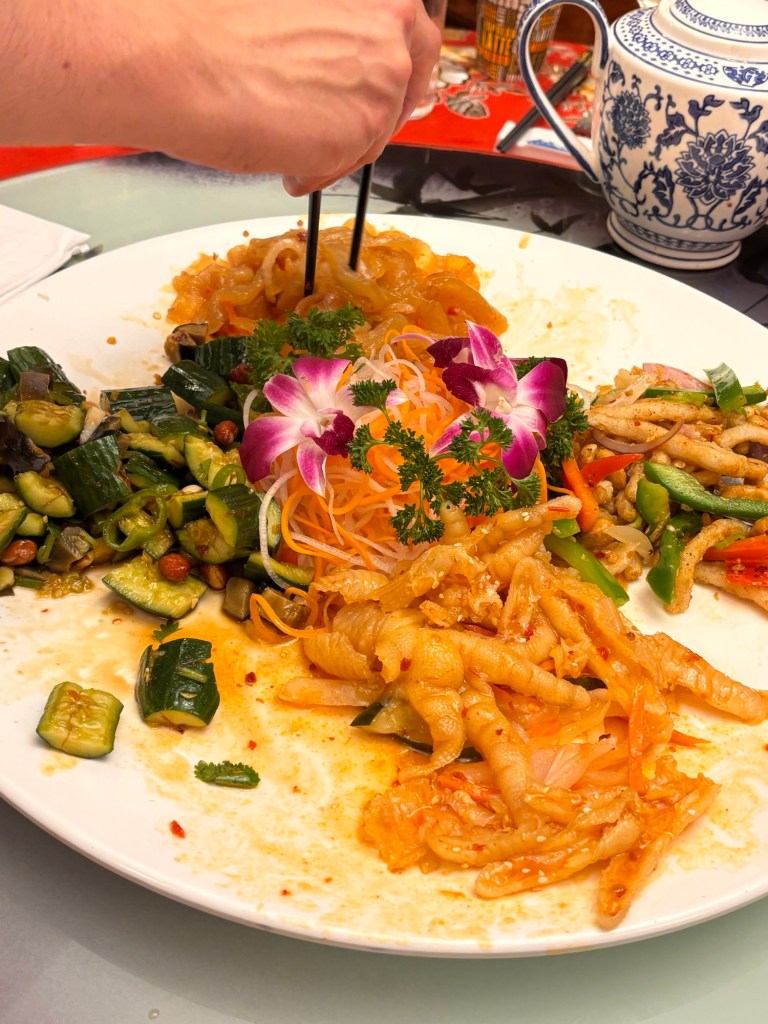
Both jellyfish (top) and chicken feet (bottom) were served as appetizers. I tried both.
I couldn’t bring myself to try the “live fish” because I was too afraid of getting a bone stuck in the back of my throat, which happened to me once as a kid.
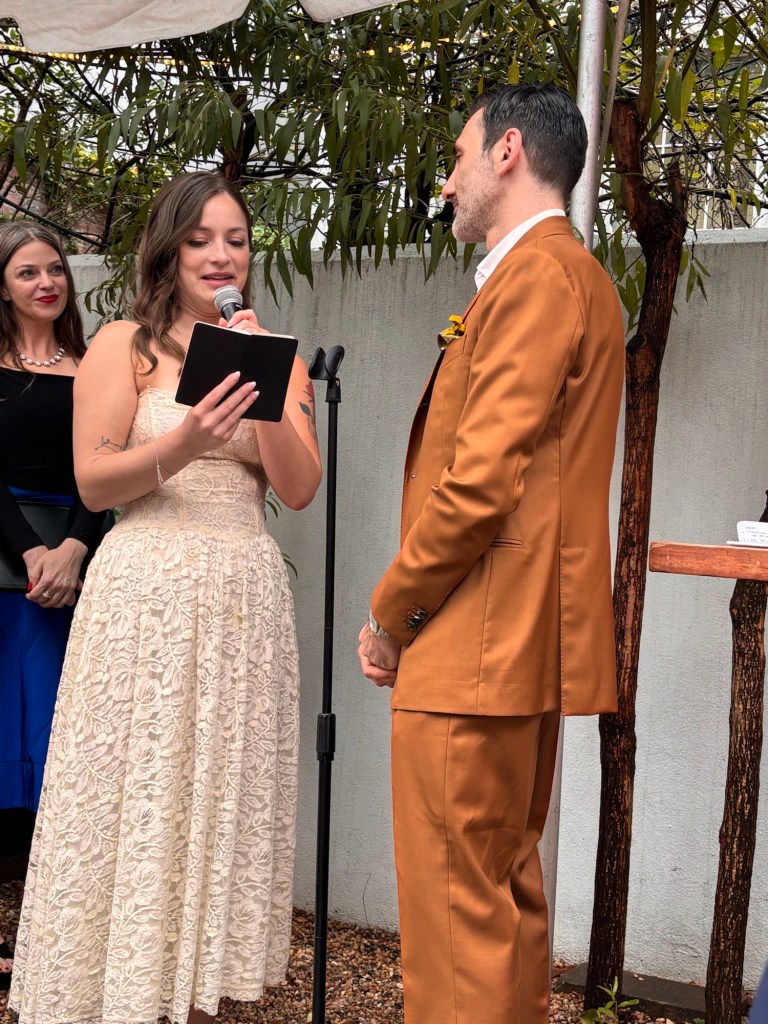
The happy couple sharing their absolutely beautiful vows 🥹
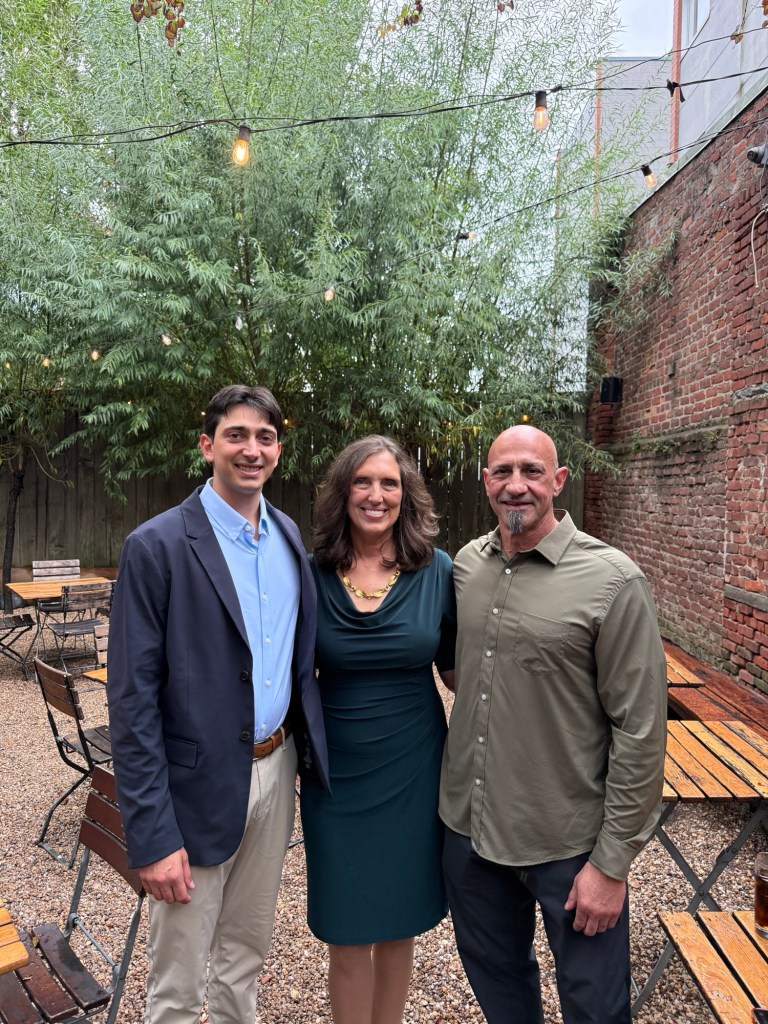
Weather was pretty rainy so this lovely patio area was a bit soggy, but we enjoyed ourselves anyway.
We made it back to Massachusetts in much better time. (The traffic gods were with us.) But my ears are still ringing. Brooklyn was loud. From the constant sirens to the extremely noisy restaurants and bars, I’m happy to be home and can’t say I’m dying to head back to NYC anytime soon.
What’s the best advice you’d give to someone younger than you?
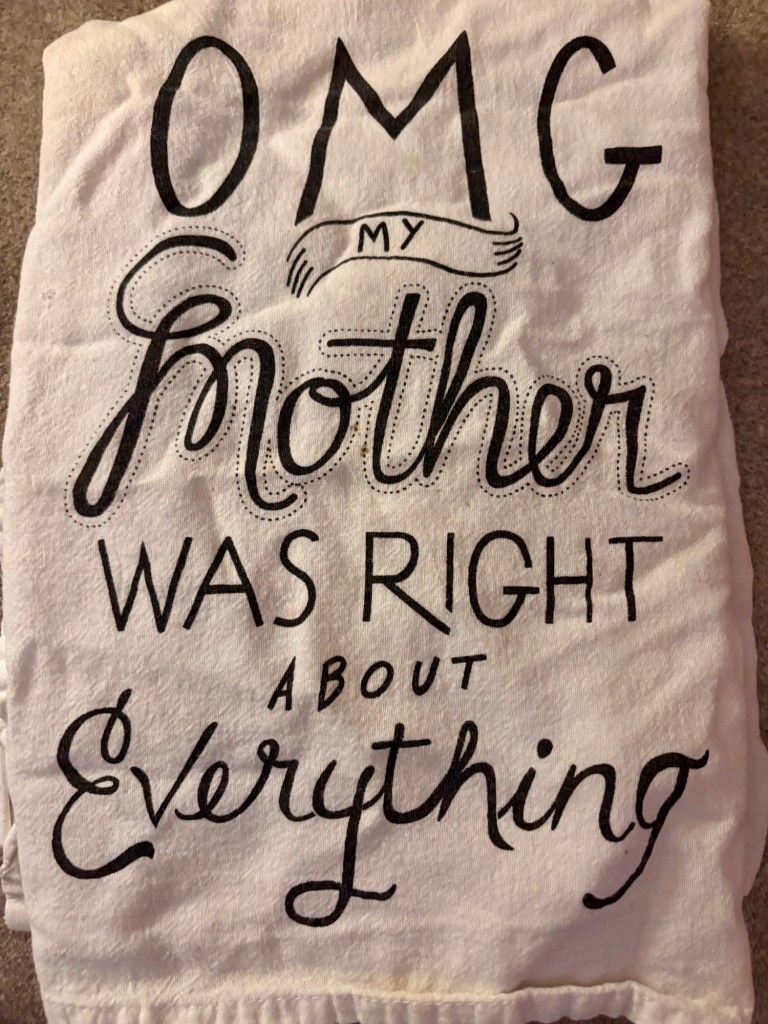
I feel like the older generations have messed things up so thoroughly that our “best advice” should be taken with a grain of salt.
However, here are a couple of things my kids have brought up recently in a “you were right” kind of way:
My daughter said it was good that she got ALL her vaccines including the HPV series that some other parents declined. It prevents unnecessary complications later in life, including during pregnancy—a time when you absolutely do not need extra things to worry about!
So, I’d say get yourself and your kids all the vaccines you’re offered, including the annual flu and Covid shots. And people 50+, get the Shingles vaccine for God’s sake. It works and Shingles SUCK. (My husband had it and it was awful.)
In general, avoid the “I do my own research” crowd, especially followers of that quack RFK, Jr. Listen to actual doctors and scientists.
My son said he broke one of my “life rules” on a recent business trip and I laughed. He had forgotten to pack a bathing suit and it turned out his hotel had a lovely pool. I LOL’d, but it’s true, I always say pack a bathing suit, wherever you go. They take up solittlespace and you just never know when an inviting pool, pond, lake, stream, ocean or hot tub will present itself to you.
As a corollary to that, I think everyone should learn to swim well. Make your kids drown-proof. Get them swimming lessons, even if it’s a hassle.
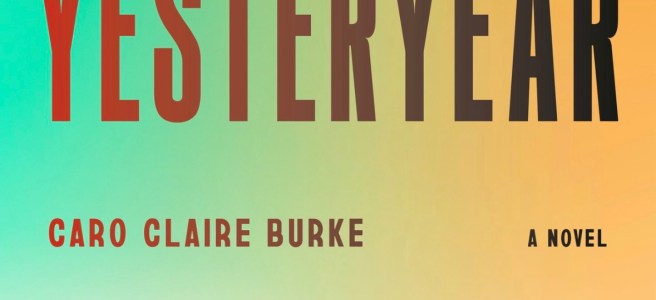
I read the book that “everyone” is talking about—Yesteryear by Caro Claire Burke. This debut novel reportedly received a low 7-figure advance and was optioned for a film starring Anne Hathaway before it was even finished. (How does a new author do that?)
In case you haven’t heard, it’s about a tradwife influencer (think Ballerina Farm) who mysteriously finds herself back in the old western pioneer days with no electricity or modern conveniences. The plot twists are compelling and au courant—both in the modern world and in the pioneer one. (Raw milk, going viral, the manosphere, immigrant farm workers, “organic” food, nepo babies, homeschooling, Target—it’s all in there.)
So it’s definitely a page turner, but I can’t say I loved it. The problem is that the main character is so unlikable. And maybe that’s the point. Women my age have been complaining for decades that we were taught to be “nice” and likable above all else. When we grew up, we realized that being nice all the time led to an awful lot of getting taking advantage of, harassment, and even abuse. So we taught our daughters to be strong, confident and to make their own money—in many cases, for their safety. (You shouldn’t need to rely on a man for anything!)
And now there is a myth (I think) that some of those girls then grew up to “hate men.”
But honestly, are there really a bunch of childless “Girl Bosses” running around Manhattan just despising men and their former friends who decided to be stay-at-home moms?
To be perfectly honest, I have said a disparaging thing or two about women in my town who did not do any paid work while raising their kids. Obviously they were fairly wealthy…who else could afford to not work? And I felt that some of them tended to get exceedingly wrapped up in their children’s lives. (Like, the results of travel basketball tryouts could send them into a tailspin for weeks.)
But back to the book…the main character really doesn’t like anyone. Not her sister or the women she grew up with, not her Harvard classmates, not her dumb rich husband, not her babies, not her fans.
It’s almost like the author is saying that women can’t win, no matter what they do.
Maybe they will make the main character more sympathetic in the film. Anne Hathaway can be complex, right?
I’m sure the setting—in the mountains of Idaho—is going to look spectacular.
Veering into dangerous, personal, none-of-my-business territory here…
I know very well how difficult life is for young people these days. Truly unaffordable for many—especially those with debt. Combined with global warming, gun violence, rising authoritarianism, and a million other things, there are many excellent reasons to not procreate. I get it.
Also, some are not blessed with good enough health and/or a supportive partner in the child bearing years—two excellent reasons to remain childless.
BUT, I will say (and did say to my nephew and his fiancé), life is short, but it can also be looooong. You might live to be 90+ like my parents. That’s 50 years beyond 40! That’s a long damn time to not have children, and therefore grandchildren, and even great grandchildren.
My nephew’s response was that you can’t have “just one baby,” so therefore they aren’t going to have any kids. This rationale is misguided in my opinion. I think only children are wonderful. Many GenXers had just one child and they’re great. Three-person families are fantastic. My book group was comprised of all women with just one awesome daughter (until I changed my mind and had a second child later in life). I love my son beyond words, but if I’d never had him, we’d be a happy family regardless. No sibling rivalry or fights and more disposable income. We probably would’ve taken a friend on vacation with us, so my daughter would’ve always had someone to play with.
And let’s face it, adult siblings are a mixed bag. Some get along. Many do not. And things can get complicated when parents get old and die, if the siblings are not on the same page. In some ways, one supportive, well-adjusted adult child is better than two or more who do not get along.
So yes, you CAN have just one child. And if you choose to remain childless, that’s fine. We love you still. But please do not compare your dog (or cat or goldfish) to our kids and grandkids. It’s really not the same. Like…at all.
My family of origin has been upsetting me a lot since January. (I believe it’s unintentional, but still—not fun.) Thankfully, my own family are all doing well, except that my husband has been significantly challenged by his recoveries from two total knee replacements.
On top of that, I am personally upset by the shitshow in Washington. The absolute incompetence of the people running our country right now is downright frightening, as are the real impacts on all of our lives. My son inherited my mother’s gas guzzler SUV a few years ago when she upgraded and recently paid $75 to fill his tank. These prices are not sustainable for young people just starting out. And he and his roommates all sat down together to watch one of Trump’s incoherent updates on the war with Iran because they are worried about getting drafted.
Long way of saying, I could use a laugh. Maybe you could too.
Here are three stand-up comedy specials I’ve watched recently and truly enjoyed. I laughed out loud many, many times.
Marcello Hernández: American Boy (Netflix)
Julio Torres: Color Theories (HBO Max)
Ramy Youssef: In Love (HBO Max)
They happen to all be young men, but all grew up outside mainstream, straight, white American male culture. Their perspectives are unique and in many cases, hysterical. 🤣
Alex Pretti, registered nurse, United States citizen
Statement from the family of Alex Pretti:
“We are heartbroken but also very angry.
Alex was a kindhearted soul who cared deeply for his family and friends and also the American veterans whom he cared for as an ICU nurse at the Minneapolis VA hospital. Alex wanted to make a difference in this world. Unfortunately he will not be with us to see his impact. I do not throw around the hero term lightly. However his last thought and act was to protect a woman.
The sickening lies told about our son by the administration are reprehensible and disgusting. Alex is clearly not holding a gun when attacked by Trump’s murdering and cowardly ICE thugs. He has his phone in his right hand and his empty left hand is raised above his head while trying to protect the woman ICE just pushed down all while being pepper sprayed.
Please get the truth out about our son. He was a good man.”
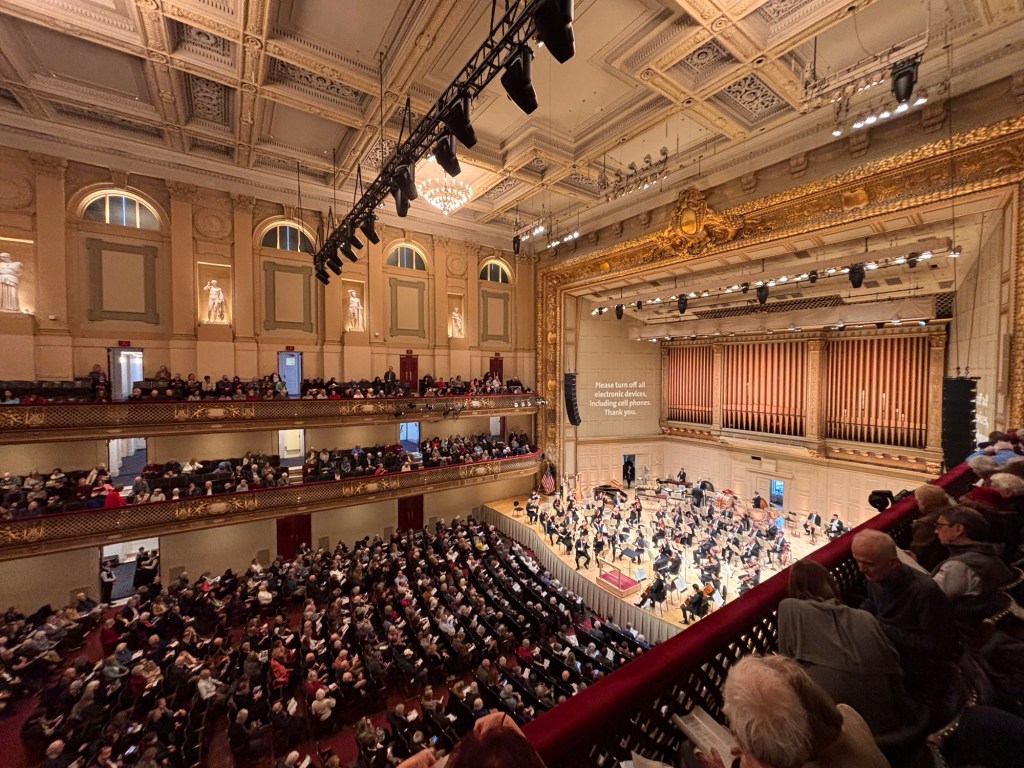
Yesterday I went to a concert by the world-renowned Boston Symphony Orchestra in Boston’s historic Symphony Hall.
Boston’s Symphony Hall yesterday afternoon
My friend Eileen and I had wanted to attend this particular concert because the planned guest conductor—a young man we knew from our days working together at the Conservatory—was making his Boston debut.
AFTER we bought our tickets, we were notified that he wouldn’t be conducting due to “ the recurring effects of a shoulder injury.” Instead, 29-year old BSO Assistant Conductor Anna Handler would be making her Symphony Hall debut. OK, well at least we were seeing someone’s debut!
The first piece was “The Imagined Forest” by 31-year old British composer Grace-Evangeline Mason. It was atmospheric and beautiful.
Something about seeing these two young women—the conductor and the composer—take their bows together felt like Progress. I’ve seen plenty of women take their bows as soloists, but not as conductors and composers—the artistic leaders—at the very highest level of classical music.
There was no mention of it being a historic first or anything like that, but you could feel that the audience was 100 percent supportive. Partial standing ovation (unusual for the first piece in a concert). Many cheers.
Brava, ladies. Well done. Respect.
29-year old Anna Handler commanded the podium in a focused, confident way as she stepped in for an ailing guest conductor of one of the world’s finest symphony orchestras
I remember my mother giving me a blue Velcro coupon organizer in my twenties (a little portable folder with dividers for keeping various types of paper coupons—food, toileteries, etc.) She would also cut out and give me coupons for various things she thought I used. It was very thoughtful.
I don’t know what happened to that organizer. At one point, I remember thinking coupons were such a hassle. Half the time, my coupons had expired by the time I got around to pulling one out. All that effort and kerfuffling at the register just to save 50 cents.
I think I had abandoned paper coupons by the time I had my own family at age 30. And I’m pretty sure my millennial/GenZ kids have never once cut out a paper coupon.
Now of course, we have endless customer loyalty programs and accompanying rewards points, electronic coupons, discount codes, promo codes, etc.
I honestly don’t know if my kids have the time and motivation to take advantage of those types of savings programs.
But I do! I will sit in my car and hit the plus sign next to every single savings offer before I go into a CVS, just in case I buy something that applies.
Beware the senior citizen with time on her hands!
According to CVS, I have saved over $3,500 since joining their free “ExtraCare” program in 2016.
The satisfaction of seeing the total bill tick down after hitting “redeem all coupons” at the soulless self-checkout reminds me of the feeling of getting a 100% on your weekly spelling quiz. There’s really no intelligence involved. It’s all preparation, and you were prepared.
Another commonly held belief seems to be that older generations are somehow tougher than younger ones. That life was harder for them and people have gotten progressively more comfortable.
I beg to differ.
Although the tremendous sacrifices and bravery of the so-called “Greatest Generation” can never be overestimated (they literally risked everything to defeat the Nazis), I would argue that non-marginalized groups in the following generation (my parents cohort) have had it pretty good. Many went from lower class (aka poor) to highly comfortable and secure in a single lifetime. And although we benefited from our parents’ prosperity, the following generation (mine) has had it harder in many ways. And our kids are going to have it even harder.
Not to be a Debbie Downer, but there are reasons the birthrate is historically low in 2025. We all know millennials who are choosing not to have children (or GenXers & Boomers who are sad that they will never be grandparents).
I asked ChatGPT to compare the lives of someone born in the mid 1930s, mid 1960s, and mid 1990s.
Facts:
1. Income & Jobs
Born mid-1930s (entered workforce ~1950s): Median household income in 1955: ~$5,000 (≈ $58,000 in today’s dollars). A single income (often the father’s) could support a family, home, and college savings. Job security was higher; pensions were common. Born mid-1960s (entered workforce ~1980s): Median household income in 1985: ~$23,600 (≈ $66,000 today). Both parents often worked, butwages grew more slowly compared to the cost of living. 401(k)s replaced pensions, shifting retirement risk to individuals. Born mid-1990s (entered workforce ~2015–2020): Median household income in 2019: ~$68,700. In real terms, wages for young workers have stagnated since the 1970s, while housing, education, and healthcare rose sharply. Gig economy and contract jobs more common, less stability/benefits.
2. Cost of College (Public University, In-State Tuition)
1930scohort (college in 1950s): $200/year tuition ($2,400 today). College was affordable even with part-time work; no significant debt. 1960scohort (college in 1980s): $1,500/year tuition ($4,000–$5,000 today). Still affordable with summer jobs; modest debt possible. 1990scohort (college in 2010s): ~$10,000/year tuition (public); $35,000–$50,000/year (private). Widespread reliance on loans; average borrower debt: $30,000+.
3. Healthcare Costs
1930s cohort: Out-of-pocket affordable; many employers covered full family insurance. Doctor visits and hospital stays far cheaper relative to income. 1960s cohort: Insurance became tied to employment. Costs rose, but still manageable. Deductibles/co-pays introduced. 1990s cohort: Healthcare costs skyrocketed (family premiums ~$24,000/year by 2025, often split with employer). Medical debt is a leading cause of bankruptcy.
4. Cost of Raising a Child (to age 18, middle-class family), not including college
1930s cohort (raising kids in 1960s): ~$25,000 total (≈ $240,000 today). 1960s cohort (raising kids in 1990s): ~$150,000 (≈ $280,000 today). 1990s cohort (raising kids in 2020s): ~$310,000. Housing, childcare, healthcare, and college costs exploded. Childcare alone can rival college tuition.
5. Retirement
1930s cohort: Retired with pensions, Social Security, mortgage-free home. Comfortable retirement was realistic for average workers. 1960s cohort: Retirement savings depended on 401(k)s and IRAs; investment risk shifted to individuals. Some still had pensions, but they were fading. 1990s cohort: Retirement is much more uncertain. Pensions rare; Social Security’s future questioned. Rising housing and healthcare costs make saving harder. Many expect to work past 65.
A final note: When my friend Carla was dying in 2022 at age 57 from brain cancer, she commented that at least she wasn’t going to have to worry about paying bills anymore. She felt that one upside of an early death would be a release from financial concerns. Carla had an advanced degree in nursing and worked (very hard) as a hospice medical director. She was married with two adult children that she’d been able to send to college.
And I’m sure she walked to school in the snow plenty of times.
![A logo for "50 Happens," [a site dedicated to Gen X women with children and grandchildren] [who embrace life's challenges with humor and resilience], [featuring a modern and uplifting design] [that embodies strength and positivity] [with an elegant and playful style] [and a harmonious blend of colors like pink, fuchsia, purple, and blue].](https://50happens.blog/wp-content/uploads/2024/12/img-5uorrxvwartomopcpuhjfjd0.png?w=300)