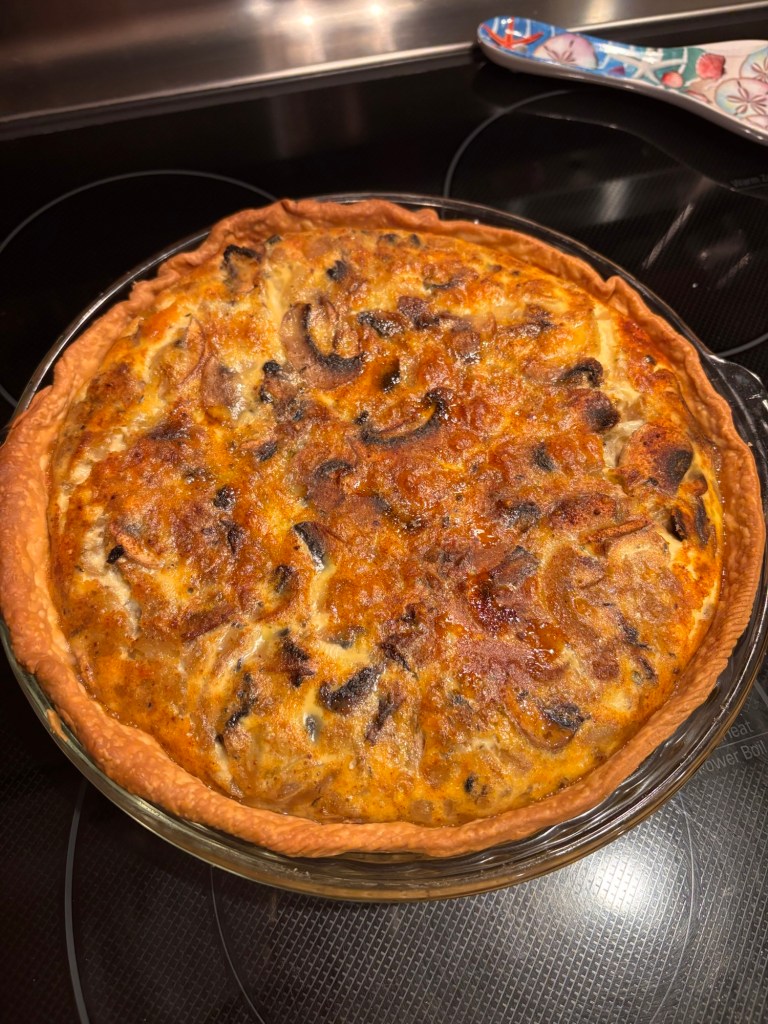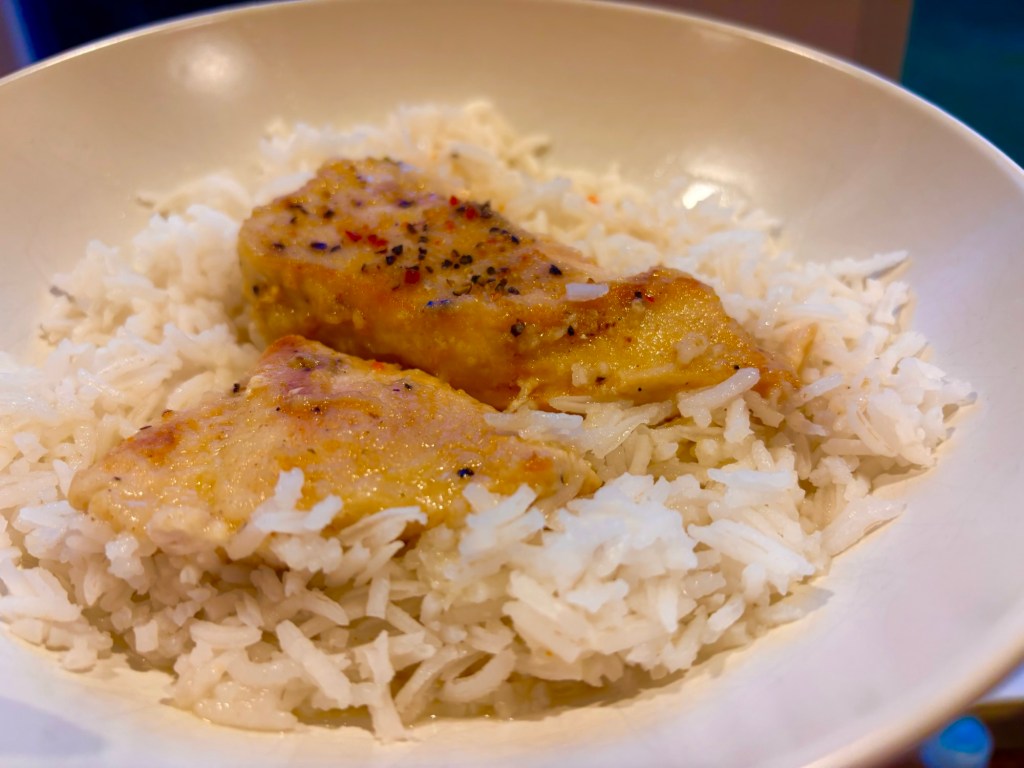
Swiss cheese and mushroom quiche

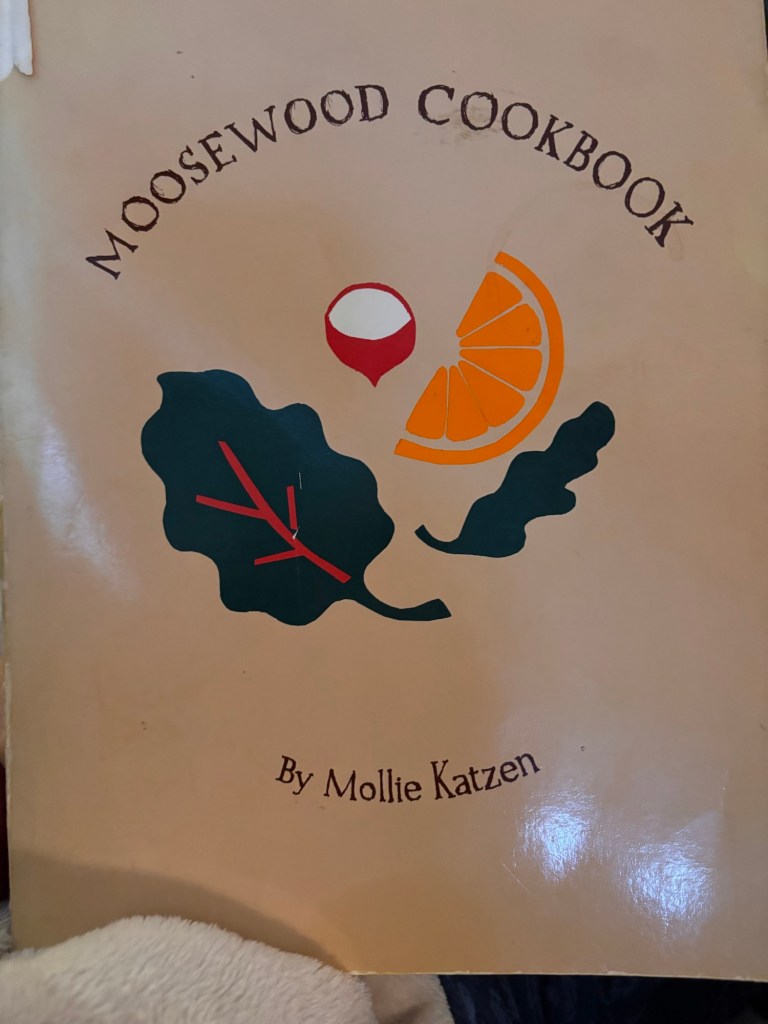
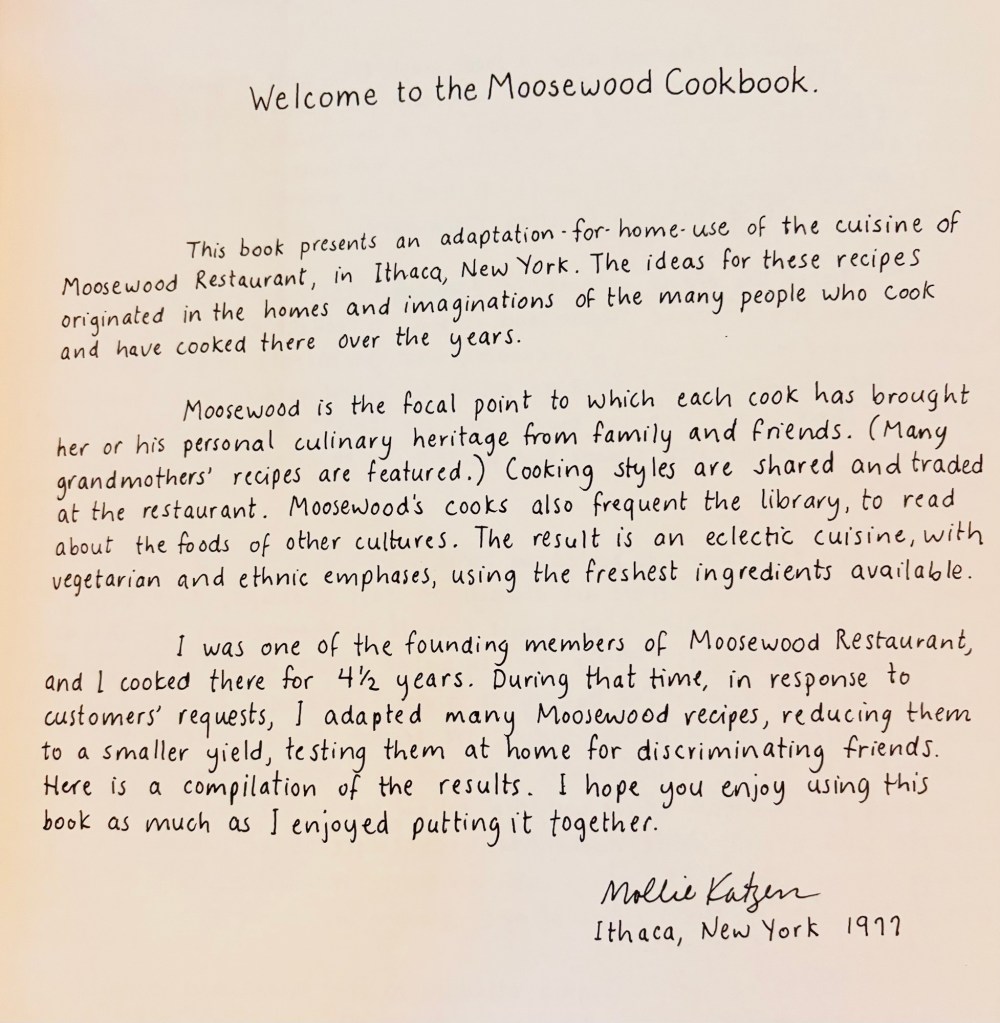
I blogged recently about the good old Moosewood cookbooks—a GenX cultural touchstone for a certain demographic. My favorite recipe from the entire Moosewood Empire is—without a doubt—the “Swiss Cheese and Mushroom Quiche” from the very first Moosewood cookbook (copyright 1977), page 111. I have made this Mollie Katzen recipe dozens, if not hundreds, of times. I’ve made it for guests, potluck suppers, baby showers, brunches, and countless times for my own family. Typically I make it with a pre-made, refrigerated pie crust and it comes out great. Every. Single. Time.

So here it is:
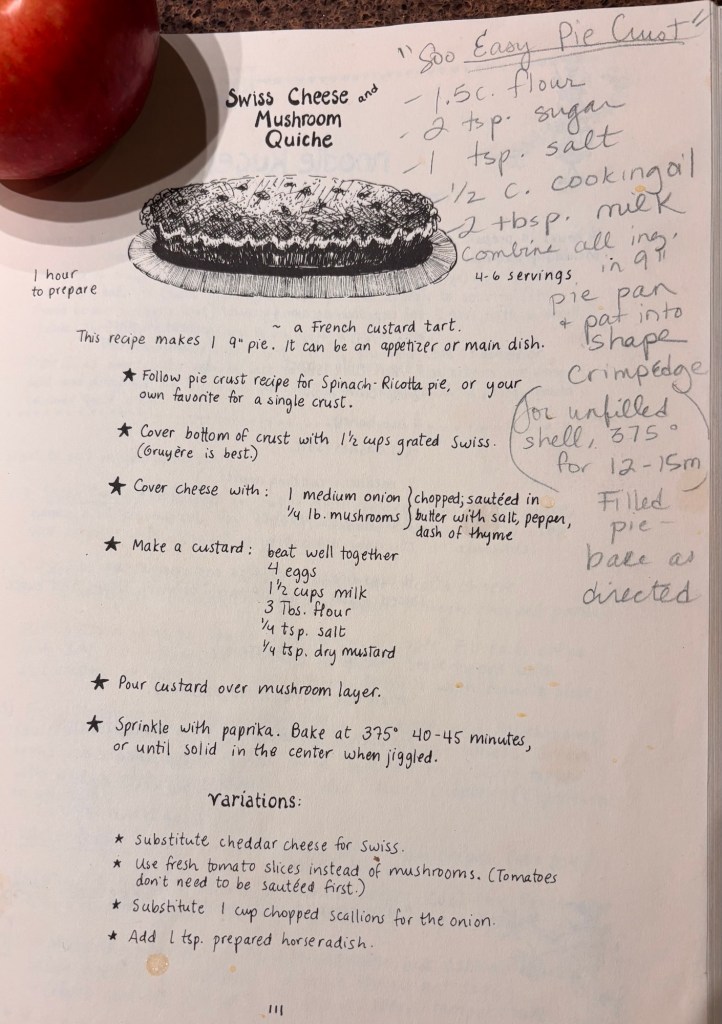
Any Swiss 🧀 will work, but as the recipe notes, Gruyère is best.
Last night’s dinner
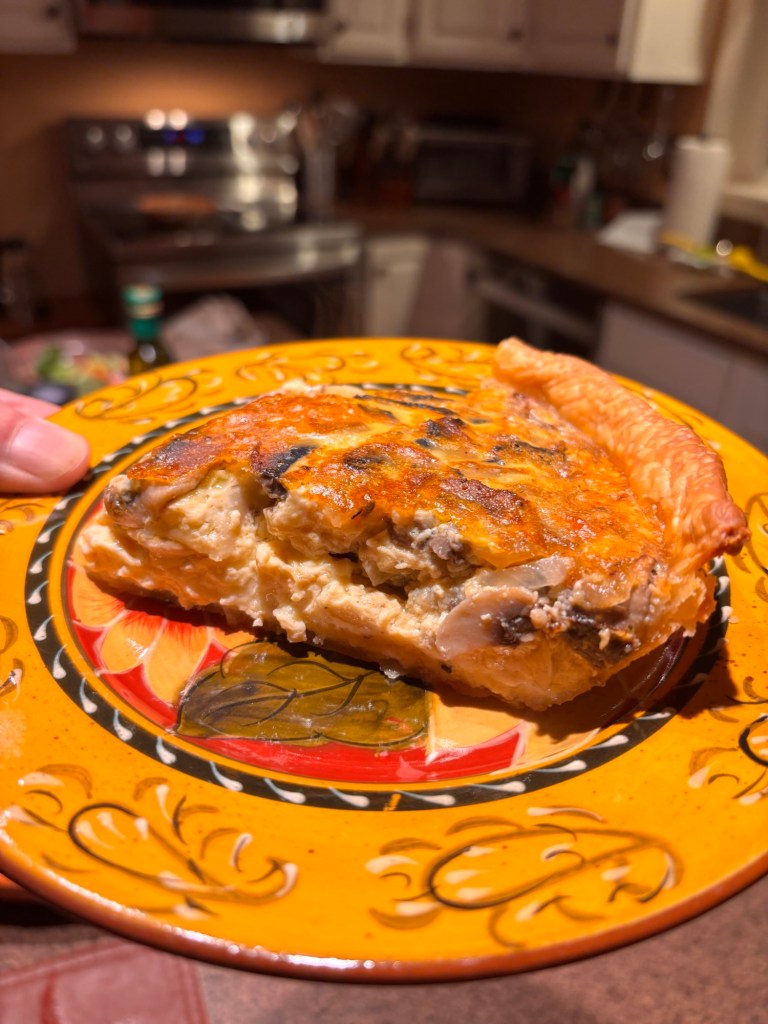
Side view

Who else remembers hearing or saying “Real Men Don’t Eat Quiche” in the eighties? Here’s the story behind it, according to ChatGPT:

“Real Men Don’t Eat Quiche” was a famous American catchphrase from the early 1980s that poked fun at traditional ideas of masculinity.

It was essentially a joke about what supposedly made a man a real man: eating steak instead of quiche, drinking beer instead of wine, watching football instead of cooking, and avoiding anything considered too refined, delicate, or feminine.

The phrase became a cultural shorthand for macho attitudes and gender stereotypes.

Where did it come from?

The phrase originated with humorist and screenwriter Bruce Feirstein, who published a book called Real Men Don’t Eat Quiche in 1982.

Interestingly, Feirstein originally came up with the line for a screenplay. When it was rejected, he developed it into a satirical book.

The book became a huge bestseller. It sold more than 1.6 million copies and spent 55 weeks on the New York Times bestseller list.

What was the joke really about?

The early 1980s were a time of changing gender roles. Women were increasingly entering traditionally male professions, and men were being encouraged to be more emotionally open, involved fathers, and equal partners at home.

The book exaggerated the anxiety some men felt about losing their traditional masculine identity.

The irony was that the book was making fun of macho men, not celebrating them.
Moosewood

What’s a small moment from your past that you still think about years later?

I still remember my college roommate Ann making an actual meal in our sophomore apartment kitchen circa 1984. I had never done any real cooking growing up, and freshman year we ate every meal in the dining hall. It was a weird feeling to have a kitchen of our own. We were like…adults…and we could be vegetarians if we felt like it.

If you were in college in the 80s and had even a passing interest in eating less meat, you probably owned The Moosewood Cookbook, or borrowed it from a roommate and never gave it back. Mollie Katzen’s hand-lettered, hand-illustrated pages felt more like a friend’s notebook than a cookbook. Everyone made the same few things: a big pot of soup, something with lots of cheese and broccoli, and a very ambitious attempt at a dinner party for six. I still have mine.

Copyright, 1977
Decades later, my son was in college in Ithaca, NY and I finally got to eat in the legendary Moosewood Restaurant in downtown Ithaca.

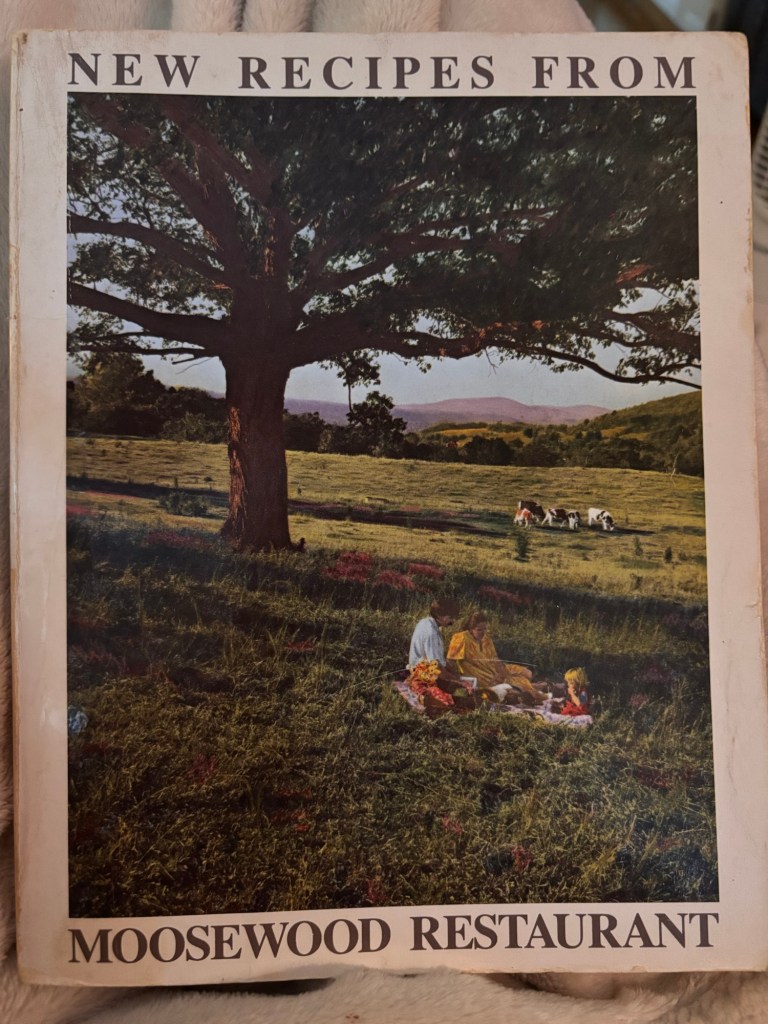
Their subsequent cookbooks, including “Enchanted Broccoli Forest,” were huge bestsellers, especially among young, liberal, vegetarian types. I bought “New Recipes from Moosewood Restaurant” when it came out in 1987–the year I graduated college. I still have that one too.

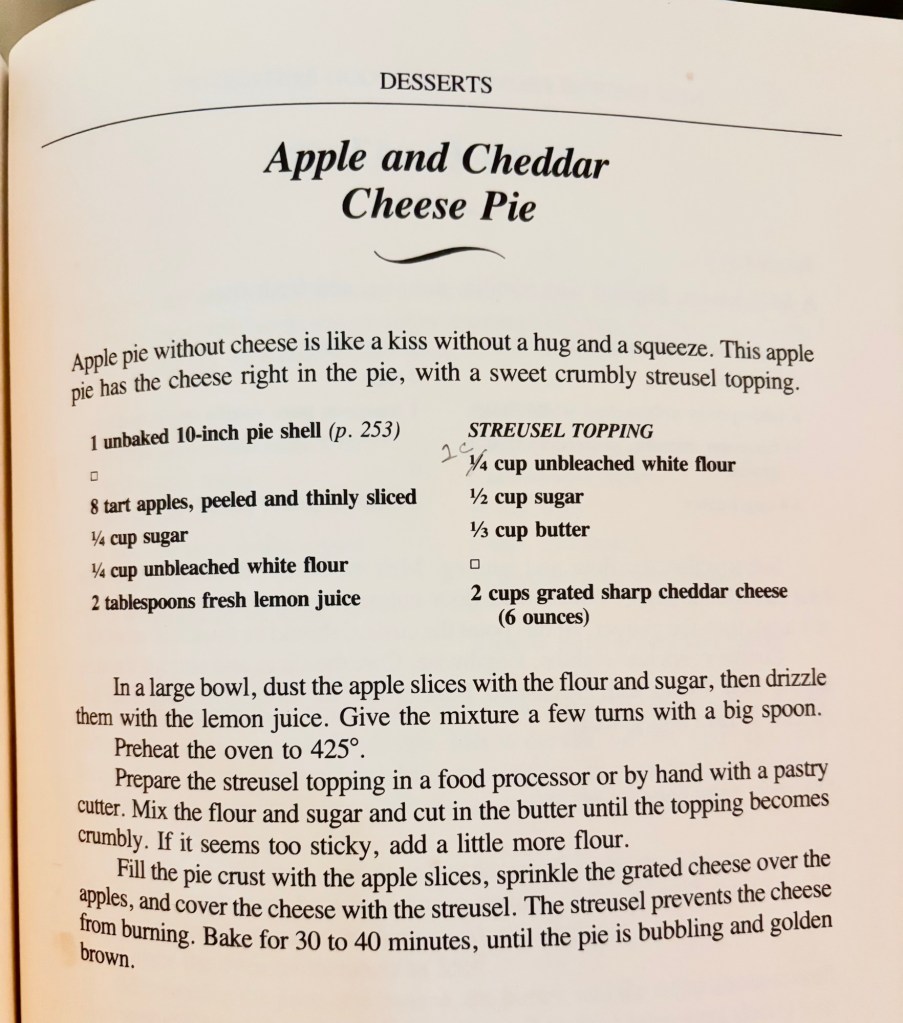
Yesterday, my husband asked for my old “Apple Cheddar Cheese Pie” recipe, so I dug it out. It was in the New Recipes cookbook.

This one has typed pages, rather than the hand-illustrated look of the original.
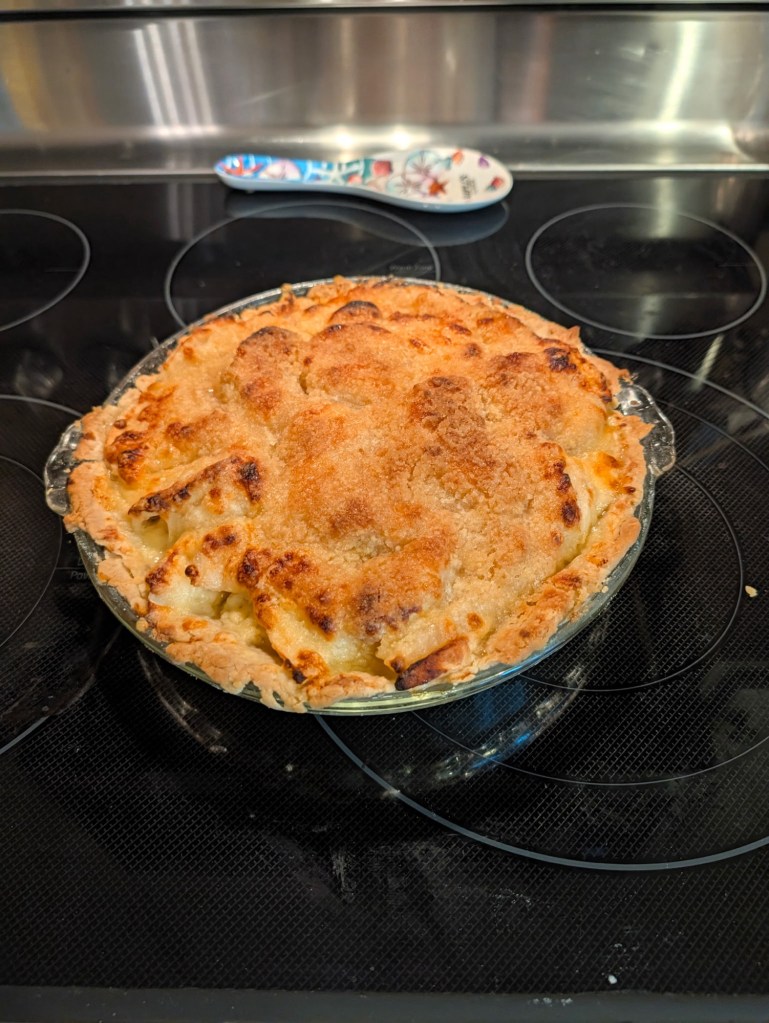
He whipped up this pie while I was working on a painting yesterday.
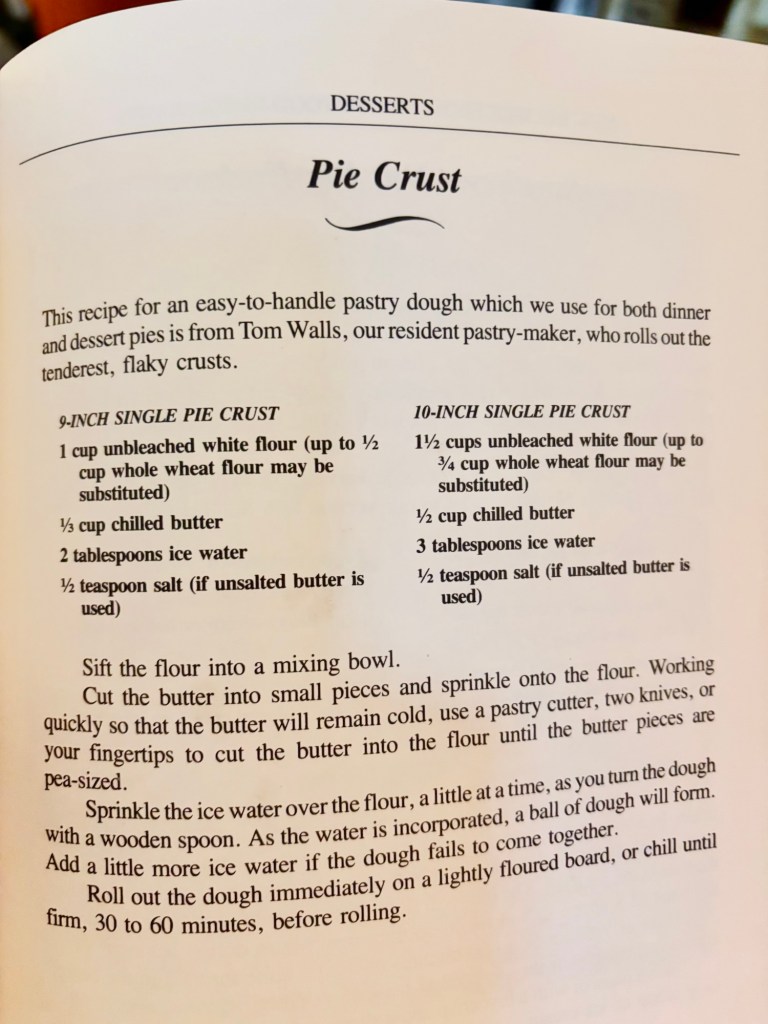
We had no pre-made pie crusts on hand, so he made the crust too. Impressive, don’t you think?

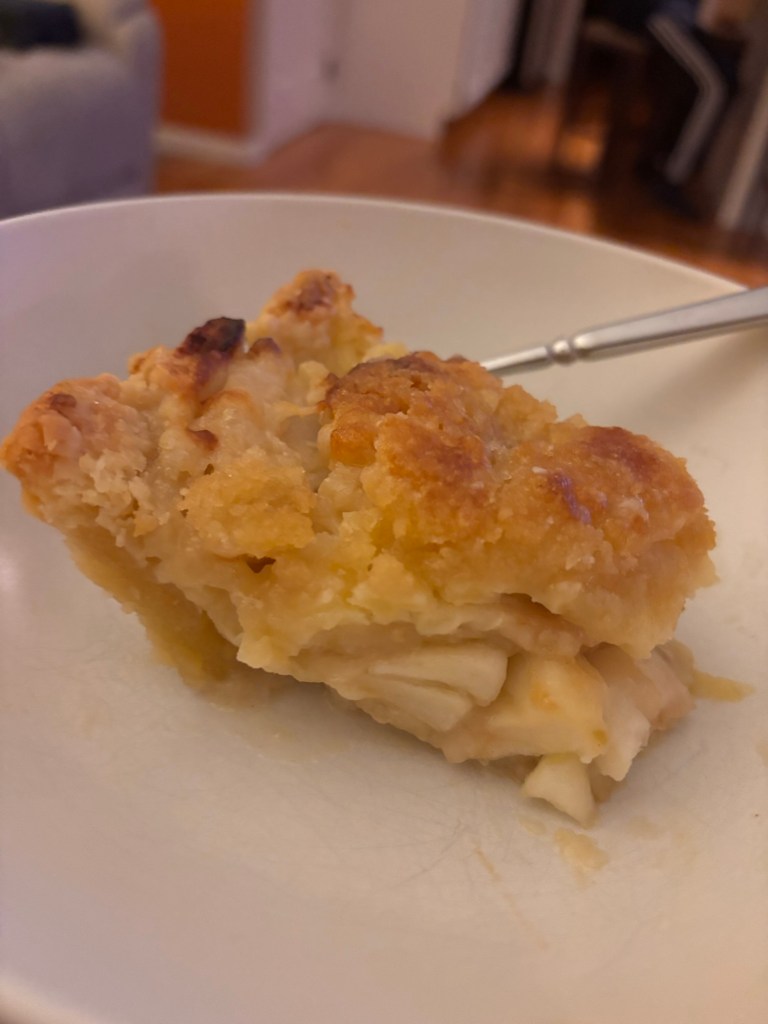
It came out great. The layer of cheese under the streusel makes this pie feel more like an actual meal. I would not add ice cream to this, but truth be told, my husband did.

Moosewood Restaurant’s Apple and Cheddar Cheese Pie. The last time I made this was at least twenty years ago.
The cheese isn’t really visible, but you can taste it and it’s lovely with the apples and sweet topping.
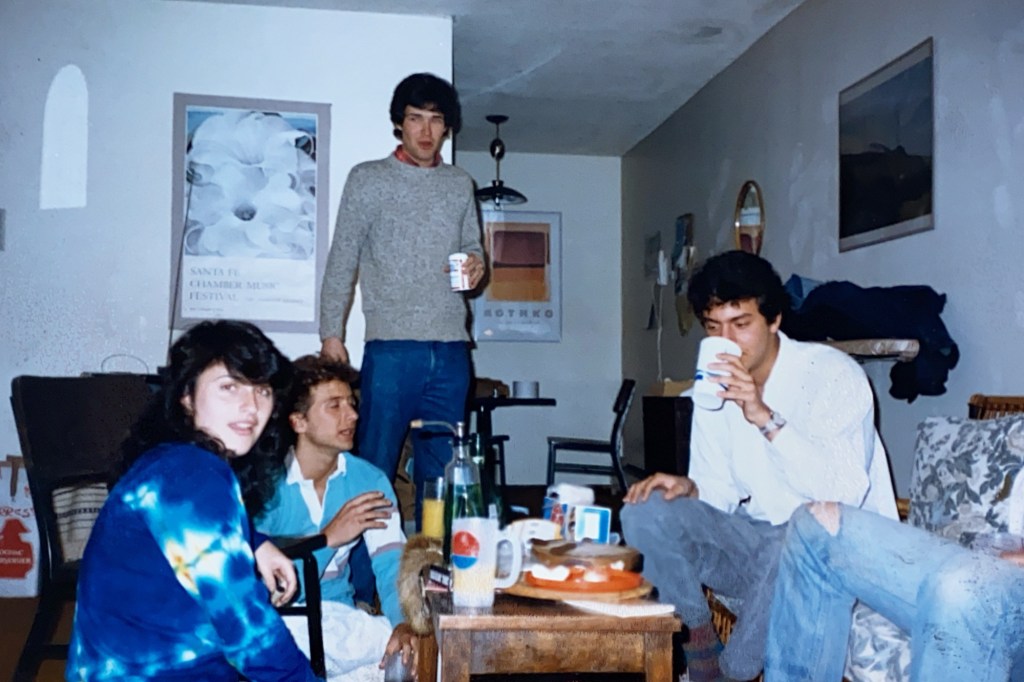
My roommate Ann (far left) and friends in our first apartment with a kitchen.
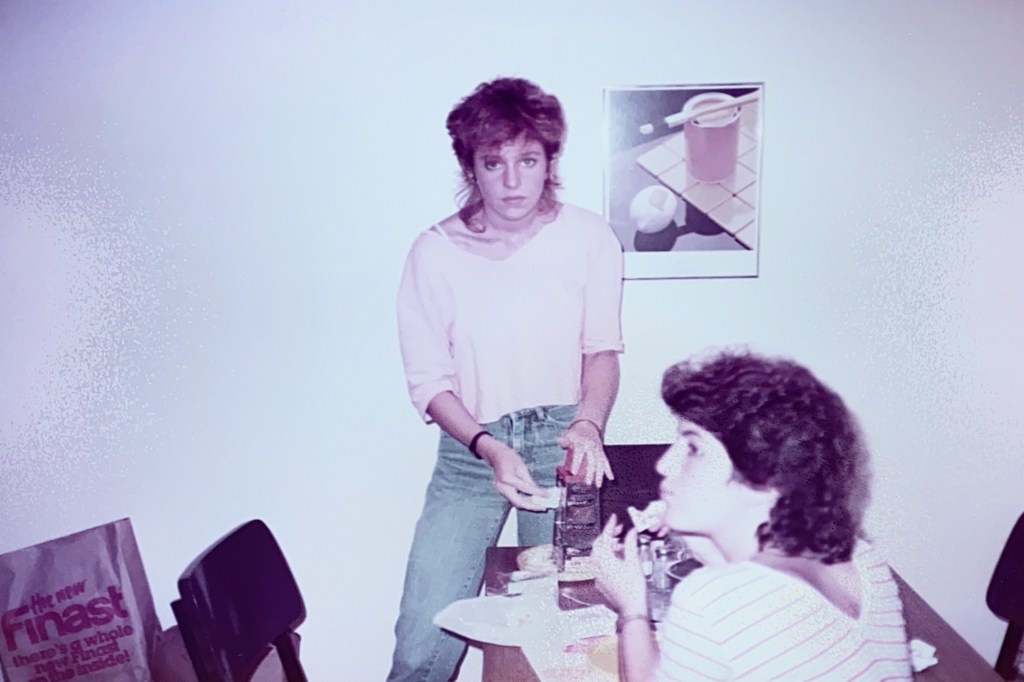
Terrible photo of my other roommate (and dear departed friend) grating cheese in that first kitchen. It was probably for a Moosewood recipe. There is lots and lots of CHEESE in Moosewood cookbooks. No meat, but a few fish recipes are included.

Oh, the places we went (without Siri)

What’s the best way to explore a new city?

I just gotta point out that before smart phones, “exploring a new city” was completely different. Young people have no idea.

First, if you were driving there, you could get completely lost just finding the city, because you had to rely on maps—fold-out paper maps or atlases (books of maps). There was no Siri, there was no Google Maps, there was no MapQuest or Waze. There was no phone in your car. There were road signs and your own God-given sense of direction.

In the olden days, the absolute best way to explore a new city, was to meet up with a friend (or a friend of a friend) who lived there. If you were lucky, they’d let you crash on their couch. At night, they would take you to some local dive bar where you met their friends and got a feel for what it was like to actually live in their city.

In the day, you wandered around visiting record stores and coffee shops and tourist sites that you’d heard of by word of mouth (talking to other humans).

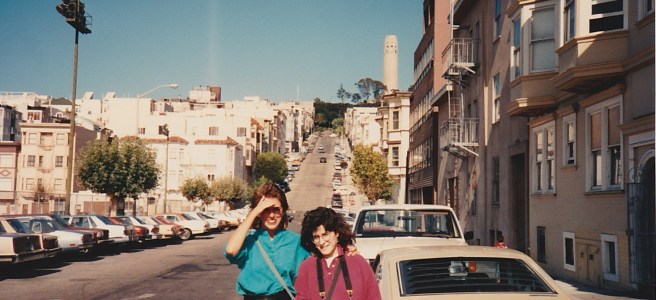
My friend Julie and me kicking around San Francisco in 1988. We stayed with a high school friend of hers. We’d driven up from LA where we’d also stayed with a friend in West Hollywood. Fortunately, it was hard to get lost on that drive up from LA. We knew if we kept the Pacific Ocean on our left, we’d get there eventually.

Food

Which relationship has taught you the most about yourself?

View all responses

Since food and I have had a good relationship for decades now, I sometimes forget about the early years. In my teens I was was pretty obsessed with being thin. Back then, there was a lot of interest in dramatic cases of eating disorders, especially Karen Carpenter’s death from heart failure due to anorexia nervosa in 1983 (my senior year of high school), but the casual use of Dexatrim (over-the-counter speed), starving yourself and occasional self-induced vomiting was no big deal. All the supermodels had protruding hip bones and thighs that did not touch. That was the goal. I remember a gym teacher talking to me once about being too thin. (I was 5’8” and about 118 pounds.) I thought I looked great. So did my boyfriend.

Thankfully, I mostly quit dieting in college and eventually got into swimming and was a pretty normal eater. I dabbled in vegetarianism, but I ended up consuming so much cheese that it elevated my cholesterol and I also developed lactose intolerance, which thankfully resolved. (Imagine a life without ice cream!) I now take a daily statin to control my high cholesterol, which I blame on my genetics. My parents both take statins, but at 87 and 92 they’re still traveling and eating whatever they want, so I’m not gonna worry about it.

I really love to eat good food now. We have a great relationship. Sometimes I try fancy recipes from the New York Times, but more often I make a few standbys that have like 4 ingredients and always come out great.

One of those is crockpot lemon chicken. A friend of mine once shared this recipe on Facebook and said “this sounds good” —and so it was. I’ve made this recipe dozens, if not hundreds, of times:

Crock Pot Lemon Chicken
Ingredients
1/4 cup all-purpose flour
3–4 large boneless, skinless chicken breasts, cut into thirds
1/4 cup butter
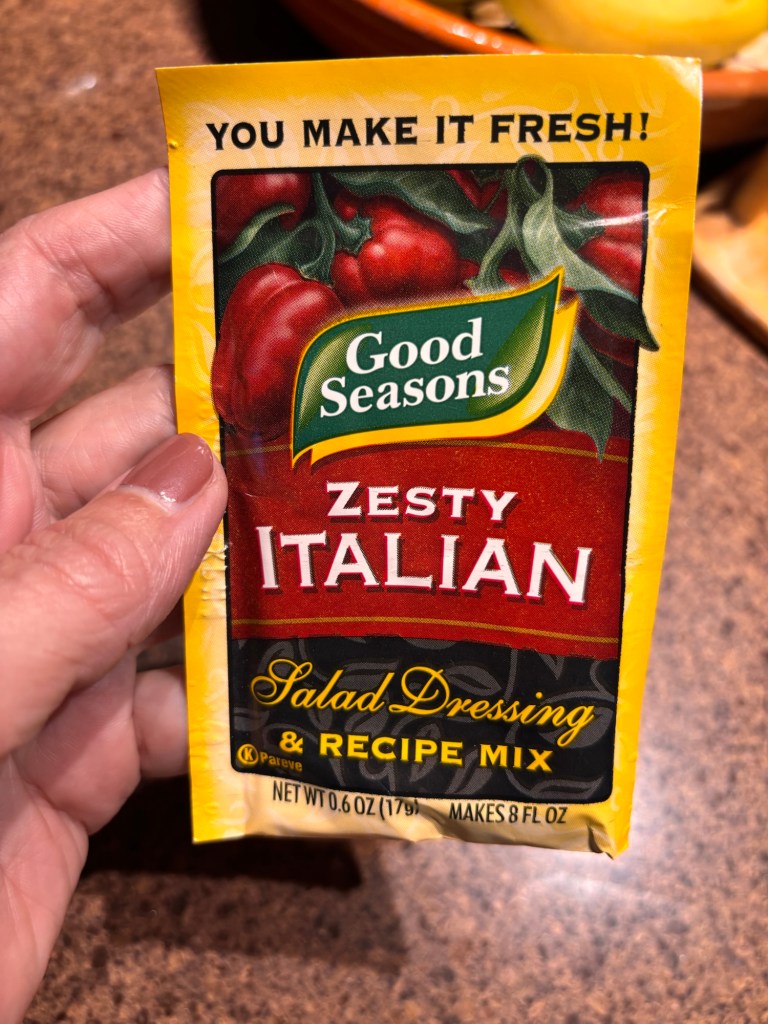
1 packet Good Seasons Italian dressing/seasoning mix
1/2 cup fresh lemon juice
1/2 cup chicken broth
Salt and pepper, to taste


Directions

1.) Rinse the chicken pieces with water, then lightly coat them in flour. Set aside.

2.) Heat 2 tablespoons of butter in a large nonstick skillet over medium-high heat. When the butter is melted, add half of the flour-coated chicken pieces. Avoid overcrowding the pan; you will cook the chicken in two batches.

3.) Season with salt and pepper. Cook the chicken for 3–4 minutes on each side, or until golden brown. You are not cooking the chicken all the way through at this stage, just creating a golden-brown crust.

4.) Remove the chicken from the skillet and place it in the crock pot.

5.) Add the remaining 2 tablespoons of butter to the skillet. Cook the remaining flour-coated chicken pieces for 3–4 minutes on each side, or until golden brown. Remove the chicken from the skillet and place it in the crock pot.

6.) Sprinkle the Italian dressing/seasoning mix evenly over the chicken.

7.) Pour the fresh lemon juice and chicken broth over the chicken.

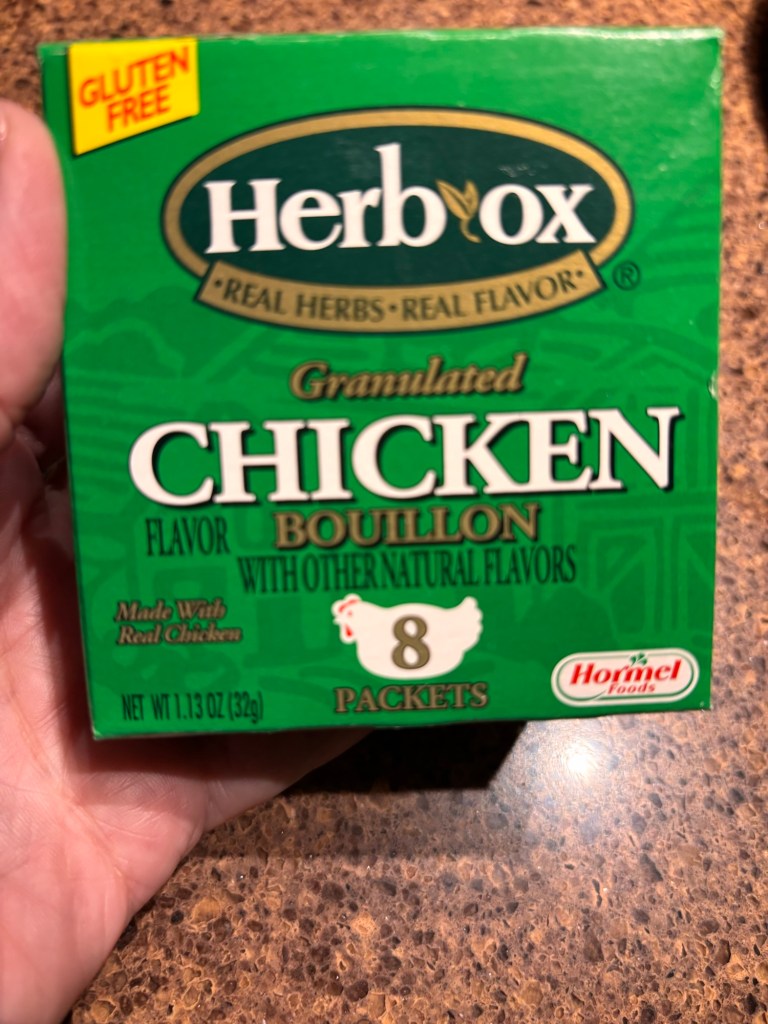
I use these packets to make the broth

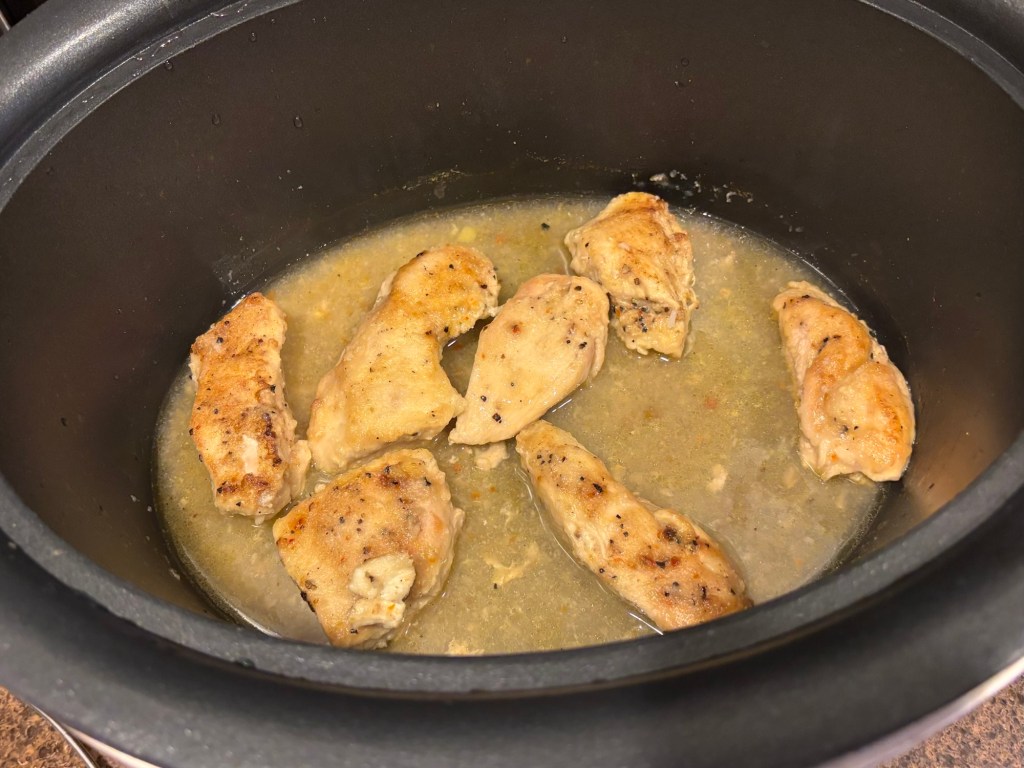
8.) Cover with the lid and cook on LOW for approximately 3 hours.

My crockpot works as a nonstick skillet too, so it’s literally a one-pot meal for me.

9.) Serve the chicken pieces whole or shredded, topped with the lemon sauce and broth.

Sometimes I serve it on rice. Other times I serve it on cholesterol-free (no yolk) egg noodles

RIP Karen Carpenter. I loved her voice so much. She was one of the greatest altos of all time. If only she hadn’t had such a fraught relationship with food, she would have been 76 now.

New England Chinese Food

Daily writing prompt
What do you love now, that you hated when you were younger?

I’m changing this prompt. I’m answering this question instead:

What do you love now, that you hated loved when you were younger, but didn’t realize was unique to your area and is slowly disappearing?

Answer: New England Chinese Food

I spent the weekend with a couple of fellow GenX/Baby Boomers and learned something new.

The Chinese food we grew up loving is not the same elsewhere in the country. It’s unique and when people move away from New England (especially Massachusetts and Rhode Island), they can’t find it and they miss it.

In a nutshell, here’s why and how ours is different:

Most New England Chinese restaurants were established by Chinese immigrant families who adapted recipes to local American tastes in the mid-20th century. Restaurants tended to influence one another, creating a regional style that became its own tradition. The result is a cuisine that’s generally:

  • Sweeter
  • More heavily fried
  • More focused on appetizers
  • Less spicy than many restaurants in places like California, New York City’s Chinatown, or areas with larger recent Chinese immigrant communities.

One of my Boomer friends, who is Jewish, grew up in Massachusetts going out for Chinese food on Christmas, so he was especially sad when his lifelong favorite Chinese restaurant closed recently. He brought me up to speed on what everyone else apparently knows already.

You can’t get this stuff everywhere!

From Scorpion Bowls to PuPu platters filled with fried delights, you will not find any of it in modern pan-Asian restaurants with bright lights and sushi chefs.

We had an absolutely delightful meal at Jade Garden in New Bedford, MA which was about as Old School as you can get.

Our PuPu platter. Pass the Duck Sauce.

Everything, especially the chicken fingers, were delicious and absolutely glistening in their fried batter. I did not manage to grab one of those classic New England-style Chinese egg rolls fast enough, so will need to return. Barely visible are the sweet, boneless park spare ribs which, according to all reports, are hard to find outside New England.

Here’s my chicken lo mein, hold the MSG. Yummy!

I am now a member of a very large Facebook group dedicated to the love of New England Style Chinese Food—“a regional Americanization of Chinese Food, which features such things as lobster sauce, pupu platters, and chow mein. This group serves as a place to share favorite restaurants, photos, and memories.”

Clearly Jewish families have many Christmas memories associated with this cuisine, and it’s sad when those restaurants inevitably close. For me, it was the Yangtze River in Lexington, Massachusetts. That was the go to place for my family, but also for the “music nerds” in my high school. We went there after all our musical performances. We could excitedly relive that evening’s performance of The Music Man or Annie Get Your Gun over a pile of fried apps as big as the snare drum from the pit orchestra.

Who knows, maybe the football team went to Yangtze River too, but they weren’t at my table. I was with the band, music and theater kids.

You do you

What is something you wish you could tell your 20-year-old self?

You are not responsible for your sister’s problems. That’s on them. Distance yourself from the dysfunction—now. Pay attention to your own feelings.

Lose the Catholic Guilt. In fact, just bag the Catholic Church church now. You were never really Catholic. You’re a Unitarian Universalist.

I know you think you couldn’t dislike any politician more than Ronald Reagan, but someone so sickening will arise in 30 years, you’re not going to believe it. Pay attention to the seeds of that catastrophe being planted now. Fight them. Observe and use your privilege.

“Welfare Queens” aren’t real.

They’re gonna legalize weed right around the same time as the catastrophe, which will be helpful. Yup, you can just walk in and buy it! And you won’t have to worry that it’s laced with anything.

Go see The Cure live.

Early birding is not for me

Daily writing prompt
Share a proverb you think is completely wrong and make your case.

I was never much for saying “the early bird catches the worm.”

The only time I ever remember getting to work early was before smart phones in the late 80s. I had forgotten to set my clock back for daylight savings and I thought it was 9am on a Monday morning, when it was actually 8am. I ran into one of the senior executives (a super annoying one) and she said “you’re here EARLY” and I was like… what?

I made a real effort to make sure my kids were “on time” for school each day, with only a few “tardies” each year. My daughter took part in one auditioned choral group in middle school that rehearsed in the morning (before school) and it was NOT fun getting her there. Who the heck wants to sing at 7am?

And now that I’m a retired Grandma, I’m more of a three cups of coffee, then maybe I’ll do some kind of chore like go to the grocery store. In contrast, my husband is up and out to the gym at like 6am. He’s the early bird.

I’m with her.
(Stock photo by Oleg Gapeenko)

That’s a wrap

Daily writing prompt
What’s a moment in your life that felt like it was straight out of a movie?

I remember walking around in the airport in Paris—Charles De Gaulle—in December 1985. I was waiting for my flight back to Boston after my semester abroad in Rome. I was listening to my Sony Walkman, which had the songs that had been the soundtrack for the entire semester—Take on Me by A-Ha, Money for Nothing by Dire Straits, 99 Luftballons by the German band Nena.

I was hungover. I was sad. It was the end. Back to America. I knew it was going to be culture shock. So many things had happened that semester—some good, some bad—but all of it was new and exciting. I had traveled through Europe with friends, had a fling with a fellow student who was studying in France, been semi-stalked by an Italian guy, smoked hash and saw Sting perform live, been chased down the street by a very angry nun who was mad I’d let my friend use my roommate’s bed in the convent, been subjected to my first public masturbator (aka “The Jerk”), ordered entire meals in Italian, been awakened on a train by a French security guard who didn’t like my friend’s Filipino passport, got all my clothes destroyed by an Italian laundromat, and seen the most magnificent art and wonders of western civilization from the Mona Lisa to the Colosseum to Pompeii to the Vatican.

Walking through that airport felt like the last scene in a movie—a very 80s movie.

Here I am in Rome in 1985 with my short 80s hair and my friend Scott who was in my program with me. Scott was my close friend Carla’s boyfriend, but she was studying in cold old England for some reason. Girl Code obviously eliminated any chance of a fling with Scott, but he was so cute, right? Look at those legs.

Changed for Good

Daily writing prompt
What’s a show that had the perfect series finale?

I have loved all five seasons of the series Hacks with Jean Smart and Hannah Einbinder and I know the series finale is being released today. I will make a point of watching it as soon as possible so that I don’t accidentally read about it.

In the olden days, you had one shot at seeing the series finale. You had to watch it when it aired—or wait forever for the rerun to come out. Most people didn’t get VCRs until the later 1980s. (And even then, “taping” your show was an unreliable process.)

The series finale I remember being the biggest deal was M*A*S*H—the long running dramedy series set during the Korean War that followed the doctors and staff of a mobile army surgical hospital. The show ran for 11 years. I was a senior in high school when it ended in 1983.

Although I had not watched every episode along the way, I knew the main characters well. I’m pretty sure I sat and watched the finale in real time and probably shed a tear or two.

According to Google, the M*A*S*H finale, titled “Goodbye, Farewell and Amen,” was 2.5 hours long and was one of the most-watched television broadcasts in U.S. history, drawing about 106 million viewers. In 1983, the total population of the US was 234 million people. So literally, half the country watched the M*A*S*H finale.

In case you’ve forgotten the very end (like I had), here’s when Hawkeye and BJ say goodbye.

Even though I haven’t seen the Hacks finale yet, I’m assuming there will be a similarity with M*A*S*H in that two people who have been through some major shit together will deeply understand that they’ve been changed for the better by the other person.

It’s like that song from the musical Wicked says:

Because I knew you, I have been changed for good.

Budapest 1987

I’ve posted a couple times about my trip to the Soviet Union in college. I was with a group of students and history professors. It was a big deal to go “behind the iron curtain” back then, so we prepped for this trip for many months—studying Russian history and learning how to behave in a communist country. (They didn’t want any of us to end up in a Siberian prison camp.)

In addition to stopping in Helsinki (Finland) on the way into the USSR, we stopped in Budapest (Hungary) on the way out. Back then, Hungary was firmly part of the Soviet-aligned Eastern Bloc. And we happened to be there in the immediate aftermath of an epic snowstorm. Other than the snow and total paralysis of transportation on the streets, I remember kind people and one particularly delicious hot meal in a restaurant with some young musicians who gave us a cassette tape of their rock band.

In light of the recent good news that Hungarians dumped their far-right leader Viktor Orbán (a buddy of both Trump and Putin) on Sunday, I dug out my Budapest pics. Google describes Budapest in 1987 like this:

Budapest in 1987 was a city in late-communist Hungary characterized by economic scarcity, socialist architecture, and a quiet, daily struggle, yet it was on the cusp of major political change. The city experienced a historic, paralyzing snowstorm in January 1987 and was designated as a UNESCO World Heritage site that same year.

I’m not in any of these photos, but I took all of them. None are particularly good, but as a group, they give you the vibe.

Fun fact: Budapest is actually two cities—Buda and Pest. In this pic, I’m standing in Buda looking over the frozen Danube River towards Pest. The large domed building on the far side is the Hungarian Parliament in Pest. (Pronounced PESHT)
The famous Fisherman’s Bastion is a fairytale-like, Neo-Romanesque lookout built between 1895 and 1902.
An Aeroflot route map in a Budapest window. (We flew sketchy Aeroflot into Russia.)
My friend Lincoln standing in an alcove in Budapest.
My friend Rob playing a balalaika at the Budapest airport.
Walking was the only option for seeing anything at all while we were there! The city was paralyzed with snow and the authorities really couldn’t deal with it.
Two of our professors at the Budapest airport. The one on the right, Dr. James West, taught Russian history and was one of the best teachers I ever had. He’s one of the reasons I majored in History.

Speaking of wonderful history professors, be sure to listen to Dr. Heather Cox Richardson’s letter from Tuesday that explains the connections between Viktor Orbán and the American right: https://open.substack.com/pub/heathercoxrichardson/p/restore-america-to-its-own-people?r=j2aww&utm_medium=ios