The Boston Masshole

What’s the most annoying trope in books or movies?

Listen, one thing I know about is Massholes. I grew up with plenty of them. I know when the accent is real.

In movies, they never get it right. Even Matt Damon and Ben Affleck, who grew up in highbrow Cambridge, don’t get it quite right. (Despite that slight flaw, I loved the film Good Will Hunting. It captured one of the key characteristics of Masshole mentality—class awareness. “You think you’re bettah than me cuz you go to Hah-vahd? Well Faaaack you”)

Mark Wahlberg, on the other hand, is an objectively terrible actor, but an authentic Boston Masshole. Did you know he grew up in the infamous South Boston “projects” and was involved in a number of serious racially-motivated assaults and harassment incidents as a teenager in Boston during the mid-1980s? I did! He’s the type of guy I would’ve avoided like the plague in high school.
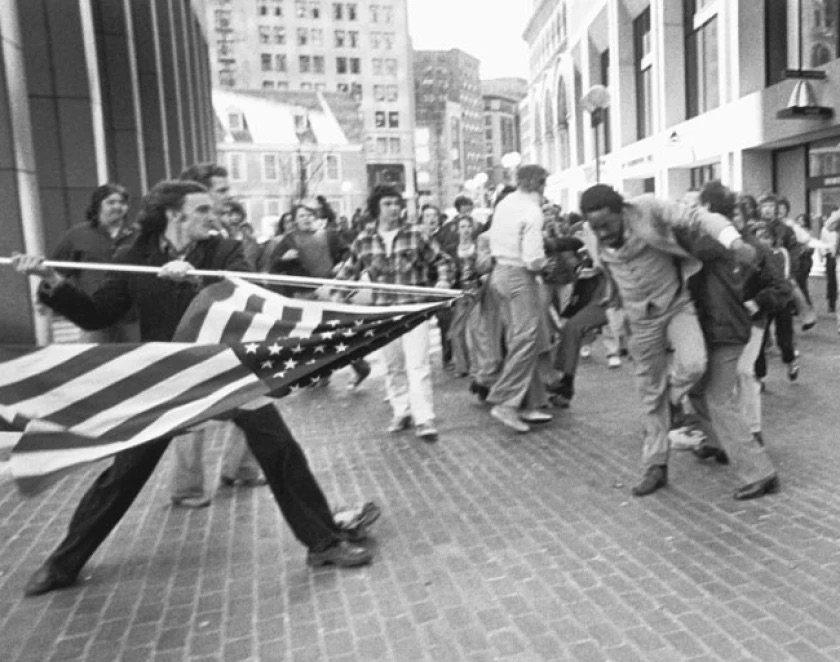
This is a famous image by Stanley Forman. Titled “The Soiling of Old Glory,” the photo won a Pulitzer Prize for breaking news photography. Forman took the picture on April 5, 1976, for what was then the Boston Herald American. A young white man lunges at a black man (Ted Landsmark) with the sharp point of a flagpole, with the American flag attached.

Well, this is all a long-winded way of saying that I finally saw an authentic portrait of that trope last night. The film Tony about one summer in the life of the late celebrity chef Anthony Bourdain has a great Masshole character played by Leo Woodall. He’s SO good in this. In my opinion, he steals the film, which is largely set on Cape Cod in the summer of 1975. His accent and demeanor are perfect. It just figures that he’s a Brit! He totally nailed his part. GENXers should go see the film for Woodall and the soundtrack (including some classic Jonathan Richman) alone.


Leo Woodall as the Masshole character—a restaurant worker named Sal—in Tony (in theaters now)
Here’s me at a dinner with Ted Landsmark (from the Pulitzer Prize winning photo) in 2013. It was an honor to meet such a distinguished Bostonian.

The Cape

I’ve been digitizing old photos over the past few weeks. I have a ton of them. There’s no way I could save all of them in the event of a fire. I wouldn’t even want to. There are too many.

Walt Whitman’s lines “I am large, I contain multitudes” keep popping into my head. I’ve gone through so many phases in my nearly 60 years. I contain multitudes. We all do.

One theme I’m finding is that we (like everyone) mostly took photos on vacations and holidays. And there’s one vacation destination in Massachusetts that everyone knows: Cape Cod. It’s known simply as “the Cape.” (There’s another popular cape in Massachusetts, but that one gets referred to by its full name: Cape Ann.)

Cape Cod is where the Kennedys summered and it’s just one of those places that everyone in Massachusetts has memories of. If you didn’t have a friend with a house “down the Cape,” then you probably rented one or stayed in a Cape hotel at least a few times in your life.

My earliest memories of the Cape include barfing after eating scallops at Thompson’s Clam Bar, having my grandmother tell me that they thought I’d drowned when I went missing at the beach one day, and waiting for the sun to come out.

I’ve been lucky to visits “The Islands” many times too. (If you’re from Massachusetts, you know that The Islands are Martha’s Vineyard and Nantucket.) But the Cape is where my earliest vacation memories happened.

I’m realizing that the places where our memories were made—where our lives have played out—are quite meaningful. They’re the settings for our stories.

The Cape, August 1970
At the beach on Cape Cod, 1970, with my Italian grandmother in a bathing suit (a rare occurrence). I don’t remember how I hurt my knee, but I do remember wearing that huge bandage.