On our last full day in Ireland, we figured out how to take a commuter train from Connolly Station in Dublin to Drogheda (about 45 minutes away) and then grabbed a cab to the Brú na Bóinne Visitor Center—commonly referred to as “Newgrange.”
Brú na Bóinne is one of the world’s most important prehistoric archaeological sites. Older than both the pyramids and Stonehenge, it’s home to the massive passage tombs of Newgrange, Knowth, and Dowth. With advance tickets, you can tour Knowth and Newgrange with a guide.
Knowth (dating from 3,200 BCE)
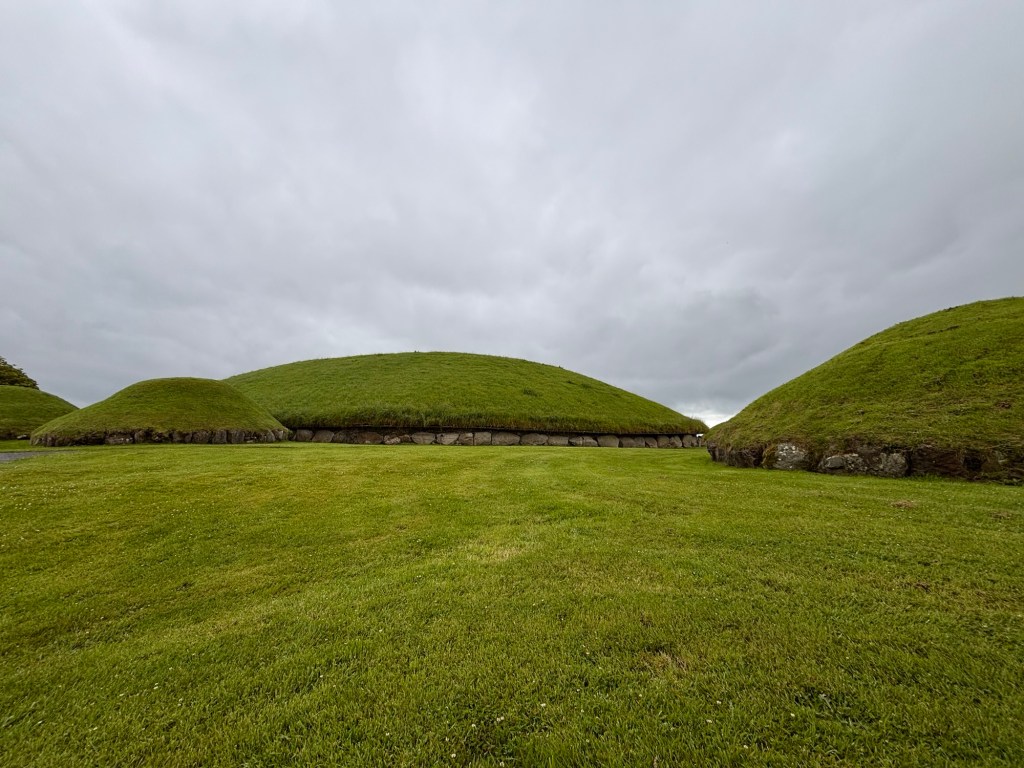
Knowth includes one large central mound surrounded by 17 smaller satellite mounds.
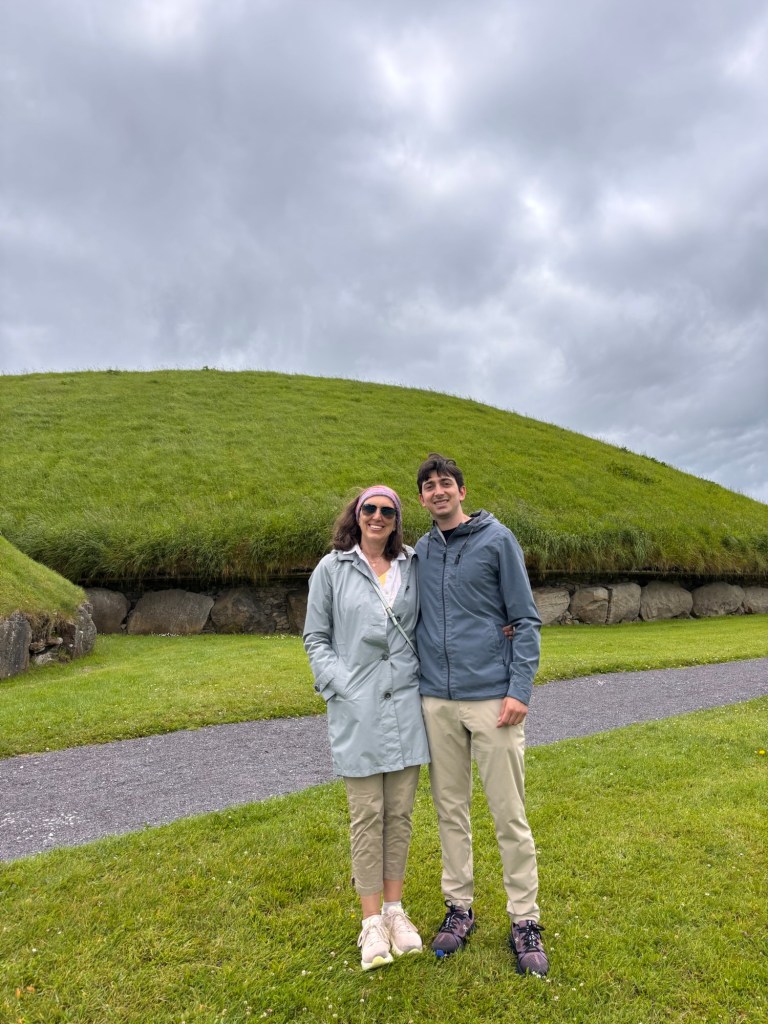
The large mound at Knowth (behind us) features two opposing passageways—one facing east and the other west—which are believed to relate to the equinoxes.
The decorated stones around the bases of the mounds are referred to as kerbstones. These large stones feature intricate megalithic art, including spirals, concentric circles, and other abstract motifs carved by Neolithic peoples.
Hard to make out, but experts believe this is an ancient lunar calendar on a kerbstone at Knowth.
The view from atop the largest mound at Knowth. We happened to visit on Father’s Day (which is the same day in Ireland) and there were Irish fathers and sons visiting too! ☘️
You can ascend to the top of the largest mound at Knowth and actually go inside the Newgrange tomb through a narrow, rocky passageway to experience this 5,000 year old sacred space which was engineered with astonishing precision to align with the solstice sun, when it miraculously lights the inner burial chamber.
Newgrange (3,200 BCE)
It’s a surreal feeling to stand in an underground chamber built by humans 5,000 years ago. At one point, the guide extinguished all light in the tomb, submerging the chamber into pitch blackness, and then demonstrated with an artificial light how the chamber lights up (for about 17 minutes) on the winter solstice.
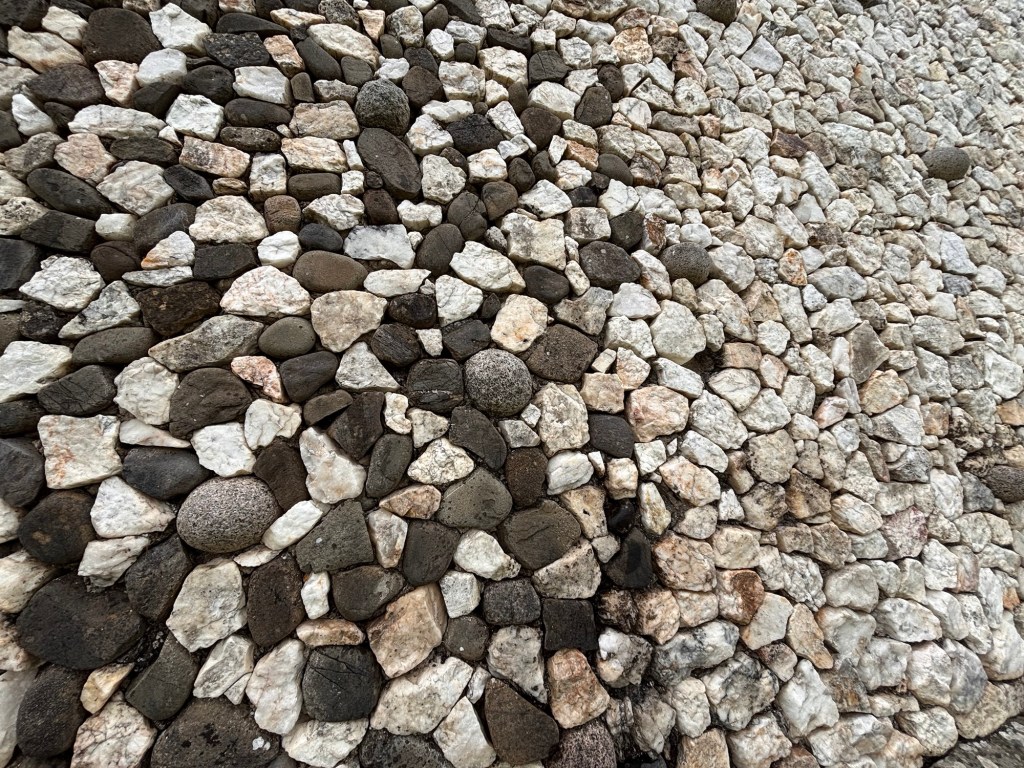
The entrance to Newgrange—the opening above the door that allows light to enter is called “the roof box.” It was ingeniously designed to align with the rising sun during the winter solstice, allowing sunlight to illuminate the inner chamber—an extraordinary feat of Neolithic engineering and astronomy.Detail of the Kerbstone at the entrance to Newgrange. No photography was allowed inside the tomb (a rule I reluctantly obeyed!), but there was a magnificent stone inside the chamber with a similar (but perfect) tri-spiral.This is a postcard picture of the tri-spiral in the chamber. Isn’t it beautiful? What do you think it means? The experts can only guess. The exterior wall of Newgrange This is a replica of one corner of the Newgrange chamber in the Visitors Center. It shows how the light first comes in on the winter solstice. The actual chamber was much bigger and very tall when we stood inside it, with large recesses on three sides for sacred objects, including one with the perfect tri-spiral stone.
It is believed that the passage tombs of Brú na Bóinne were Stone Age burial sites for high-status individuals, where cremated human remains were placed in stone basins within the chambers. These tombs reflect a Neolithic belief system centered on death, ancestor worship, and a deep reverence for cosmic cycles—especially the sun.
In addition to human remains, archaeologists have found animal bones—including those of cattle, birds, and dogs. It is thought they had ritual significance, possibly as offerings or symbolic companions in the afterlife, reflecting complex spiritual beliefs that linked humans, animals, and the natural world.
Pre-Christianity is fascinating, right?? Because nobody really knows what they believed or were actually thinking! What do you think?
![A logo for "50 Happens," [a site dedicated to Gen X women with children and grandchildren] [who embrace life's challenges with humor and resilience], [featuring a modern and uplifting design] [that embodies strength and positivity] [with an elegant and playful style] [and a harmonious blend of colors like pink, fuchsia, purple, and blue].](https://50happens.blog/wp-content/uploads/2024/12/img-5uorrxvwartomopcpuhjfjd0.png?w=300)




 50 Happens
Absolutely marvelous! I, too, wondered what the three spirals indicated. By the way, spirals are my favorite shape.
LikeLiked by 1 person
Thanks Laurie! I was really drawn to that shape too. I even bought my daughter a necklace with the tri-spiral. I hope she likes it.
LikeLike
Beautiful photos!
LikeLiked by 2 people
Thank you!
LikeLiked by 1 person
Worth the trip just for this adventure, is what I think! Captivating.
LikeLiked by 1 person
Thanks Stephanie! I’m definitely glad we made the extra effort to get up there. It was a trip highlight for sure.
LikeLiked by 1 person
Your photos are so clear, too, really transmit the atmosphere.
LikeLiked by 1 person
It’s amazing that we used to lug cameras everywhere. Phone photos are so good now!
LikeLiked by 1 person
Wonderful photos, Mary, and what an amazing trip! I enjoyed your posts.
LikeLiked by 2 people
Thank you so much Lauren. I definitely felt the magic of Ireland. ☘️✨
LikeLiked by 1 person