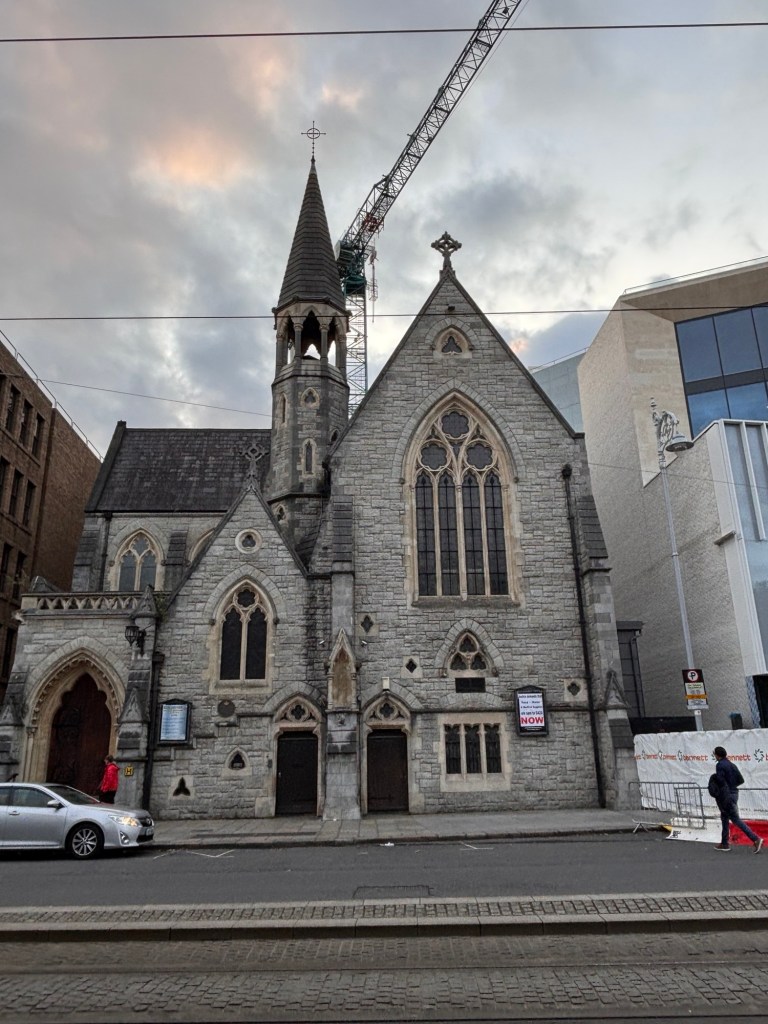
I’ve already posted many Irish doors from my trip in June, but not this one:
This is the Dublin Unitarian Church, which I walked by many times before realizing what it was. The church was right near our hotel, but so “tucked in,” I didn’t notice it until the very end of my time there.
It’s clearly in the gothic style, similar to last week’s doors. I guess I like “recessed arches.” (Thanks to Suzette for naming them for me.) And look at those cool hinges.
Seriously, this church has NO breathing room on either side. By the time I noticed it was a Unitarian Church, it was time to go home. I never got to see the inside. The doors were locked both times I tried. ☹️
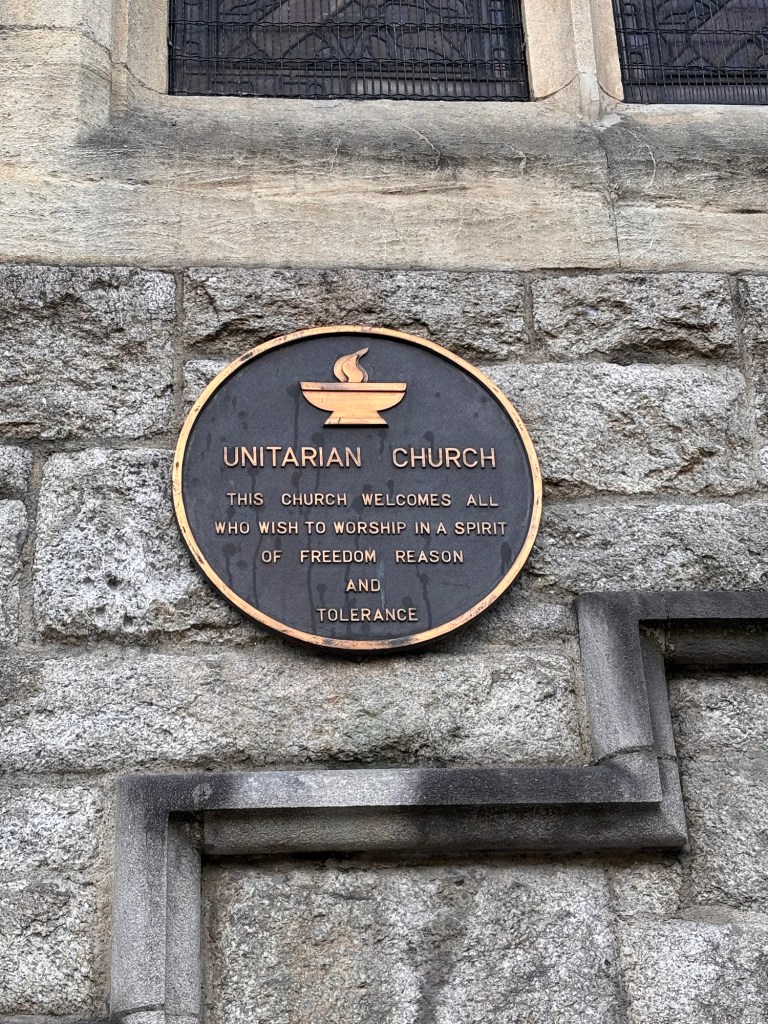
Similar to Unitarian Universalist churches in the USA, it uses the flaming chalice symbol.
What’s the difference between Unitarian Universalist and just Unitarian?
PerChatGPT:
American Unitarian Universalism (UU) emerged in 1961 from the merger of Unitarian and Universalist traditions, forming a non-creedal, pluralistic movement embracing humanists, theists, atheists, pagans, and others. It emphasizes individual freedom, social justice, and spiritual diversity without doctrinal boundaries.
European Unitarian churches, including Dublin’s, remain rooted in liberal Christian heritage, emphasizing reason, conscience, and the moral teachings of Jesus while rejecting the Trinity. They are typically more theistic and biblically grounded, though open and inclusive. In short: American UUism is multi-faith and post-Christian, while European Unitarianism is liberal Christian with freedom of belief.
For more Thursday Doors, see Dan’s blog No Facilities.
It’s now been a whole year since the Hamas-led terrorist attacks on Israel in which 1,200 men, women and thirty-six children were horrifically killed and 250 abducted. Since then, over 40,000 Palestinian civilians have been killed and countless thousands have been injured and displaced, including mothers, children and infants.
Mothers, children, and infants, like my precious granddaughter…
My minister shared this poem on Sunday and it really struck a chord with our Unitarian Universalist congregation.
“If God Would Go On a Sick Leave: A Poem of Peace”
by Rabbi Zoë Klein
Nowhere is there more prayer. The Nuns at the Holy Sepulchre. The faithful at Al Aqsa Mosque. The worshippers at the Wall. The call to prayer at dawn and dusk Warbling from the citadels. The church bells, The Persian trills, The passion spilled over texts From every major/minor religious sect. Nowhere is there more prayer than Jerusalem, Thanks be to God, Hamdilala, Baruch Hashem. And yet, I’m starting to think that it’s You and not them, God, what’s the point of prayer? If there’s nowhere where There’s more prayer, And terror reigns Then, Who’s to blame? If suddenly, without a whisper goodbye, Jesus, Allah, Adonai, The three men they admire most All took the last train for the coast, And the Moslems got up from their knees And the Christians put down their rosaries And the Jews stayed their hands from kissing Their mezuzahs, And everyone looked up, And realized something’s missing… God is missing. Stop the praying! No One’s there, They’d arrange a party to search everywhere. They’d look for God But there’d be no Presence In Holy Books or stars and crescents Or steeples and crosses. People’d be at a loss, Is He ever coming back? They’d be so distraught, Their searching for naught, There’d be nothing on high So they’d turn to on low, There’d be nothing above So they’d turn to below, And they’d finally see there, In the face of the other, A semblance of sister, The eyes of a brother, They’d turn and they’d lean Upon one another. You see, every group can’t believe that they’re the ones chosen, Every group can’t believe that the Holy Land’s owed them, Sometimes faith in You, God, Builds insurmountable walls, And everyone falls. Everyone falls. How wise are the secularists for whom the dead aren’t martyred But, quite plainly, murdered… This might sound like an absurd, ungodly thing to say, A truly heretical supplication to pray, (I say this only out of the deepest respect) But if for a few days, God, You’d just give it a rest, If You’d take a sick leave and just go away And let Israel work this out without You in the way, God, for that kind of peace, You’re a small price to pay.
As I’ve mentioned many times (including yesterday), I was raised Catholic, but left that church as a young adult.
I found my way to a Unitarian Universalist (UU) church for my wedding, and years later joined a different UU church, due primarily to a wonderful young minister who gave fantastic sermons. He left, but I joined the choir and that kept me involved. I found it to be a warm and welcoming community for me and my daughter. My husband, also an ex-Catholic, wasn’t interested in going to church on Sundays, so we went without him.
Later, when we moved to a different town, I checked out several UU churches in my new area. I ended up joining the one with the best choir and the most beautiful sanctuary. I’ve been a member of that church for nearly 20 years now. I’m still singing in the choir and will be joining the Standing Committee (leadership team) for the coming year.
One of the things I like about my church is the large handmade quilt that hangs in the front, behind the pulpit.
Italicized text excerpted from Reverend Fred Small’s dedication sermon, October 22, 2006:
As a non-creedal faith, Unitarian Universalism honors and draws upon all of the world’s wisdom traditions. The FCU Sanctuary Quilt, “Many Paths, One Congregation,” includes symbols of world religions and philosophies – and one blank.Unitarian Universalism descends from protestant Christianity, but today is multi-faith.Unitarian Universalists believe that we can learn something from every religion. As individuals, we may favor Buddhism or Christianity or Paganism or Humanism, but as a religious movement we draw upon all of these and more.
The Quilt Squares
First Row
In the upper left, representing Humanism, is the symbol of the American Humanist Association: a stylized human figure in the form of a capital H. According to the Humanist Manifesto III: “Humanism is a progressive philosophy of life that, without supernaturalism, affirms our ability and responsibility to lead ethical lives of personal fulfillment that aspire to the greater good of humanity.”
In the top center is a symbol of the Unitarian Universalist Association: a flaming chalice within two overlapping circles, which represent the consolidated movements of Unitarianism and Universalism.
Last but by no means least: an empty space. It acknowledges the quilt’s incompleteness and our own, affirms humility in the face of mystery, and celebrates our continuing journey toward understanding.
Second Row
Next are three religions rooted in Asia: Taoism, Hinduism, and Buddhism.
The yin and yang symbol shows opposites intertwined, in eternal Equilibrium, representing Taoism.
The Hindu symbol is the word “Om” in Sanskrit, evoking the infinite Brahman and the entire Universe. Revered as the primal sound, “Om” is the first word of most Hindu mantras.
The Buddhist symbol is the wheel of dharma. “Dharma” means law or teaching. The wheel’s turning represents spiritual progress through the Buddha’s Eightfold Path, symbolized by the eight spokes of the wheel.
Third Row
In the next row are the familiar symbols of the three Abrahamic faiths in chronological order left to right: the Jewish Star of David, the Cross of Christianity, and Islam’s Crescent and Star.
Muslims call all three religions “people of the book” because all deem holy the Hebrew Scriptures, with Christians adding their New Testament and Muslims the Qur’an as well.
Fourth Row
The bottom row bears the symbols of Native American, Earth-centered, and Goddess-centered religions. These ancient and indigenous traditions undergird and inform the scriptural religions that followed them and absorbed many of their images, stories, and practices.
The turtle represents the Nipmuc people, who lived in this region before the coming of Europeans. The Nipmuc call our world Turtle Island because it sits on the turtle’s back. The thirteen shells represent the lunar months.
The tree of life, branches reaching into the sky, roots sunk deep in the earth, linking the three worlds: heaven, earth, and underworld. Skeletal and deathlike in winter, green and lush in summer, the tree represents immortality, rebirth, and wisdom in many cultures.
The triple moon, symbolizing the goddess, the feminine face of the divine. The three lunar phases—waxing, full, and waning—represent the three stages of women’s power: Maiden, Mother, and Crone.
Wait a sec! I just noticed that last bit about the three phases of women’s power. I’m not so sure I like being called a “crone.” I’ll have to give that some thought and report back.
That’s one thing about being UU, there’s always room for discussion.
![A logo for "50 Happens," [a site dedicated to Gen X women with children and grandchildren] [who embrace life's challenges with humor and resilience], [featuring a modern and uplifting design] [that embodies strength and positivity] [with an elegant and playful style] [and a harmonious blend of colors like pink, fuchsia, purple, and blue].](https://50happens.blog/wp-content/uploads/2024/12/img-5uorrxvwartomopcpuhjfjd0.png?w=300)




 50 Happens