Of Light and Air

I dragged brought my husband to the special Winslow Homer exhibition at Boston’s Museum of Fine Arts. Given my recent interest in watercolor painting, I couldn’t miss Of Light and Air.

Here’s what I learned:

Watercolors fade. These paintings are delicate. That’s why they only display them once every forty years or so—and in very dark galleries. (If you really want to make art that lasts forever, watercolors might not be a great choice.)
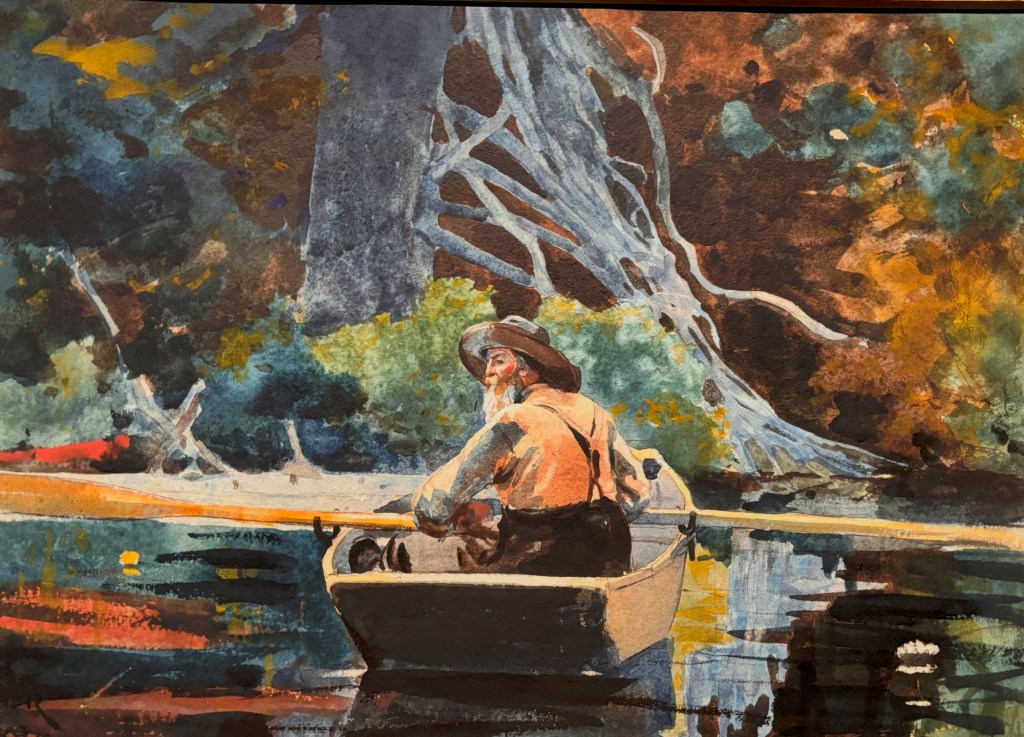
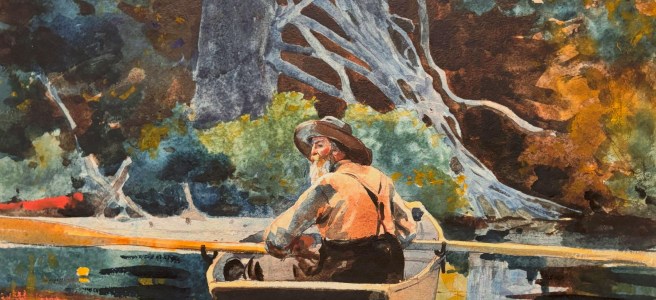
One of the most famous (and vibrant) pieces in the show

Pencil lines are OK, as long as they don’t bleed into the paint. In fact, most of his works were described as “watercolor over graphite.” And being able to draw well really helps. Plenty of modern painters can’t draw, but most artists I admire draw well…really well. So, keep practicing or studying drawing.

Having started as a commercial lithographer and magazine illustrator, Homer could create a realistic image with just a few well-planned lines. In fact, one of his magazine employers sent him to the front lines of the Civil War to draw battlefield images. Talk about trial by fire!
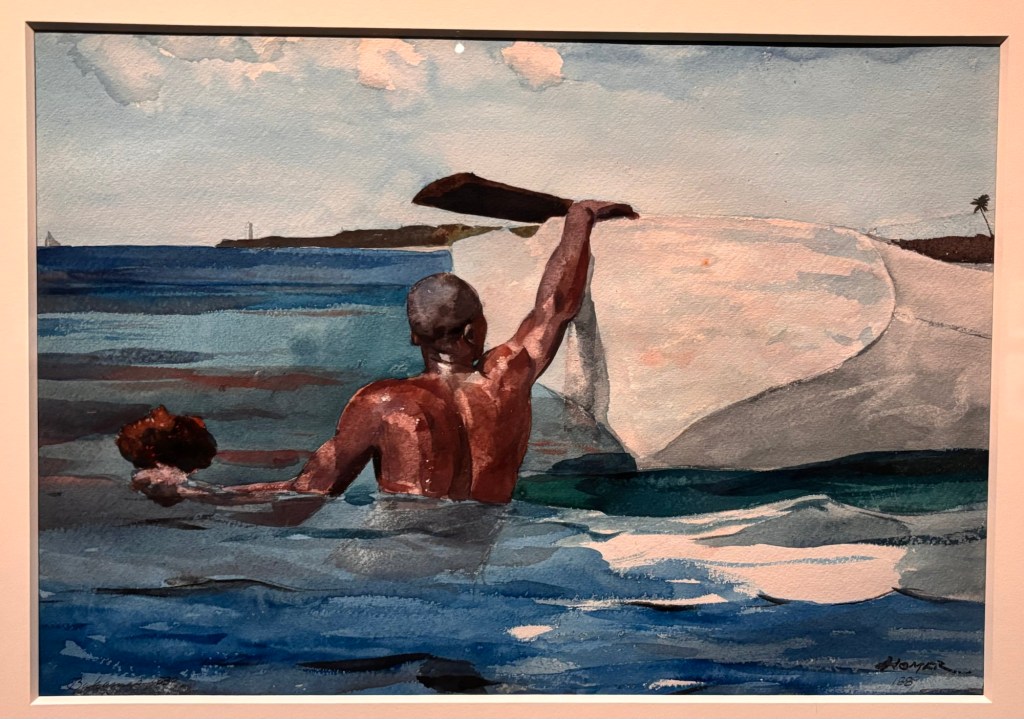
A sponge diver in the Bahamas. I have no idea how he would’ve painted something like this without a photo to refer to.

Watercolor paintings are about choices. There is no real white in watercolors. Your white is your paper, so what you choose not to paint is a critical decision.

Things can be represented with just a few brush strokes. Layers matter. Choices. What will you choose to fully depict? What will you simply allude to with a brush stroke or two?
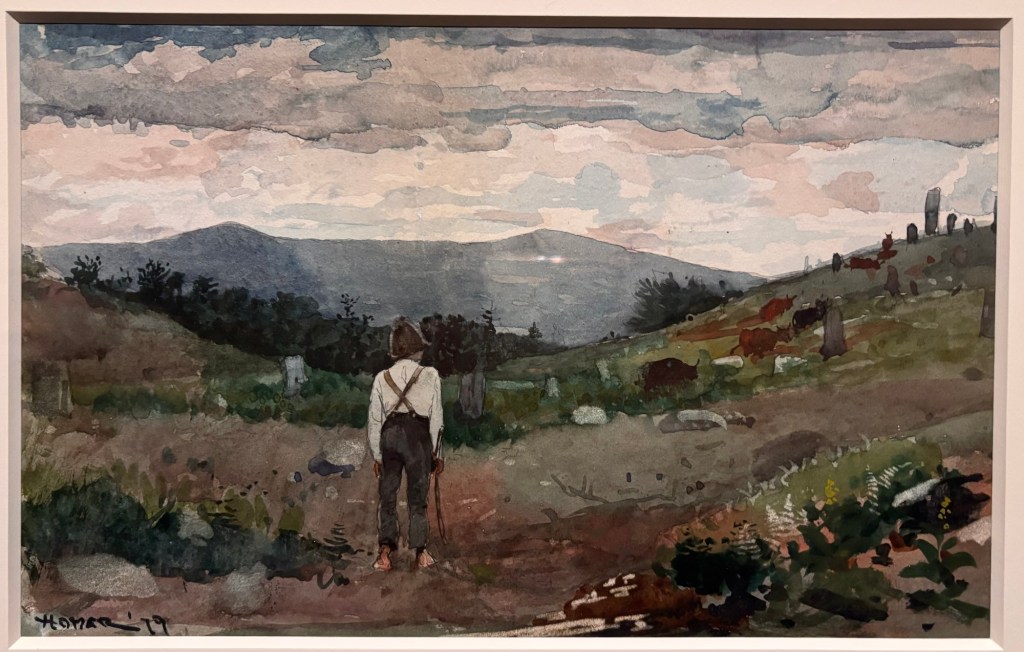
Driving Cows to Pasture, 1879
“This watercolor, painted in central Massachusetts, is noticeably looser and more abstract than earlier work. The boy, turned away from the viewer, is seemingly rooted to the ground; dappled hills and unruly vegetation surround him. A moody sky, composed of thin washes of blues and purples, casts a somber tone. The cows, rendered as brown dabs on the hillside, would be easily missed were it not for the title. Here, Homer embraced abstraction as well as some advanced watercolor techniques, removing pigment through scraping and lifting to create rough rocks and ghostly ferns.”

Everyone’s eyesight gets worse as they age. Apparently Homer told people to save rocks for your old age, because “painting rocks is easy.”

Art museums

My husband and I are very different. In fact, we’re almost complete opposites. He likes a lot of things that I will never ever be into like weightlifting in gyms, football and other contact sports like rugby, and hardcore (punk) music. I like a lot of things that he will never ever be into like singing in choirs, going to musicals, and swimming.

For many years, we just kind of did our own thing. I went to the beach with friends, while he stayed home and went to the gym…

But if you’re going to stay married to one person for your entire adult life, you must come up with at least a few shared activities, especially after your kids fly the coop, or you will have absolutely nothing interesting to talk about!

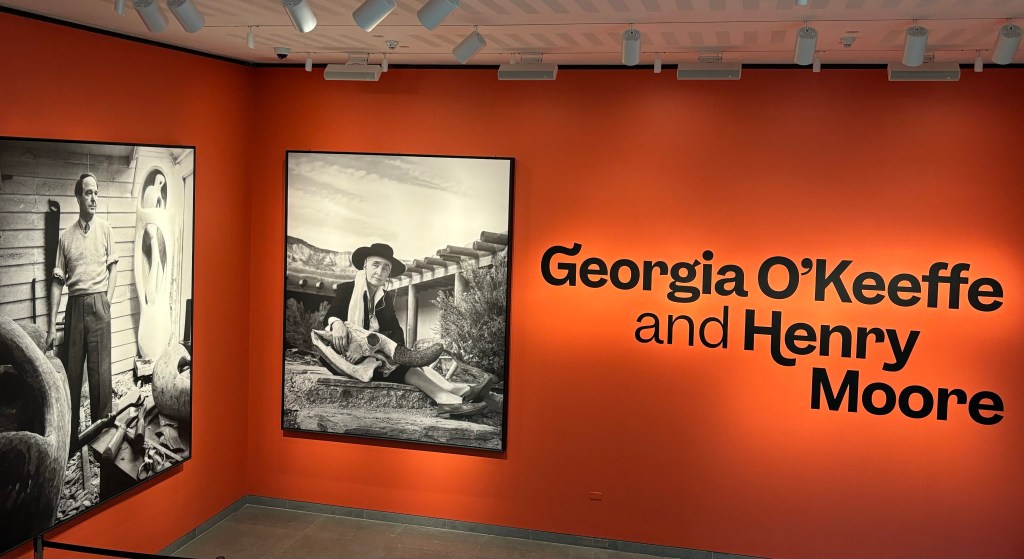
One of the things we both like to do is go to art museums. We have memberships at a few local museums and we go to their major exhibitions. Yesterday was the Georgia O’Keefe and Henry Moore exhibit at Boston’s Museum of Fine Arts.

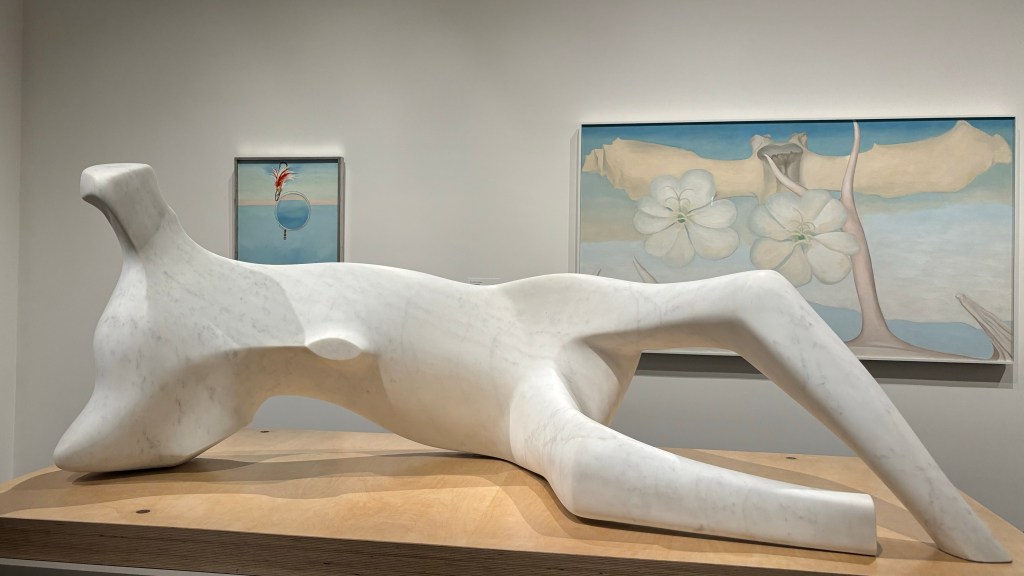
It was an interesting idea. They took two artists who worked in different mediums (a painter and a sculptor) in the same time period (early 20th century) and put them side by side. The idea was to see how they were grappling with similar themes in their work, especially nature and tension/balance between shapes, and appreciate how they influenced each other.

The galleries were quite crowded (a great sign for art museums!), but that made it a bit difficult to fully consider the interplay between the two artists. Still, I think I got the idea.

This gallery, with a large Moore sculpture in the foreground and O’Keefe paintings on the walls, shows what the curators were going for with this exhibit.

My husband liked the Moore sculptures best. Me? I just love those famous Georgia O’Keefe flower paintings. As many times as I’ve seen them reproduced as prints and posters, the originals are so nuanced and gorgeous. What can I say? I like flowers and pretty colors. (They sort of reminded me of the Northern Lights.)

And then, for something completely different, we took a stroll through a Salvador Dalí exhibit. The famous Spanish surrealist was truly an extraordinary painter. Interestingly, he was a contemporary of Moore and O’Keefe. All three lived through World War II—an event so monumental no artist was unaffected by it.

The Three Ages (Old Age, Adolescence and Infancy) by Dalí, 1940. If you look closely, each section of the painting is a double image (i.e. the left side is a standing, stooped figure and also an old man’s face).
“This painting revisits Dalí’s most famous composition, The Persistence of Memory, which by the early 1950s had become emblematic not only of Dalí, but also of the Surrealism movement.
Here Dali once again places melting watches in a barren landscape, but now the context is the post-war atomic age. An elaborate grid of bricks recedes toward the distant horizon, the boxy shapes becoming missile-like forms. Typical of the artist, the picture’s meaning is ambiguous, though very much of the nuclear era.”