Alex Pretti, registered nurse, United States citizen
Statement from the family of Alex Pretti:
“We are heartbroken but also very angry.
Alex was a kindhearted soul who cared deeply for his family and friends and also the American veterans whom he cared for as an ICU nurse at the Minneapolis VA hospital. Alex wanted to make a difference in this world. Unfortunately he will not be with us to see his impact. I do not throw around the hero term lightly. However his last thought and act was to protect a woman.
The sickening lies told about our son by the administration are reprehensible and disgusting. Alex is clearly not holding a gun when attacked by Trump’s murdering and cowardly ICE thugs. He has his phone in his right hand and his empty left hand is raised above his head while trying to protect the woman ICE just pushed down all while being pepper sprayed.
Please get the truth out about our son. He was a good man.”
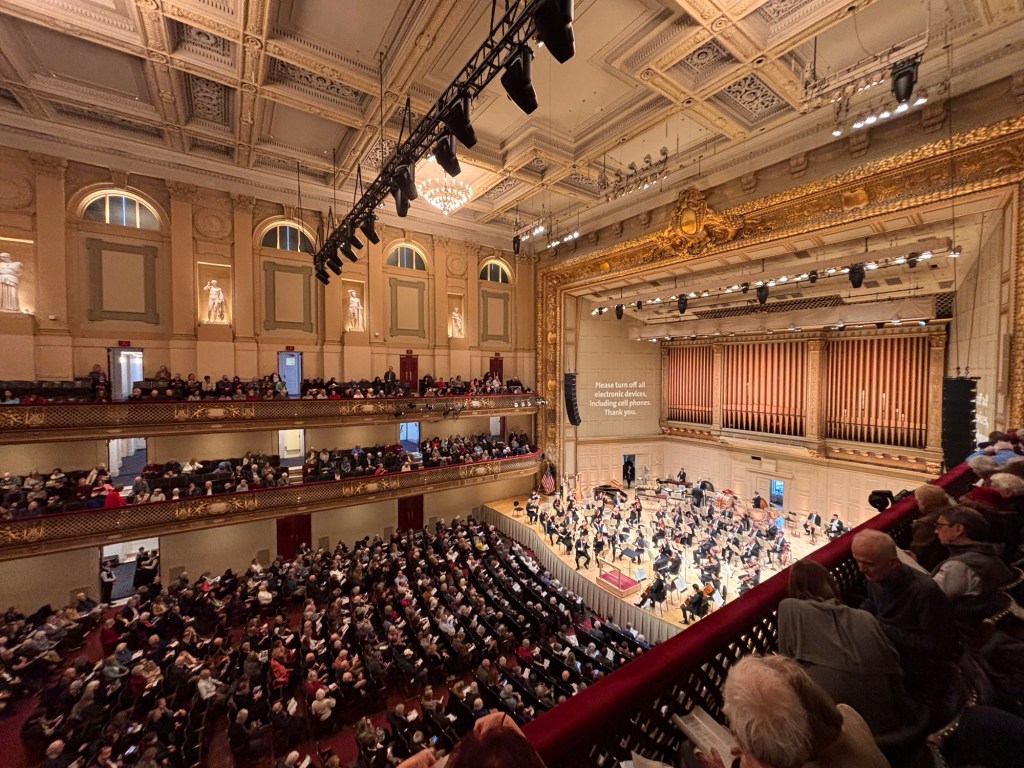
Yesterday I went to a concert by the world-renowned Boston Symphony Orchestra in Boston’s historic Symphony Hall.
Boston’s Symphony Hall yesterday afternoon
My friend Eileen and I had wanted to attend this particular concert because the planned guest conductor—a young man we knew from our days working together at the Conservatory—was making his Boston debut.
AFTER we bought our tickets, we were notified that he wouldn’t be conducting due to “ the recurring effects of a shoulder injury.” Instead, 29-year old BSO Assistant Conductor Anna Handler would be making her Symphony Hall debut. OK, well at least we were seeing someone’s debut!
The first piece was “The Imagined Forest” by 31-year old British composer Grace-Evangeline Mason. It was atmospheric and beautiful.
Something about seeing these two young women—the conductor and the composer—take their bows together felt like Progress. I’ve seen plenty of women take their bows as soloists, but not as conductors and composers—the artistic leaders—at the very highest level of classical music.
There was no mention of it being a historic first or anything like that, but you could feel that the audience was 100 percent supportive. Partial standing ovation (unusual for the first piece in a concert). Many cheers.
Brava, ladies. Well done. Respect.
29-year old Anna Handler commanded the podium in a focused, confident way as she stepped in for an ailing guest conductor of one of the world’s finest symphony orchestras
I remember my mother giving me a blue Velcro coupon organizer in my twenties (a little portable folder with dividers for keeping various types of paper coupons—food, toileteries, etc.) She would also cut out and give me coupons for various things she thought I used. It was very thoughtful.
I don’t know what happened to that organizer. At one point, I remember thinking coupons were such a hassle. Half the time, my coupons had expired by the time I got around to pulling one out. All that effort and kerfuffling at the register just to save 50 cents.
I think I had abandoned paper coupons by the time I had my own family at age 30. And I’m pretty sure my millennial/GenZ kids have never once cut out a paper coupon.
Now of course, we have endless customer loyalty programs and accompanying rewards points, electronic coupons, discount codes, promo codes, etc.
I honestly don’t know if my kids have the time and motivation to take advantage of those types of savings programs.
But I do! I will sit in my car and hit the plus sign next to every single savings offer before I go into a CVS, just in case I buy something that applies.
Beware the senior citizen with time on her hands!
According to CVS, I have saved over $3,500 since joining their free “ExtraCare” program in 2016.
The satisfaction of seeing the total bill tick down after hitting “redeem all coupons” at the soulless self-checkout reminds me of the feeling of getting a 100% on your weekly spelling quiz. There’s really no intelligence involved. It’s all preparation, and you were prepared.
Another commonly held belief seems to be that older generations are somehow tougher than younger ones. That life was harder for them and people have gotten progressively more comfortable.
I beg to differ.
Although the tremendous sacrifices and bravery of the so-called “Greatest Generation” can never be overestimated (they literally risked everything to defeat the Nazis), I would argue that non-marginalized groups in the following generation (my parents cohort) have had it pretty good. Many went from lower class (aka poor) to highly comfortable and secure in a single lifetime. And although we benefited from our parents’ prosperity, the following generation (mine) has had it harder in many ways. And our kids are going to have it even harder.
Not to be a Debbie Downer, but there are reasons the birthrate is historically low in 2025. We all know millennials who are choosing not to have children (or GenXers & Boomers who are sad that they will never be grandparents).
I asked ChatGPT to compare the lives of someone born in the mid 1930s, mid 1960s, and mid 1990s.
Facts:
1. Income & Jobs
Born mid-1930s (entered workforce ~1950s): Median household income in 1955: ~$5,000 (≈ $58,000 in today’s dollars). A single income (often the father’s) could support a family, home, and college savings. Job security was higher; pensions were common. Born mid-1960s (entered workforce ~1980s): Median household income in 1985: ~$23,600 (≈ $66,000 today). Both parents often worked, butwages grew more slowly compared to the cost of living. 401(k)s replaced pensions, shifting retirement risk to individuals. Born mid-1990s (entered workforce ~2015–2020): Median household income in 2019: ~$68,700. In real terms, wages for young workers have stagnated since the 1970s, while housing, education, and healthcare rose sharply. Gig economy and contract jobs more common, less stability/benefits.
2. Cost of College (Public University, In-State Tuition)
1930scohort (college in 1950s): $200/year tuition ($2,400 today). College was affordable even with part-time work; no significant debt. 1960scohort (college in 1980s): $1,500/year tuition ($4,000–$5,000 today). Still affordable with summer jobs; modest debt possible. 1990scohort (college in 2010s): ~$10,000/year tuition (public); $35,000–$50,000/year (private). Widespread reliance on loans; average borrower debt: $30,000+.
3. Healthcare Costs
1930s cohort: Out-of-pocket affordable; many employers covered full family insurance. Doctor visits and hospital stays far cheaper relative to income. 1960s cohort: Insurance became tied to employment. Costs rose, but still manageable. Deductibles/co-pays introduced. 1990s cohort: Healthcare costs skyrocketed (family premiums ~$24,000/year by 2025, often split with employer). Medical debt is a leading cause of bankruptcy.
4. Cost of Raising a Child (to age 18, middle-class family), not including college
1930s cohort (raising kids in 1960s): ~$25,000 total (≈ $240,000 today). 1960s cohort (raising kids in 1990s): ~$150,000 (≈ $280,000 today). 1990s cohort (raising kids in 2020s): ~$310,000. Housing, childcare, healthcare, and college costs exploded. Childcare alone can rival college tuition.
5. Retirement
1930s cohort: Retired with pensions, Social Security, mortgage-free home. Comfortable retirement was realistic for average workers. 1960s cohort: Retirement savings depended on 401(k)s and IRAs; investment risk shifted to individuals. Some still had pensions, but they were fading. 1990s cohort: Retirement is much more uncertain. Pensions rare; Social Security’s future questioned. Rising housing and healthcare costs make saving harder. Many expect to work past 65.
A final note: When my friend Carla was dying in 2022 at age 57 from brain cancer, she commented that at least she wasn’t going to have to worry about paying bills anymore. She felt that one upside of an early death would be a release from financial concerns. Carla had an advanced degree in nursing and worked (very hard) as a hospice medical director. She was married with two adult children that she’d been able to send to college.
And I’m sure she walked to school in the snow plenty of times.
Chris of A New Life After Cancer reminded me that it’s International Women’s Day (IWD), which is not typically on our radar (or our calendars) in the US.
With the resurgence of full blown patriarchy on steroids here, it’s probably a good year to remember to mark IWD!
I’ll start with Boston Mayor Michelle Wu who did a great job defending our city in front of the bullies in Congress this week. She was forced to travel to DC to testify in front of hostile MAGA legislators just 7 weeks after giving birth and many found her calm, brave strength inspiring.
Boston Mayor Michelle Wu with 7-week old Mira in Washington DC on Ash Wednesday
Thank you Mayor Wu—a strong and fearless millennial.
My parents are part of the so-called Silent Generation. They were born in the 30s, in the decade before the baby boom started. My father is about five years older than my mother so he remembers being a kid during World War 2. He was born to poor Italian immigrants, but thanks to the GI Bill, after serving four pre-Vietnam years in the Air Force, he got to go to college for free. He wisely studied engineering and his life went straight up from there. My mother was born to lower middle class second-generation immigrants of mixed European descent and her parents were able to afford to send her to UMass on their modest incomes. She graduated debt-free and stopped working as a teacher the minute she started “showing” with me and never really had to work after that.
They were able to buy a new house (actually two), raise two daughters, send them to college (in my sister’s case, numerous colleges), travel the world, and enjoy a decades-long comfortable retirement, including 6+ weeks in sunny Florida each winter. Now, as they enter the final season of their lives, they are in remarkably good health and have various good options. They could sell their two-story home (which they purchased for about 30K in the 60s and is now worth 1M+) and move into one of several different high-end assisted living facilities nearby, or move into their one-floor condo, or adapt their two-story house as needed and just stay there. They have many different options.
From the GI Bill to plentiful and affordable new housing, quality public education (including college), Medicare, Social Security, and generous ongoing veterans benefits, America has been great to them.
Now, I’m not complaining (much) because I’ve been lucky too, but things were a bit different for us. My husband and most of my friends incurred tremendous debt to go to college and grad school in the 80s and 90s. We made sacrifices for me to stay at home for a couple of years when my kids were babies, including buying a dilapidated, antique house with a down payment I had to ask my father for in a humiliating conversation.
We worked hard to fix up that tiny old house with the severely slanting floors, lead paint, and leaking fieldstone basement. I got a job, my husband got a second job, and he also put in tons of sweat equity. We were able to roll his student loans into our mortgage. And then, when we decided to try to sell that house in 2004, we got lucky. I found buyers that overpaid significantly for our house. I met a woman on a playground (another young mom) who wanted to buy a house in our town and I told her that ours just happened to be on the market. We hit it off personally and that predisposed her to like my house more than she should have when she and her husband came to see it with a realtor. We ended up making nearly 150% on that house in just nine years. If we had waited three more years to sell it, the subprime mortgage crisis would’ve been underway and we never would’ve done so well. That one lucky sale set us to be able to get most of the things my parents got. We’ve achieved a similar lifestyle to theirs, but without the second home, extravagant travel, and 6+ weeks in Florida each winter.
After we moved to our bigger, newer house, we were super savers and got lucky with some corporate stock from one of my husband’s jobs and were able to give our two kids debt-free college educations. We know this is rare. This is not what most Americans can expect these days.
And as we face very uncertain times ahead, I can only hope that my kids, and their kids, will be able to get most of what we had. We will help them as much as we can, but we have our own retirement to worry about. Who the hell knows what will happen with Social Security and Medicare. We have to be prepared to pay for everything ourselves.
The contrast between what my immigrant grandparents arrived with and what my parents have been able to achieve in this country is staggering. Yes, my parents worked hard and stayed married (divorce is a real wealth killer), but they also happened to be born at a very good point in American history. I think it may turn out that they got the absolute best of America.
Four generations together for the first time yesterday
There’s no feeling like holding your first grandchild for the first time. It’s an experience of pure love. It’s a bit different than the new parent feeling of baby love, which is such a huge life-altering event. (Your life is ever after divided into two parts—before and after.)
Becoming a grandparent is just a…gift. A gift from the universe. I’m crying as I write this. I don’t love the word “blessed” because of its association with traditional Christianity, but…I mean…heck… it sure does apply here.
I’ve been searching for quotes about becoming a grandparent that resonate. I kind of like this one:
“Grandchildren are the reward for those who have labored as parents.”
But I don’t love the word “reward” in it. Children are not rewards.
Becoming a grandparent is just awesome. That’s all I can say. I know I’m very lucky too. For whatever reasons, the birthrate is way down in the US. A significant number of millennials are choosing not to have children. I’m just so fortunate that my wonderful daughter and her partner have chosen to take the parenthood plunge.
And some practical advice for new grandmothers (based on my one week of experience):
Don’t be annoying.
Be helpful.
Let the parents figure out how to feed and care for their brand new baby. Do your best to take care of the parents—with meals, cleaning, recycling boxes, and whatever else they obviously need. Some ideas have changed since we had kids, especially around bottle vs breast “nipple confusion.” Don’t assert yourself too hard with your old ideas. And don’t say any of those annoying things that all mothers have up their sleeve! Tell the parents how awesome they’re doing at life’s hardest job.
One thing you will always be 100% in agreement on is that their baby (“our” baby 😉) is the cutest baby.
I’ve mentioned before how much I enjoyed the Leanne Morgan comedy special “I’m Every Woman” on Netflix. This bit about becoming a grandma is one of my favorite parts 😂🤣😂
![A logo for "50 Happens," [a site dedicated to Gen X women with children and grandchildren] [who embrace life's challenges with humor and resilience], [featuring a modern and uplifting design] [that embodies strength and positivity] [with an elegant and playful style] [and a harmonious blend of colors like pink, fuchsia, purple, and blue].](https://50happens.blog/wp-content/uploads/2024/12/img-5uorrxvwartomopcpuhjfjd0.png?w=300)









 50 Happens