![A logo for "50 Happens," [a site dedicated to Gen X women with children and grandchildren] [who embrace life's challenges with humor and resilience], [featuring a modern and uplifting design] [that embodies strength and positivity] [with an elegant and playful style] [and a harmonious blend of colors like pink, fuchsia, purple, and blue].](https://50happens.blog/wp-content/uploads/2024/12/img-5uorrxvwartomopcpuhjfjd0.png?w=300)

I just love this miniature homemade vanilla birthday cake that my daughter made for her daughter last weekend.
💕
Posted for John’s Cellpic Sunday.
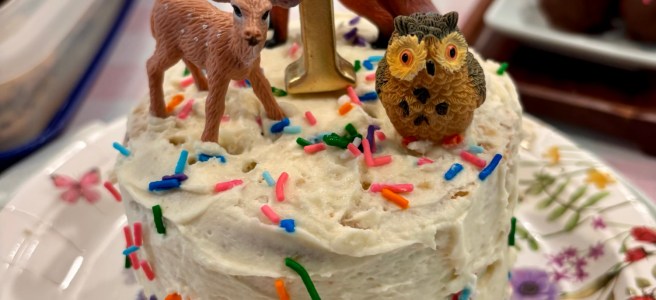
I just love this miniature homemade vanilla birthday cake that my daughter made for her daughter last weekend.
💕
Posted for John’s Cellpic Sunday.
I remember my mother giving me a blue Velcro coupon organizer in my twenties (a little portable folder with dividers for keeping various types of paper coupons—food, toileteries, etc.) She would also cut out and give me coupons for various things she thought I used. It was very thoughtful.
I don’t know what happened to that organizer. At one point, I remember thinking coupons were such a hassle. Half the time, my coupons had expired by the time I got around to pulling one out. All that effort and kerfuffling at the register just to save 50 cents.
I think I had abandoned paper coupons by the time I had my own family at age 30. And I’m pretty sure my millennial/GenZ kids have never once cut out a paper coupon.
Now of course, we have endless customer loyalty programs and accompanying rewards points, electronic coupons, discount codes, promo codes, etc.
I honestly don’t know if my kids have the time and motivation to take advantage of those types of savings programs.
But I do! I will sit in my car and hit the plus sign next to every single savings offer before I go into a CVS, just in case I buy something that applies.
Beware the senior citizen with time on her hands!
According to CVS, I have saved over $3,500 since joining their free “ExtraCare” program in 2016.

The satisfaction of seeing the total bill tick down after hitting “redeem all coupons” at the soulless self-checkout reminds me of the feeling of getting a 100% on your weekly spelling quiz. There’s really no intelligence involved. It’s all preparation, and you were prepared.

I was determined to close all three rings on my Apple Watch yesterday, so I went out for a walk in the rain. I wore a baseball hat and a large LL Bean raincoat with the hood up. My peripheral vision may have been slightly impaired.
I was listening to music from my phone in my pocket, when I briefly looked at my watch to see how far I’d walked. I must have stepped on a piece of loose asphalt and turned my ankle.
I went down. All the way down. I landed on my left side and caught myself with both wrists. I was briefly laying on my side in the wet street (a quiet cul de sac).
My watch started beeping and tapping my wrist telling me that I’d fallen and asking if it should call for help. That part was actually nice. Someone cared! But I didn’t think anything was broken, so I hit the little X to decline.
What the fuck ankle! You can’t handle stepping on a little bump?? (This ankle has let me down before.) How many times have I implored my mother and others “watch your step, don’t fall”? Falling is the worst. It’s sudden. It’s stupid. You weren’t watching. Dumb.

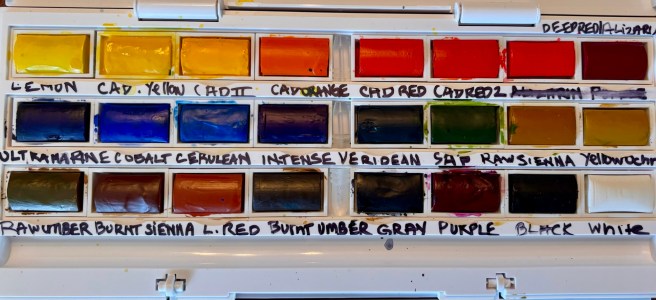
Started one of my art classes today and was wildly impressed with the community arts center where it’s being offered. I’ve lived within half an hour of this place for years and I had no idea how nice it is. Galleries, theaters, studios…kilns! It really has a lot going on.
Anyway, our teacher’s approach was to basically just dive right in. I haven’t used watercolor paints since elementary school, so that was a bit unnerving. I hadn’t even unwrapped my paints yet. Shouldn’t she teach us some sort of technique first? I guess she wanted to see where everyone is at. There are 12 of us in the class (all women) and some are total beginners, but others are quite experienced.
She pulled out a bin of objects and I got two plastic pears.
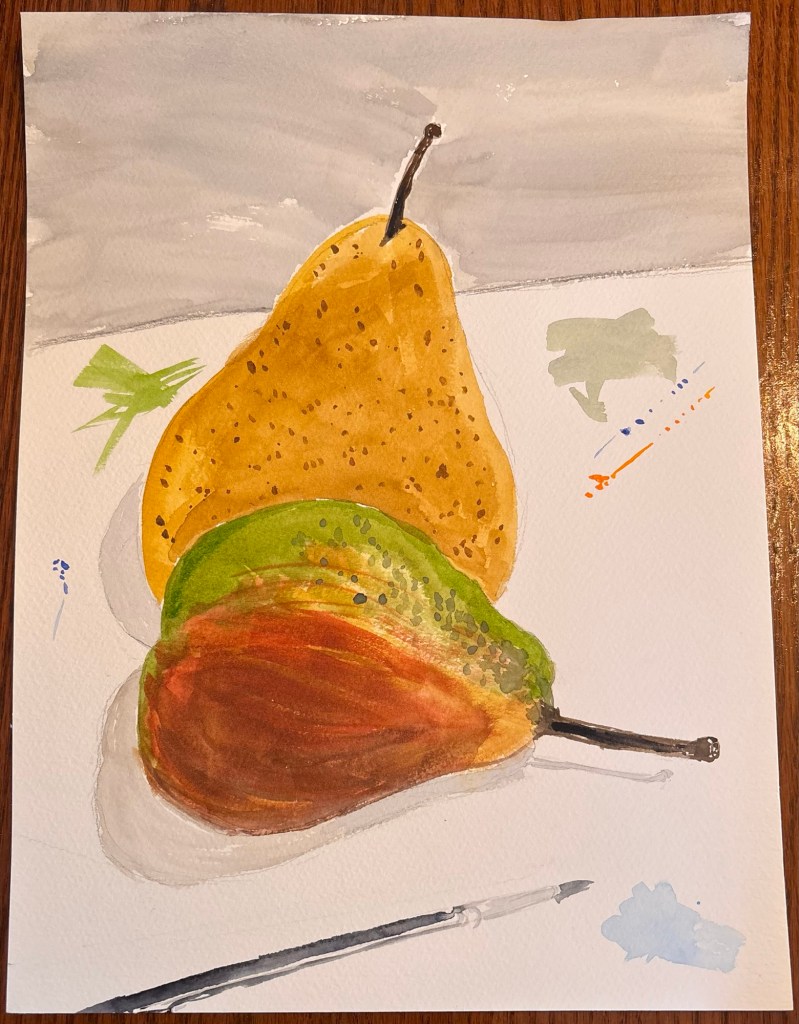
Our teacher has a degree (or two) in visual art and is a wonderful ceramicist, but said she’s “self-taught” in watercolor painting. She said she learned by trial and error and feels that’s the best way to learn. It seems like she’s one of these “there are no wrong answers” type of people.
I tend to like a bit more formality, so we’ll see how this goes…
My classmates seem nice.
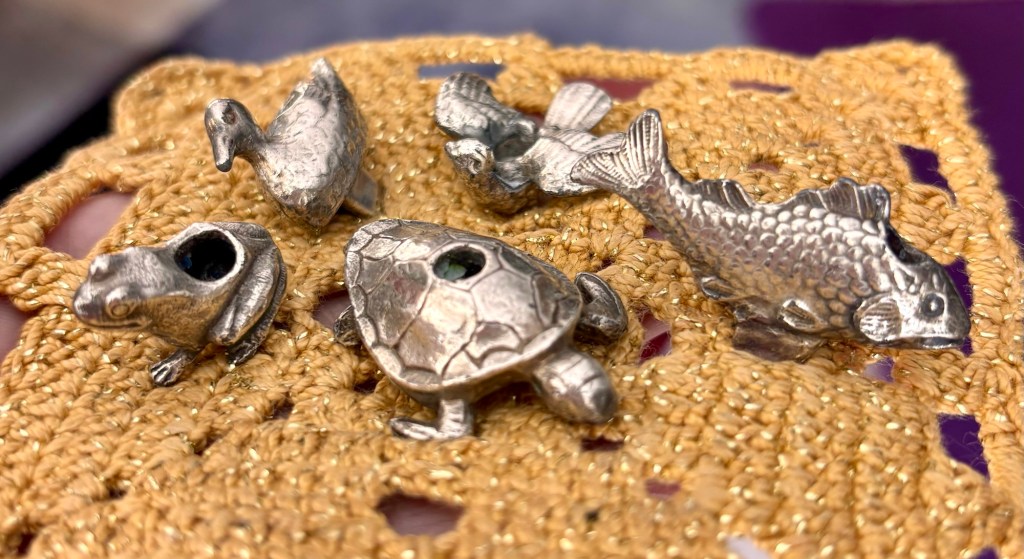
A tiny silver turtle, a fish, a bird, a duck and a frog—60-year old birthday candle holders.
A gift from a dear friend of my mother—a 3x “boy mom” who so loved little girls—on the occasion of my first birthday (we think).
Passed by my mother to me, I used them when I remembered. (The candle holes are narrow, so candles must be shaved to fit.)
Now they are polished and ready to go to my daughter.
We pass things on.
They use what they wish.
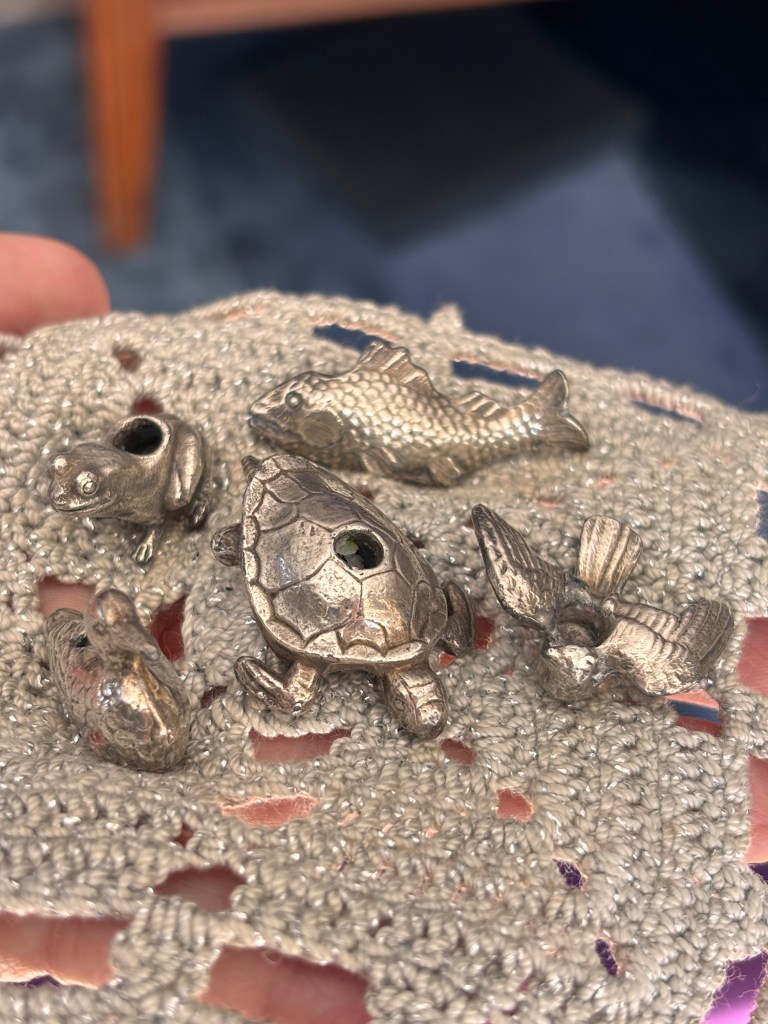
Posted for John’s Cellpic Sunday
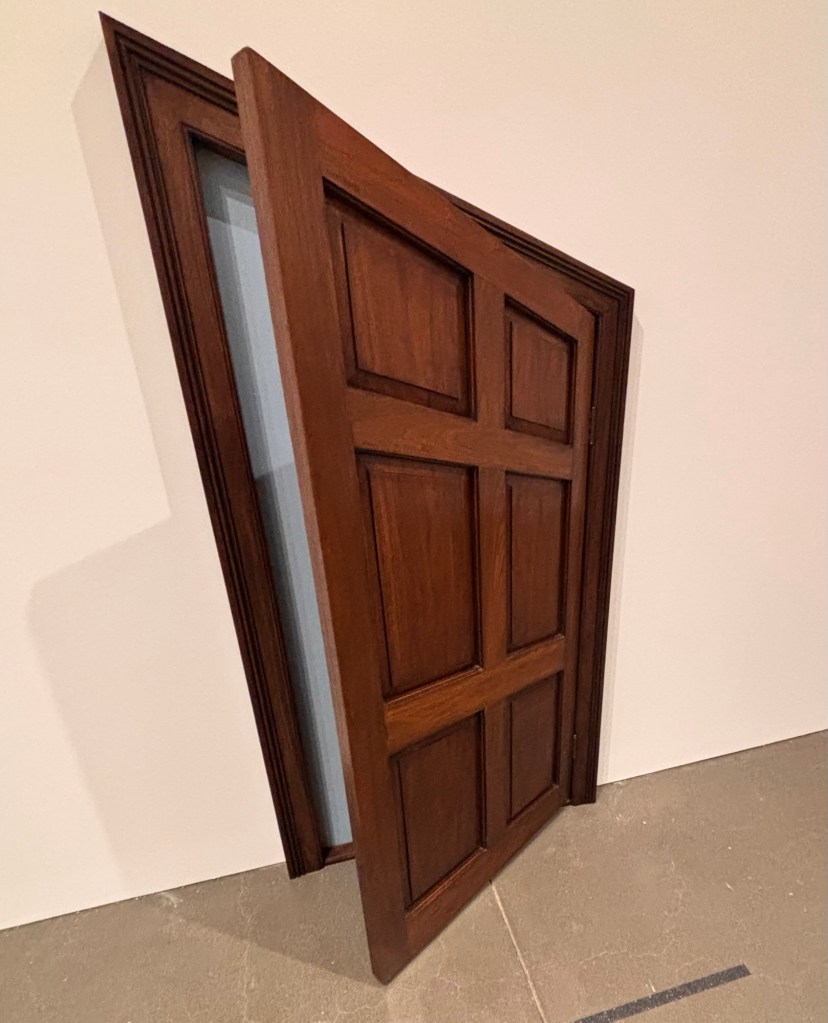
This door is a work of art by Kazumi Tanaka, a living artist born in 1962.
First conceived in 1996 during an unusual artist residency at Sabbathday Lake in Maine (the last active Shaker community in the world), Tanaka’s door was not shown until 2025. As part of The ICA/Boston’s Believers exhibition, the anamorphic door sat permanently ajar and is said to have alluded to Shaker founder Mother Ann Lee’s sentiment that the Shakers should open windows and doors to receive “whoever will arrive” in a spirit of openness and generosity.
Thursday Doors challenge

With increasingly unhinged far right authoritarians running the show here in the US, it’s hard to stay calm. Due to the Kirk assassination, many people will no longer be able to speak their minds due to promised retaliation by the government. And I don’t just mean talk show hosts and journalists. Teachers, doctors, university leaders, nonprofit administrators and regular old corporate employees are losing their jobs over what they say.
Here’s Commander Waterford and Commander Putnam lying about left-leaning organizations promoting violence and telling us their grand plan for Gilead.
Therefore, if you are able, I recommend escaping to the great outdoors or, if it’s raining, the great indoors—a big-ass movie theater with reclining seats, Dolby Atmos sound, and a bar.
I thoroughly enjoyed the sold-out premiere of Downton Abbey: The Grand Finale. If you ever loved the show, you won’t want to miss the final installment set in 1930. Downton looks amazing on the big screen and your old favorite characters all make appearances, even the deceased ones. Not to give too much away, but acceptance of divorced women and gay people into polite society is a major theme.
You will be reminded that time marches on and progress has—and always will be—a matter of more inclusion, rather than less.

It’s Cellpic Sunday and I’ve learned a new word: lamellae (the gills of a mushroom). I’m a native English speaker and I’d never heard it before.
The singular version is lamella.
🍄🍄🟫🍄🍄🟫🍄🍄🟫🍄
My husband and I tried to remember the last time we’d seen a gruesome assassination of a public figure. We couldn’t think of anything. We were too young to have seen JFK’s mortal head wound (when his brains went spattering across Jackie’s suit). And when John Lennon got shot, there was no video. Melissa Hortman, the Minnesota legislator assassinated in June, and her husband were not nationally known and again, there was no video.
So, this Charlie Kirk assassination is fairly shocking to me. I watched the close-up video and wow…a total kill shot. His whole upper body shook, and blood came spurting out of his neck as he went limp with the microphone in his hand. Absolutely horrific.
Even though we see it in movies and on TV all the time, real murder and gun violence is scarring to see at close range, even in a video.
Check-out Lydia’s post for a clearer understanding of Mr. Kirk’s views on gun violence and policy in the United States.

As I’ve already mentioned, I’m 💯% Team Rosie so I watched her interview on 60 Minutes Australia with great interest.
I did not love the guy who interviewed her. He seemed smug. (And what the heck is a “jelly” in Australia. Was that some sort of an insult in his opening? Maybe Brizzy May can explain.)
I thought Rosie did pretty well under the circumstances. She still managed to be funny and light in a very serious situation. She’s basically a United States artist and citizen living in exile due to fear of retribution from the President of the United States. It’s so fucked up.
What do you think?
Related post:
 50 Happens