Cellpic Sunday—The Country Fair

My church runs an annual “country fair” which serves as both a fundraiser for the church and a fall festival for the town. A portion of the proceeds are donated to a local nonprofit each year.

It’s always in early October and it has been going on for decades. Different teams work to prepare and then implement the various revenue areas: the book sale, the country store, “trash & treasure,” face painting, bake sale, etc.

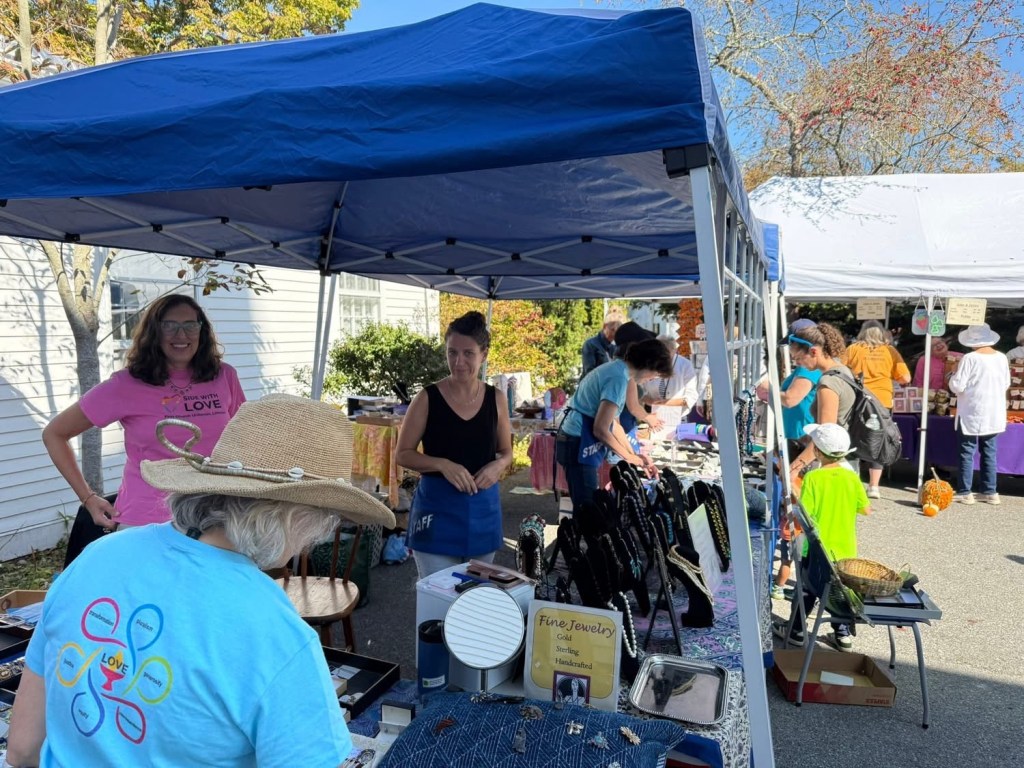
For the past few years, I’ve worked jewelry. We get a tremendous amount of jewelry donated by members and friends of the church throughout the year—everything from diamond rings to Mardi Gras beads.

Sorting, pricing and displaying it is a big job! There are about five of us that usually handle this task, with Julie being our fearless leader. Julie is a former Peace Corps volunteer and retired high school teacher with an eye for precious metals. She’s extremely good at making sure we don’t accidentally give away a real gold ring or a vintage sterling brooch for $5.

She tends to monitor and sell the “real jewelry” at the fair while the rest of us sell the mounds and mounds of “costume jewelry.” She can be tough when needed, especially on the early birds who are clearly looking to score some real gold for next to nothing.

Julie has permanently dedicated a significant portion of her basement to donated jewelry, props on which to display jewelry, and tools to evaluate and repair jewelry.

Here’s my snap of Julie the Jewelry Queen setting up necklace displays in the church office the night before the Country Fair.

And here’s a cell pic of our group in action yesterday. (It was taken by our minister.)
Posted for John’s Cellpic Sunday.

Most of us wear our church t-shirts to work at the fair which have our shared UU values on the back.

A Model Philanthropist

Daily writing prompt
If you could have something named after you, what would it be?

Naming facilities is something I know a bit about due to my career in fundraising and philanthropy. At my last job, we built a sweet, state-of-the-art, 300-seat black box theater that could’ve been named (in 2009) for a mere $3 million. Sadly, we could not find a lead donor at that level…in Boston of all places (where we have many wealthy patrons of the arts). It was a real bummer. A total fail. We blamed the recession.

More recently (in 2023), a spectacular new non-profit community music center opened up near my home in the northwestern suburbs. And when I say spectacular, I mean it. You’ve heard of Tanglewood, right? This place is like Tanglewood East. Check it out here. I don’t know how much Groton Hill Music Center cost to build, but I’m certain it was hundreds of millions of dollars with the massive parcel of land that it’s set on (part of which was formerly owned by rocker J. Geils, who died in 2017). There is no other community music school like it – anywhere.

And get this. It was all paid for (including an endowment for maintenance) by an anonymous donor who wanted NO recognition. He didn’t put his name on any of it! It was only after his recent death that the community learned the donor was Al Stone, owner of Sterilite (maker of those ubiquitous clear plastic storage bins).

Recently, I spoke to Groton Hill staff and here’s what I learned about Mr. Stone. He was a visionary philanthropist. He didn’t believe in naming things (the Susie Smith elevator, the John Doe staircase, etc). He believed that type of fundraising let donors off the hook. Once they’d given enough money to get their names on something, they tended to stop giving. Mr. Stone wanted the community to embrace the venue and keep supporting its operations, year after year, regardless of recognition. The music itself should be the reward.

At Groton Hill Music Center, all donors (from $100 to $1,000,000+) are listed on a simple, tasteful sign in the lobby. A community resource this magnificent belongs to all of us.

I was in awe the first time I went to a concert in the largest of the venues within the music center. Known simply as “The Concert Hall,” it can seat 1,000 people and hosts all types of artists—from major classical performances, to Broadway stars, to folk, pop and world music.
Meadow Hall (seats 300)
A partial view of the exterior
Groton Hill Music Center, Massachusetts
One of dozens of studios for lessons and rehearsals at Groton Hill Music Center

Related posts:

Dream job

Playing for the other team

Dream job

What’s your dream job?

I had a job I loved for many years and now it’s over. I worked with inspiring leaders and brilliant faculty and made great friends.

My work as a fundraiser contributed to the mission of terrific organizations that changed lives through music and the arts. The money I earned helped pay the bills and put two kids through college debt-free.

I had my dream job. I’m grateful.

Playing for the other team

What alternative career paths have you considered or are interested in?

Having spent my whole career in fundraising, I used to think it would be fun to work on the other side – giving the money away, rather than seeking it. I remember I applied for a fellowship to work at the National Endowment for Arts in Washington, DC, when I was in my twenties. (I didn’t get it.)

I’ve met all kinds of “philanthropists” through my work over the years – from extremely wealthy individuals (think Maya Rudolph in “Loot”) to highly-educated subject matter experts at large private legacy foundations like Hearst and Ford.

I think I’m past the point where I’d want to switch careers to work for a government agency or a large private foundation, but if someone needed my help giving away a couple million a year, I’d be down.

When hard work pays off

In what ways does hard work make you feel fulfilled?

I worked as a grantwriter for a wonderful arts school for many years. It was not a full-time gig. I was a contractor/consultant. We needed to raise $12 million for a new theater building. Financing for the entire $20+ million project was dependent on us raising our share. The school badly needed this new theater building, which also would house several state-of-the-art music and dance studios. The old theater was more than fifty years old and had no orchestra pit or air conditioning.

It was 2008 and the economy was terrible—the Great Recession. We were having a difficult time getting that capital campaign going. I worked very hard to bring in a large state grant to get us started. When we finally got the grant, it was exhilarating. I remember we jumped around and screamed when we got the good news.

Here I am with two dear colleagues holding the big celebratory check. That was a great day and definitely one of my most fulfilling moments at work.