✅ Baton twirling instructor – one time a little girl removed the rubber cover on one end of her baton and jabbed another little girl in the upper arm, making a round cookie cut-out of her flesh. 🤢
✅ Lifeguard (at a motel pool with very few guests, other than the occasional trucker) I mostly sat around and worked on my tan.
✅ Waitress in a retirement community
✅ Retail salesperson in a children’s shoe store
✅ Administrative assistant – at a forklift dealership, a medical center, a municipality, and various other offices
As I’ve mentioned many times (including yesterday), I was raised Catholic, but left that church as a young adult.
I found my way to a Unitarian Universalist (UU) church for my wedding, and years later joined a different UU church, due primarily to a wonderful young minister who gave fantastic sermons. He left, but I joined the choir and that kept me involved. I found it to be a warm and welcoming community for me and my daughter. My husband, also an ex-Catholic, wasn’t interested in going to church on Sundays, so we went without him.
Later, when we moved to a different town, I checked out several UU churches in my new area. I ended up joining the one with the best choir and the most beautiful sanctuary. I’ve been a member of that church for nearly 20 years now. I’m still singing in the choir and will be joining the Standing Committee (leadership team) for the coming year.
One of the things I like about my church is the large handmade quilt that hangs in the front, behind the pulpit.
Italicized text excerpted from Reverend Fred Small’s dedication sermon, October 22, 2006:
As a non-creedal faith, Unitarian Universalism honors and draws upon all of the world’s wisdom traditions. The FCU Sanctuary Quilt, “Many Paths, One Congregation,” includes symbols of world religions and philosophies – and one blank.Unitarian Universalism descends from protestant Christianity, but today is multi-faith.Unitarian Universalists believe that we can learn something from every religion. As individuals, we may favor Buddhism or Christianity or Paganism or Humanism, but as a religious movement we draw upon all of these and more.
The Quilt Squares
First Row
In the upper left, representing Humanism, is the symbol of the American Humanist Association: a stylized human figure in the form of a capital H. According to the Humanist Manifesto III: “Humanism is a progressive philosophy of life that, without supernaturalism, affirms our ability and responsibility to lead ethical lives of personal fulfillment that aspire to the greater good of humanity.”
In the top center is a symbol of the Unitarian Universalist Association: a flaming chalice within two overlapping circles, which represent the consolidated movements of Unitarianism and Universalism.
Last but by no means least: an empty space. It acknowledges the quilt’s incompleteness and our own, affirms humility in the face of mystery, and celebrates our continuing journey toward understanding.
Second Row
Next are three religions rooted in Asia: Taoism, Hinduism, and Buddhism.
The yin and yang symbol shows opposites intertwined, in eternal Equilibrium, representing Taoism.
The Hindu symbol is the word “Om” in Sanskrit, evoking the infinite Brahman and the entire Universe. Revered as the primal sound, “Om” is the first word of most Hindu mantras.
The Buddhist symbol is the wheel of dharma. “Dharma” means law or teaching. The wheel’s turning represents spiritual progress through the Buddha’s Eightfold Path, symbolized by the eight spokes of the wheel.
Third Row
In the next row are the familiar symbols of the three Abrahamic faiths in chronological order left to right: the Jewish Star of David, the Cross of Christianity, and Islam’s Crescent and Star.
Muslims call all three religions “people of the book” because all deem holy the Hebrew Scriptures, with Christians adding their New Testament and Muslims the Qur’an as well.
Fourth Row
The bottom row bears the symbols of Native American, Earth-centered, and Goddess-centered religions. These ancient and indigenous traditions undergird and inform the scriptural religions that followed them and absorbed many of their images, stories, and practices.
The turtle represents the Nipmuc people, who lived in this region before the coming of Europeans. The Nipmuc call our world Turtle Island because it sits on the turtle’s back. The thirteen shells represent the lunar months.
The tree of life, branches reaching into the sky, roots sunk deep in the earth, linking the three worlds: heaven, earth, and underworld. Skeletal and deathlike in winter, green and lush in summer, the tree represents immortality, rebirth, and wisdom in many cultures.
The triple moon, symbolizing the goddess, the feminine face of the divine. The three lunar phases—waxing, full, and waning—represent the three stages of women’s power: Maiden, Mother, and Crone.
Wait a sec! I just noticed that last bit about the three phases of women’s power. I’m not so sure I like being called a “crone.” I’ll have to give that some thought and report back.
That’s one thing about being UU, there’s always room for discussion.
As one of the oldest GenXers, I’ve had the internet for just about half of my life, so I remember pre-internet life quite well.
The turning point was around the time I got married—in 1993. I planned the entire wedding and honeymoon without the internet. Imagine that. I had books, a work friend who loved weddings, Bride magazine, a landline, and my mother as my main resources.
As a courtesy to my mother, I called my childhood Catholic church to inquire about getting married there. At that time, my future husband and I were already living together, which is considered to be “the sin of adultery” in the Catholic Church. The fact that we were cohabitating was clear from the greeting on our answering machine.
Well, the very sound of the priest’s condescending voice on my answering machine when he returned my call sent me straight to the Unitarian church down the street. And that’s where we ended up getting married.
Before the internet, the human voice and all its various inflections, mattered more than they do now. There were no emojis, only “your tone” — and I did not like Father Sheehan’s tone.
I’m pretty good at making recipe substitutions, based on what I have on hand.
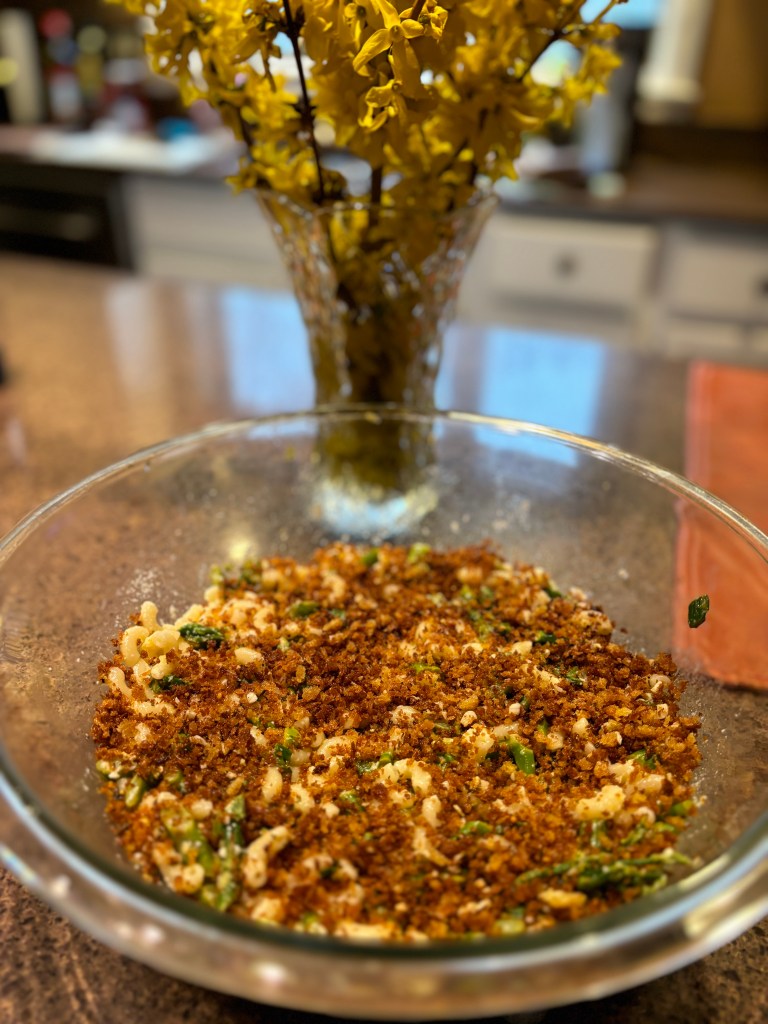
I tried this NYT Cooking recipe for “Lemony Orzo with Asparagus and Garlic Bread Crumbs” a couple of weeks ago. (I’ve actually made it twice now.) It first caught my eye on Instagram. It’s meatless, tasty and light. It could be a nice side dish, but we had it as the main course. Two thumbs up!
I didn’t have any orzo, so I substituted another small pasta (elbows). I had no fresh mint, parsley or dill, so I used basil.
This prompt took me straight to FOOD. Maybe it’s because I just listened to “I’m Glad My Mom Died” by Jennette McCurdy—the bestselling memoir about a child star with an abusive mother and a really major eating disorder.
Having it all can mean the entire pint of ice cream, the whole row of Oreos, the full bag of chips. And yes, sadly, it is attainable.
Not to make light of eating disorders, but do my fellow GenXers remember those ubiquitous Alka-Seltzer ads? Before the famous “plop, plop, fizz, fizz” jingle, there was this guy (and his long-suffering wife) saying “I can’t believe I ate the whole thing.”
To this day, I don’t think I’ve ever taken an Alka-Seltzer. They say it’s for “upset stomach and headache,” which sounds like code for a hangover. Did Madison Avenue intend for adults to read between the lines? Have you ever taken an Alka-Seltzer? And if so, was it because you were hung?
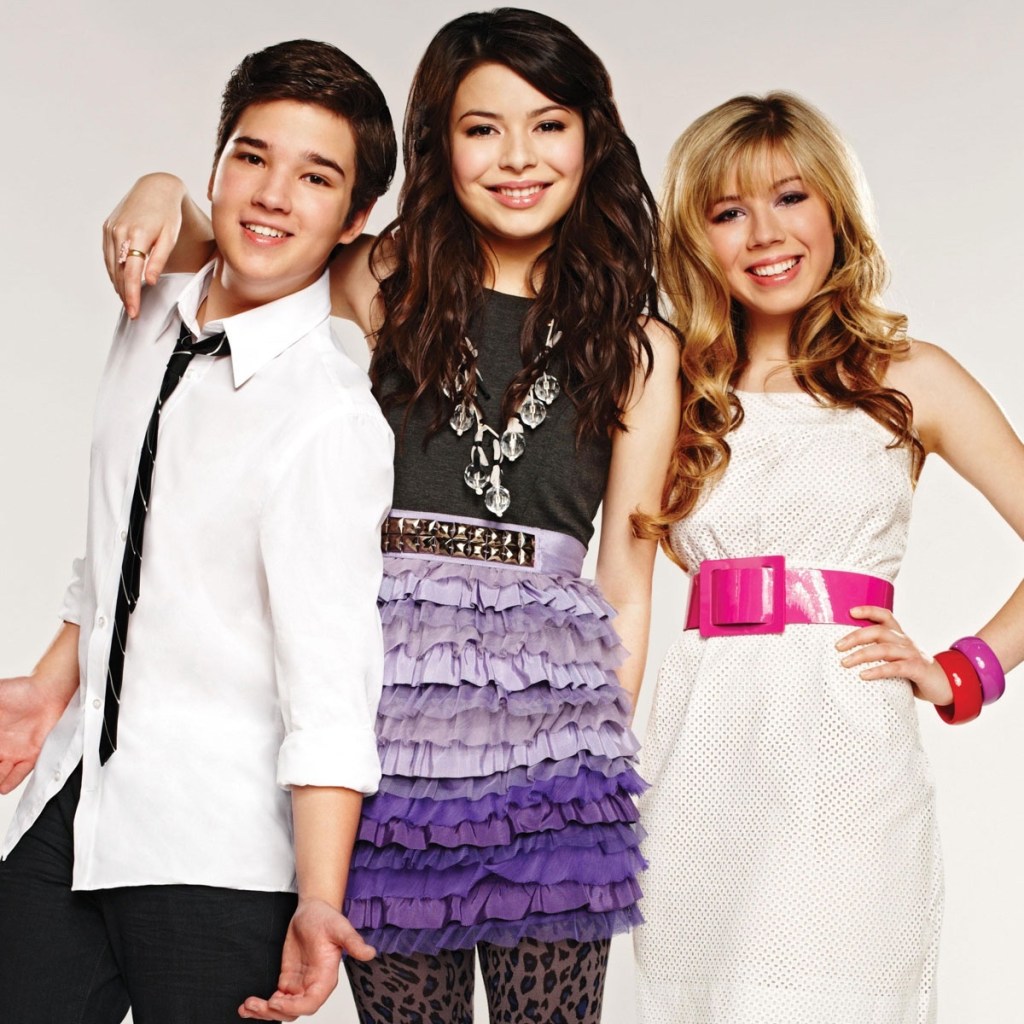
Jennette McCurdy (right) and her iCarly co-stars. Her award-winning memoir “I’m Glad My Mom Died” has sold over 2 million copies and been translated into ten foreign languages.
I guess the thing I can’t live without is my house. I mean, I could, but it would be tough.
People, of course, matter more than anything else and are irreplaceable.
I feel badly that home ownership seems to be out of reach for so many people—especially in Massachusetts. I love my state, but the lack of affordable housing is a major problem.
Our first house looked a bit “overgrown” when we drove by a few years ago.
My husband and I had very lucky timing. We bought our first house in 1995 when our daughter was 6 months old for 155K. It was an antique house with lead paint, no garage, a leaky fieldstone basement, a horrible old kitchen over a crawl space and 1.5 bathrooms. We sold it 9 years later, in 2004, for 385K with some moderate updates (including the kitchen). It went up 148.5% in 9 years!
It was just plain luck. If we’d waited 5 years, it would’ve been mid-housing crisis and things would not have worked out so well.
As a kid, I had numerous collections—shells, rocks, stamps, glass animals, and dolls…lots of dolls.
I’ve purged the attic of all my old collections (I think), including my vinyl record albums. (That one was sad, but they were warped and I don’t own a turntable anymore.)
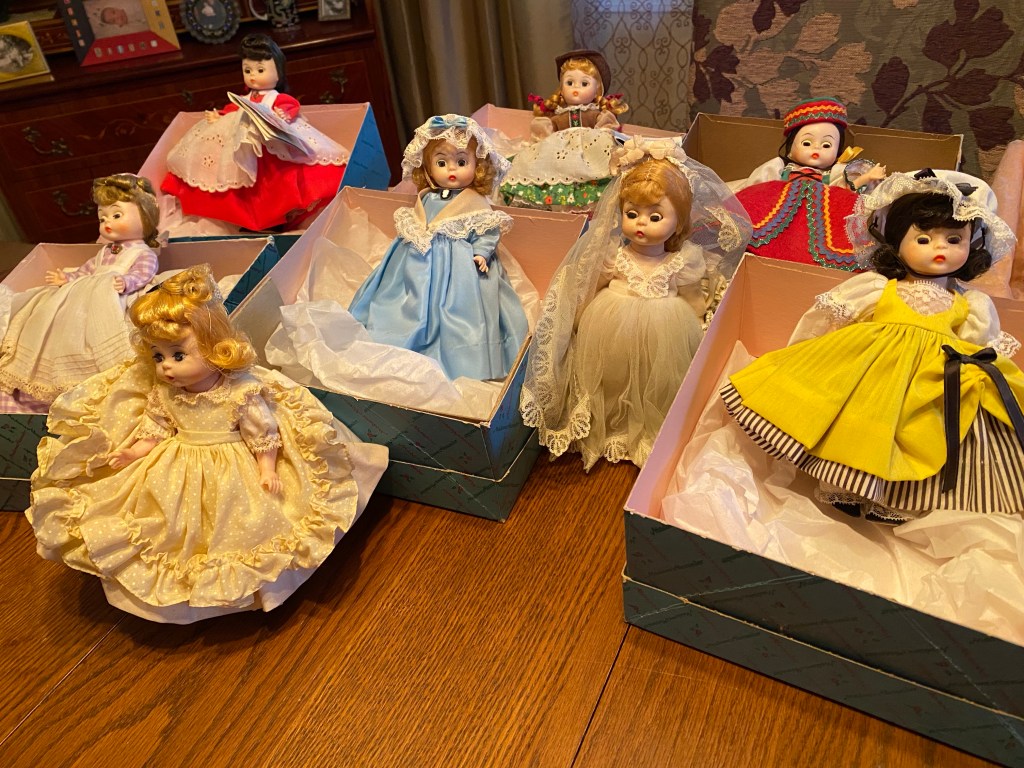
The last collection to go was the dolls. I had a few specialty dolls, along with a large collection of Madame Alexander dolls, which were very popular gifts for girls in the 70s. I loved their pretty costumes representing the nations of the world. These weren’t dolls you played with (like Barbie), they were meant to be displayed and admired. They lived on a shelf in my room. Of course, I did play with them sometimes, but I felt badly for doing so. Thinking back, I already felt enough pressure to be perfect and not commit “sins” (as defined by the Catholic Church), so I really didn’t need those dolls tempting me too!
In the end, they were basically worthless. Even though they were in good shape (with their original boxes), a doll dealer gave me less than $50 for the whole lot. I should have played with them all along.
They sat on the dining room table for about a week, creeping out my husband, before I sold them.
The child bride doll (talk about creepy!) was the one I played with the most.
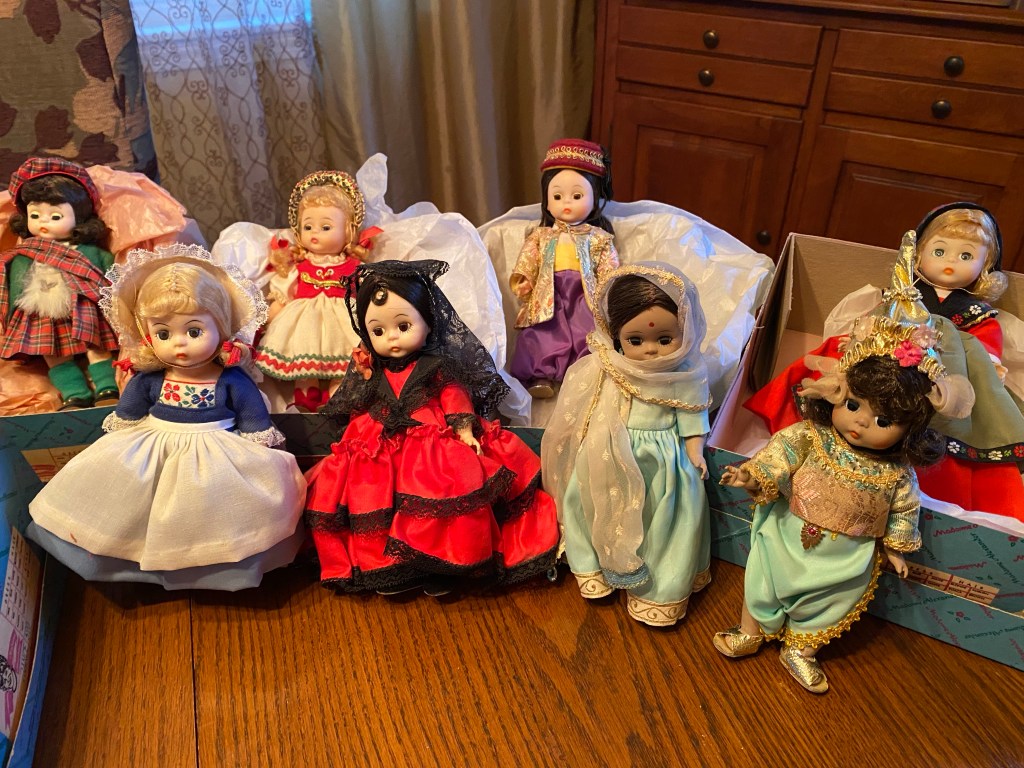
I’m pretty sure some of these costumes would be considered stereotypical or even racist now. You can’t see them in the photo, but the Dutch girl had real wooden clogs. And the Scottish girl had bright green eyes like emeralds. Spain was cool with her black veil. The Indian doll had a red dot on her forehead.
The question of legacy always reminds me of the song “Everything Possible” by Fred Small. I knew Fred when he was my minister in the early 2000s. I heard him perform this lullaby on several occasions and each time it made me cry.
It was especially meaningful during the battle for marriage equality in Massachusetts. We were the very first state to legalize same-sex marriage in 2004 (20 years ago), but it was a protracted legal and legislative fight. Though it had been written in 1983, “Everything Possible” struck a chord during that time. In our church, Fred took a stand and stopped performing all marriages, until marriage was legal for same-sex couples too. The song became a highly emotional signature anthem for the Boston Gay Men’s Chorus.
Recently, Fred tweaked the lyrics to be more inclusive of non-binary people and created a children’s book to accompany the song and further spread the message of love and acceptance.
The chorus is the most beautiful part.
You can be anybody you want to be, You can love whomever you will You can travel any country where your heart leads And know that I will love you still You can live by yourself, you can gather friends around, You can choose one special one And the only measure of your words and your deeds Will be the love you leave behind when you’re done.
Here’s a beautiful live performance of the song by the Boston Gay Men’s Chorus.
And here’s Fred himself singing the new version of “Everything Possible.”
I’ll definitely be buying this book for my granddaughter, when she’s old enough.
I’d like to be remembered for the love I leave behind when I’m done.
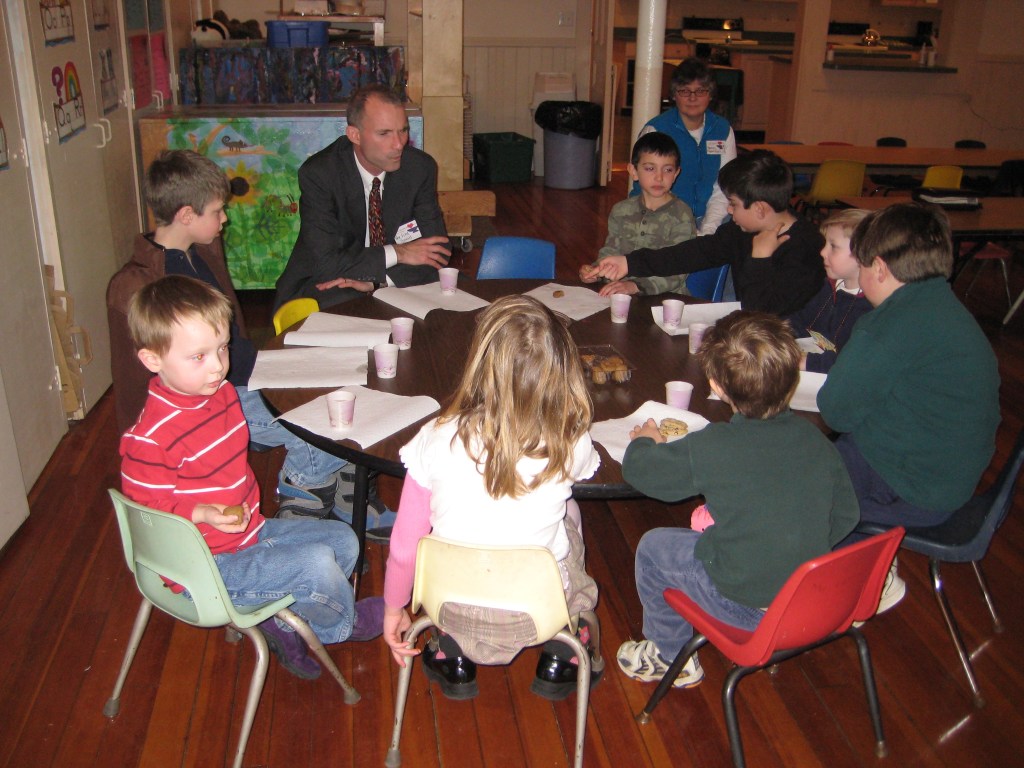
Rev. Fred Small having a chat with a group of children in my church around 2004—the year when marriage equality became law in Massachusetts
I don’t like cold weather. I especially dislike snow. We have so many places in the Northeast that are spectacularly beautiful—in the summer. The Finger Lakes region (aka the Southern Tier) of upstate New York is one of them.
This area is a very long drive from Boston (about 6 hours), so I made this weekend’s graduation trip to Ithaca a “bucket list” sort of trip. I have enjoyed my many visits up here, but I doubt I’ll be back again.
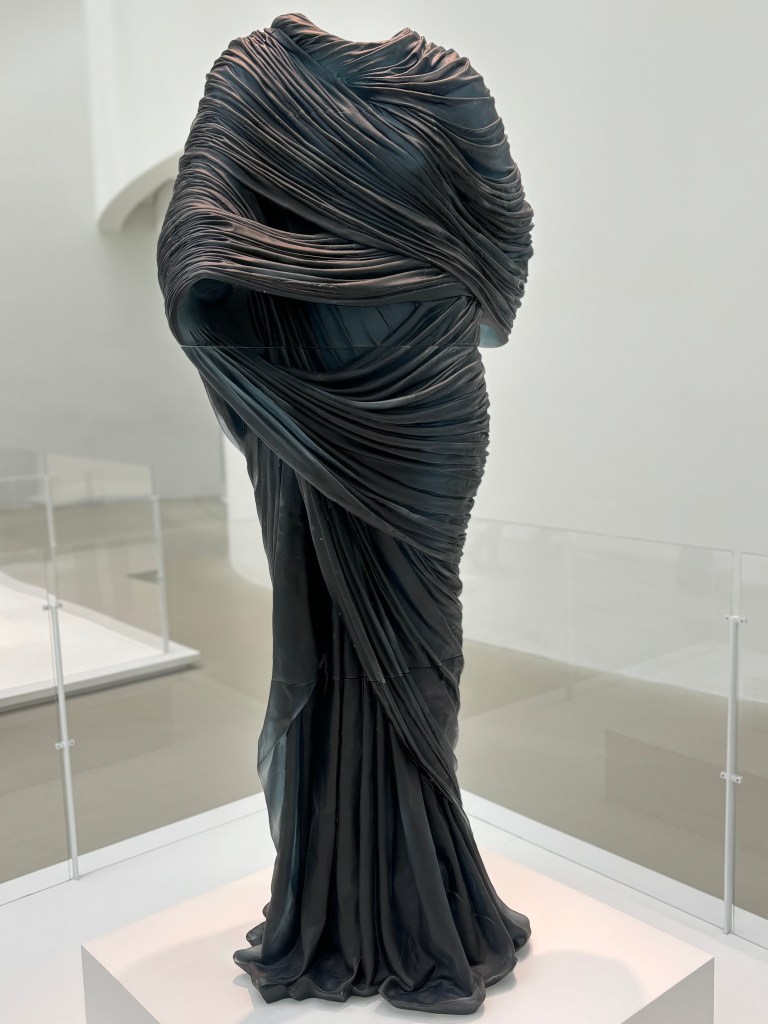
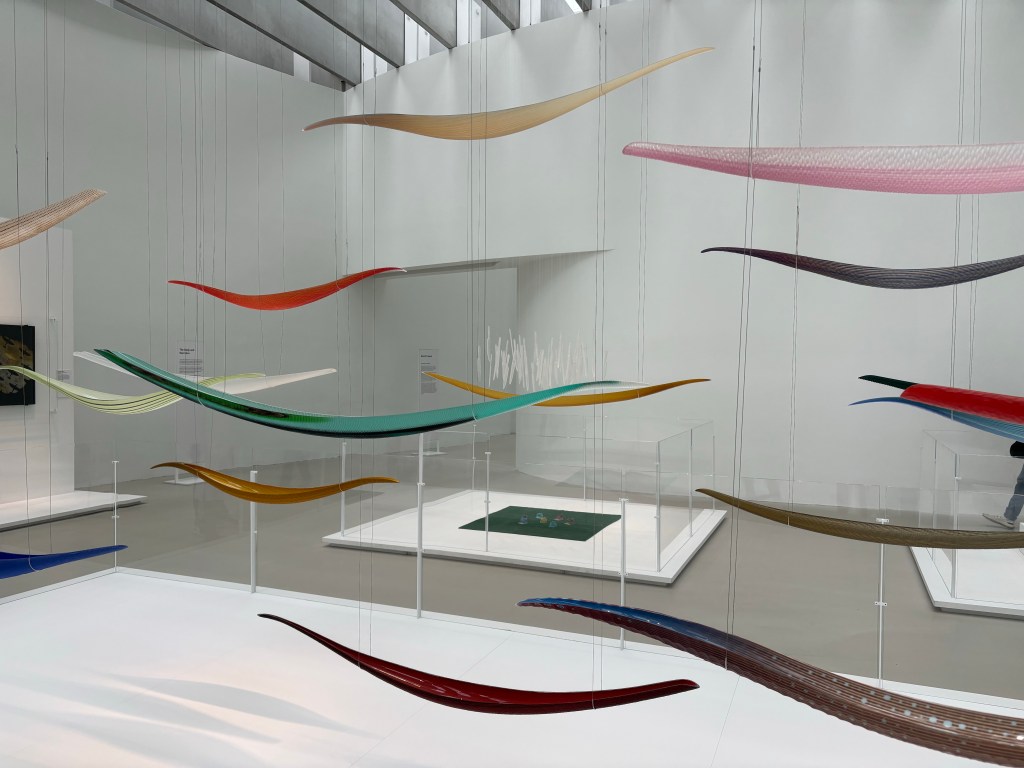
Stunning glass sculpture at the Corning Museum of Glass in Corning, NY
Corning Museum of Glass
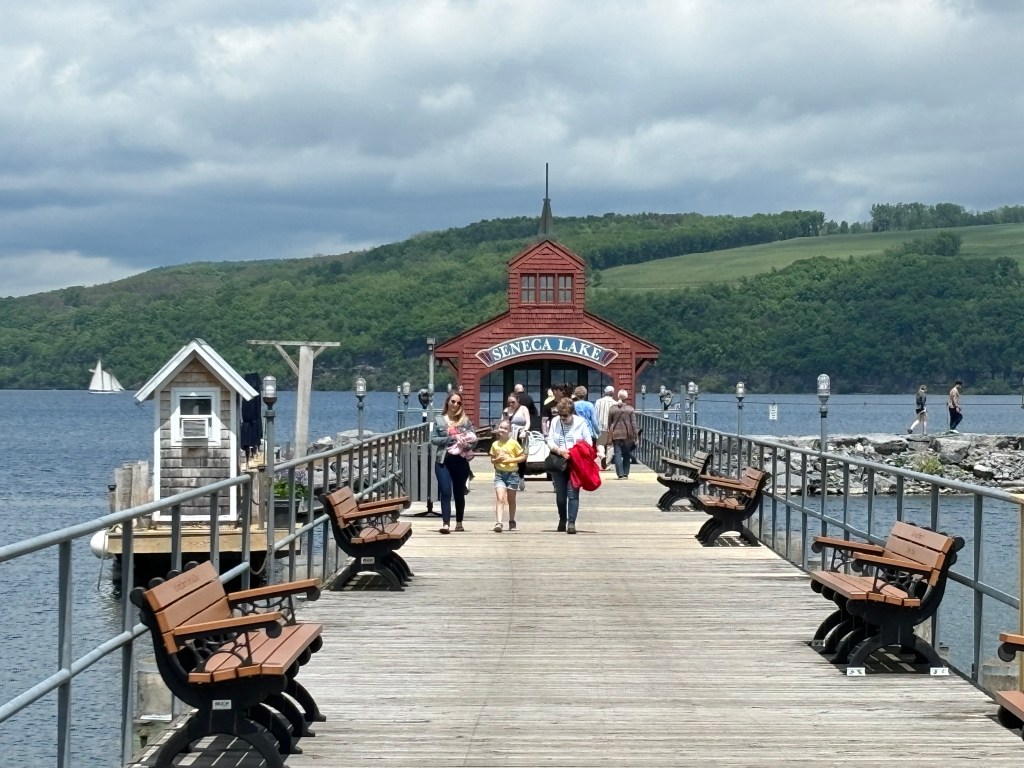
The city of Ithaca, NY is on Lake Cayuga and I’ve seen it many times. This trip, I wanted to see the next Finger Lake over—Lake Seneca. It is equally beautiful and has the cute town of Watkins Glen at the bottom.
The harbor area in Watkins Glen on Lake Seneca
Watkins Glen is also home to one of New York’s most beautiful state parks.
Watkins Glen State Park
There are many wineries in the area, but I had never been to a cidery, so we stopped at South Hill Cider after graduation for a glass of hard cider and a charcuterie board. Lovely spot and their dry, sparkling Baldwin cider was great. I bought a bottle to take home.
The view at South Hill Cider in Ithaca, NY
There’s an expression you may have heard—Ithaca is Gorges. Its deep gorges and their accompanying waterfalls are truly gorgeous, and there are dozens of them all over the region. I had seen the showstopper—Taughannock Falls—on a previous trip, but wanted to check out a couple of others before we left.
![A logo for "50 Happens," [a site dedicated to Gen X women with children and grandchildren] [who embrace life's challenges with humor and resilience], [featuring a modern and uplifting design] [that embodies strength and positivity] [with an elegant and playful style] [and a harmonious blend of colors like pink, fuchsia, purple, and blue].](https://50happens.blog/wp-content/uploads/2024/12/img-5uorrxvwartomopcpuhjfjd0.png?w=300)




















 50 Happens