Supporting Susan

We have a woman in our church choir with dementia or Alzheimer’s (not sure of her official diagnosis). She has a lovely singing voice. In fact, she was a music teacher at one point.

But Susan (not her real name) is getting worse. She has an extremely difficult time keeping track of her sheet music and the folder it lives in. Last Sunday, as we began to warm-up before the congregation arrived, she turned to me and said, “I have no idea why I’m standing here, but I was a music teacher once.” She gets upset when she doesn’t know what’s going on. She’s never caused a scene or melted down, but her anxiety is a real issue. She needs constant reassurance. And she can get snippy with people who are trying to help her.

Her partner Jim is a nice man who has already lost both of his adult daughters to diseases. He’s doing his best, but this has got to be really tough on him.

The plan now is to make a formal schedule whereby her fellow sopranos will take turns supporting her each week, so that nobody gets stuck doing it all the time. It’s going to mean showing up early, sitting with her, making sure she has music, reassuring her throughout the rehearsal and performance, and then making sure she gets back to Jim.

To be perfectly honest, I’m not looking forward to it. I never knew this woman before she had dementia. She’s not a family member of mine. I have no special fondness for her.

But clearly, I need to step up. That’s the whole point of church, especially Unitarian Universalist churches, where belief in God is optional. “Community” is the goal. I know that if I get dementia (or cancer or anything else), these people will support me. They are GOOD PEOPLE. Most are better than me. (I’m not just saying that. They really are.)

Here’s something Susan said to me in one of her sweeter moments: “I have a trick for when I don’t know what’s going on. I smile more.”

I’m going to try to remember that. Smile more. If she’s annoying me with her inability to follow along and constant questions, I’ll smile at her. She has a lovely smile. And so do I.
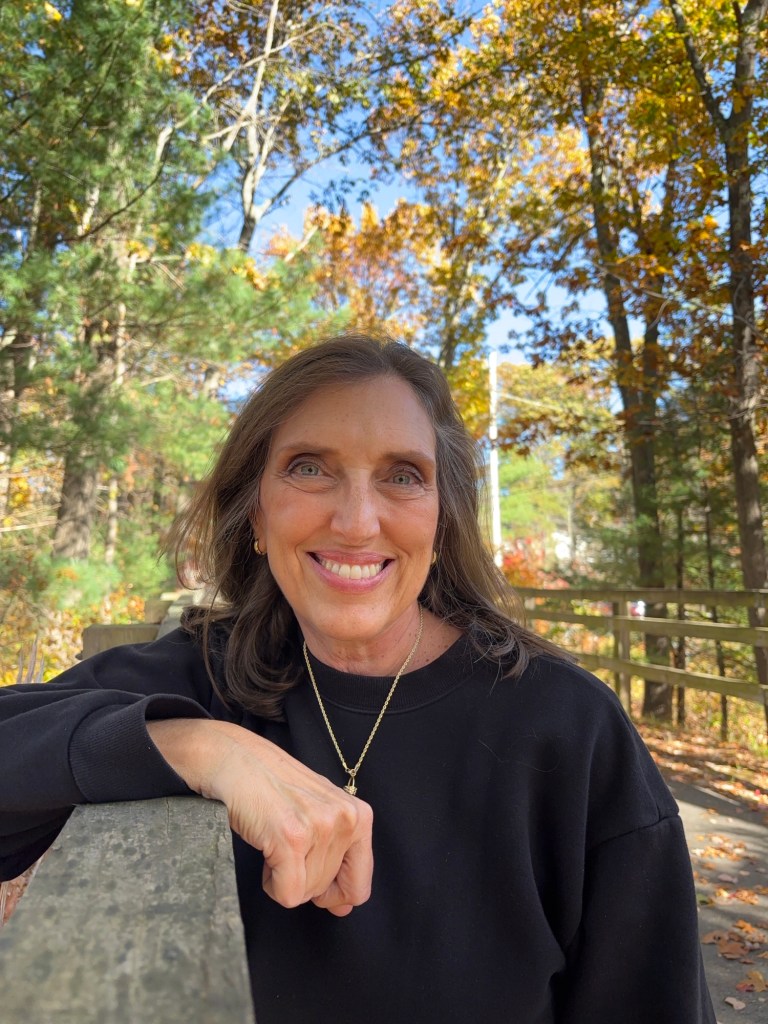
Selfie on the rail trail. I was trying to get a pic for a self-portrait for painting class.
Our rail trail yesterday

Smiling in annoying or uncomfortable situations might not help. But it can’t hurt. I think this might be a uniquely American thing.

The Choir Teachers

Daily writing prompt
Who was your most influential teacher? Why?

That was nice when Billie Eilish thanked her choir teachers at the Oscars when she won Best Song for “What was I Made For” from Barbie.

I had great choir teachers all through junior high and high school. Ms. Glinka was 7th grade. It was 1978 and she was my first-ever “Ms.” It took some getting used to (to call a teacher MIZZ, when we’d only ever had a Miss or Missus). Ms. Glinka was a cool, modern woman who wore dangly earrings. Her main influence on me was that she loved The Beatles and taught us their music. I specifically remember singing When I’m Sixty-Four and Ob-La-Di Ob-La-Da in her class. Whoever introduces you to The Beatles shall never be forgotten. Am I right? Thanks Ms. Glinka. You rocked.

8th grade was Mrs. Nolan. She was married to Mr. Nolan, who also taught at the school. Mrs. Nolan was a bit more traditional than Ms. Glinka, but also great. She liked Irish/Celtic music. She taught us All Around My Hat by Steeleye Span, which I loved singing. I still sing it to this day and attempted to teach it to my kids.

Finally, in high school, we had Mr. Phinney. He was a legend in my town. A tall, demanding, sexist, old-school choirmaster, Mr. Phinney presided over the music wing of the school with his equally-powerful counterpart—the Band Director, Mr. Toland. As a majorette (baton twirler) for the marching band, I worked with Mr. Toland as well. If they liked you, you were all set. Fortunately, they liked me, so I had a TON of fun performing in high school ensembles, musical productions, and twirling my baton with the marching band. My best friends came from those circles, two of whom are still close friends of mine.

Mr. Phinney was a bit of a tyrant, but we learned a lot about musicianship from him. I’m surprised our yearbook advisor let that “quote” be printed on his photo.

Although I did not became a professional musician, music is an important part of my life, especially singing with others.

Thank you to my public school music teachers.

High school choir yearbook photo

Related post:

Music sets Christmas apart

Grant Us Peace

I hope you enjoy this recording that my choir made in 2021 during the pandemic lockdown. We each recorded ourselves singing alone at home and then sent the files to our choir director. She mixed them together using some sort of software and it really sounds quite good, especially considering she’d never done anything like this before. It was also very meaningful to the choir, and to the congregation, to hear our voices blended again after being separated for so long. Many were struggling with loneliness and isolation.

The text “Dona nobis pacem” means “Grant us peace.” The melody has been passed orally, although it is sometimes attributed to Mozart. English-language hymnals usually mark it “Traditional.” It is sung as a round, so you can sing any of the three parts at any time. You’ll never be wrong.

Beyond use at church, the round has been sung around the world in secular settings as a prayer for peace.

Here’s the music. Sing with us.

Merry Christmas.

Peace on Earth.