With increasingly unhinged far right authoritarians running the show here in the US, it’s hard to stay calm. Due to the Kirk assassination, many people will no longer be able to speak their minds due to promised retaliation by the government. And I don’t just mean talk show hosts and journalists. Teachers, doctors, university leaders, nonprofit administrators and regular old corporate employees are losing their jobs over what they say.
Here’s Commander Waterford and Commander Putnam lying about left-leaning organizations promoting violence and telling us their grand plan for Gilead.
Therefore, if you are able, I recommend escaping to the great outdoors or, if it’s raining, the great indoors—a big-ass movie theater with reclining seats, Dolby Atmos sound, and a bar.
I thoroughly enjoyed the sold-out premiere of Downton Abbey: The Grand Finale. If you ever loved the show, you won’t want to miss the final installment set in 1930. Downton looks amazing on the big screen and your old favorite characters all make appearances, even the deceased ones. Not to give too much away, but acceptance of divorced women and gay people into polite society is a major theme.
You will be reminded that time marches on and progress has—and always will be—a matter of more inclusion, rather than less.
My husband and I tried to remember the last time we’d seen a gruesome assassination of a public figure. We couldn’t think of anything. We were too young to have seen JFK’s mortal head wound (when his brains went spattering across Jackie’s suit). And when John Lennon got shot, there was no video. Melissa Hortman, the Minnesota legislator assassinated in June, and her husband were not nationally known and again, there was no video.
So, this Charlie Kirk assassination is fairly shocking to me. I watched the close-up video and wow…a total kill shot. His whole upper body shook, and blood came spurting out of his neck as he went limp with the microphone in his hand. Absolutely horrific.
Even though we see it in movies and on TV all the time, real murder and gun violence is scarring to see at close range, even in a video.
Check-out Lydia’s post for a clearer understanding of Mr. Kirk’s views on gun violence and policy in the United States.
As I’ve already mentioned, I’m 💯% Team Rosie so I watched her interview on 60 Minutes Australia with great interest.
I did not love the guy who interviewed her. He seemed smug. (And what the heck is a “jelly” in Australia. Was that some sort of an insult in his opening? Maybe Brizzy May can explain.)
I thought Rosie did pretty well under the circumstances. She still managed to be funny and light in a very serious situation. She’s basically a United States artist and citizen living in exile due to fear of retribution from the President of the United States. It’s so fucked up.
The CVS app said that the newly updated Covid vaccine is available so I decided to get one while I can (before the brain worm host sends us back to the 1940s).
I easily booked an appointment to get both the new Covid vaccine and the updated flu shot at my local Massachusetts CVS. Since I’m under 65, I had to choose a “condition” to qualify for the Covid vaccine of which many were listed including mood disorders and having a BMI over 25. I chose “current or former smoker” which is true, but nobody asked for any proof of that.
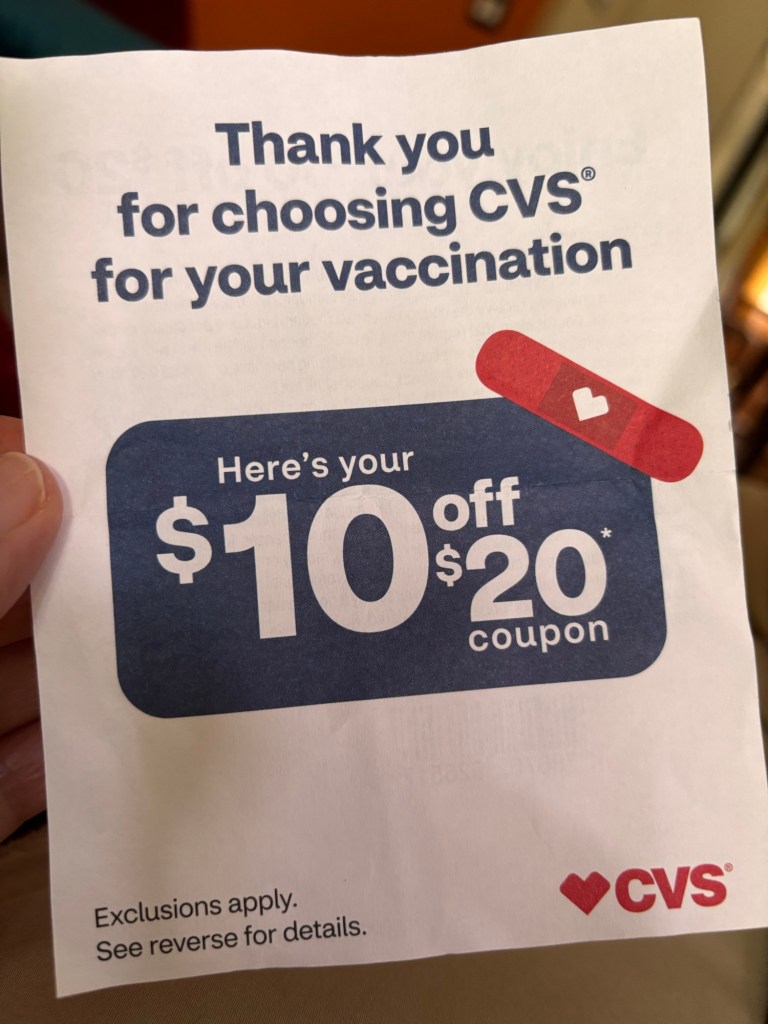
Nobody asked me for my insurance card or charged me any money. I got one jab in each arm and a 50% off coupon. I bought some moisturizer that’s supposed to make me look younger with the coupon.
Happy Thursday! I’ve just learned of Dan’s Thursday Doors through Ritva’s post and I like it! Who doesn’t love an interesting door?
Here’s my understanding of the parameters:
Thursday Doors is a weekly feature allowing door lovers to come together to admire and share their favorite door photos from around the world. Anyone may join the fun by creating their own Thursday Doors post and then sharing the link in the comments on Dan’s site, anytime between Thursday morning and Saturday noon (North American Eastern Time).
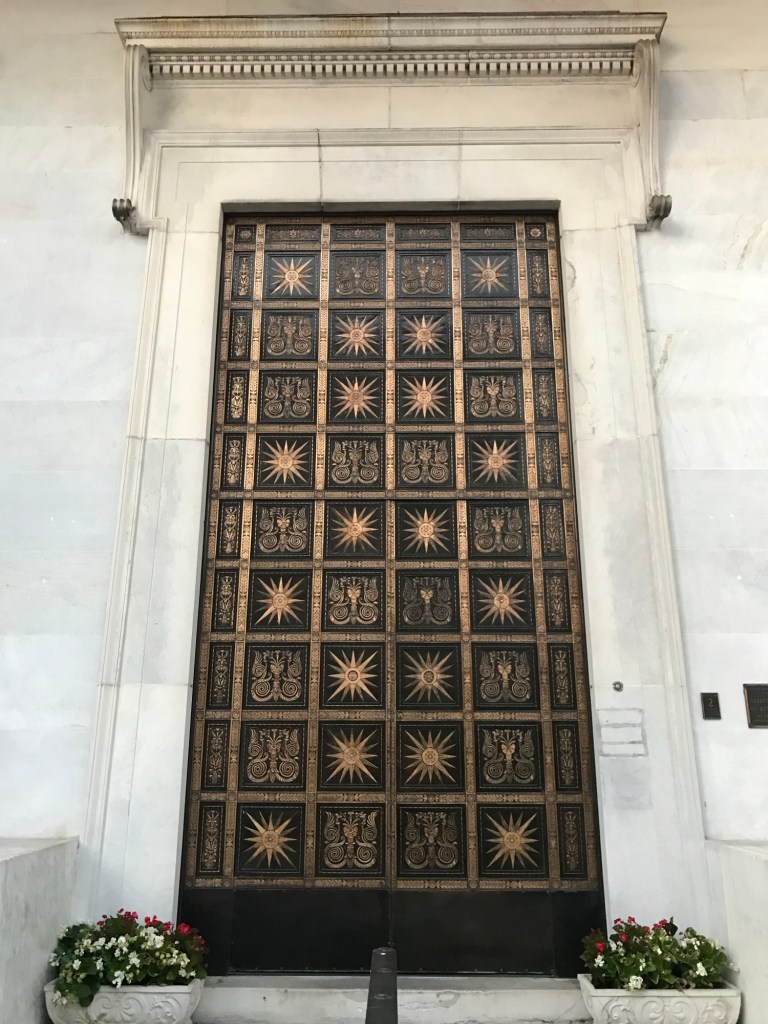
The mammoth bronze doors of the historic Bank of Chester County (now a Wells Fargo) in downtown West Chester, Pennsylvania. The Greek Revival building was completed in 1836 and is in the National Register of Historic Places.
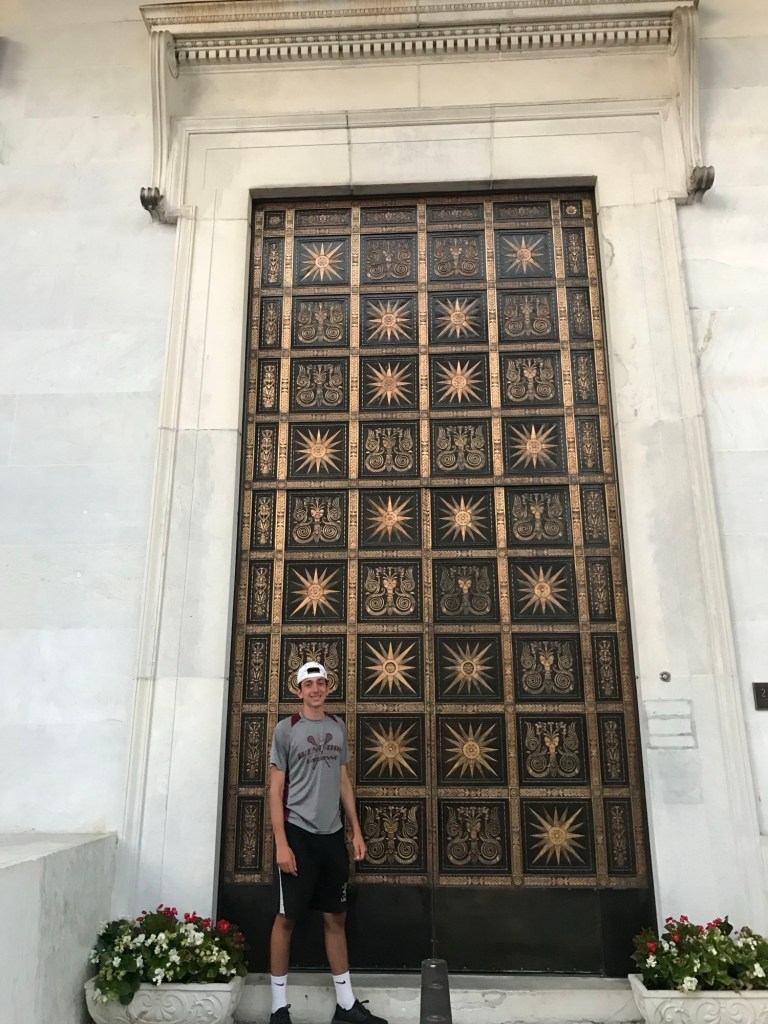
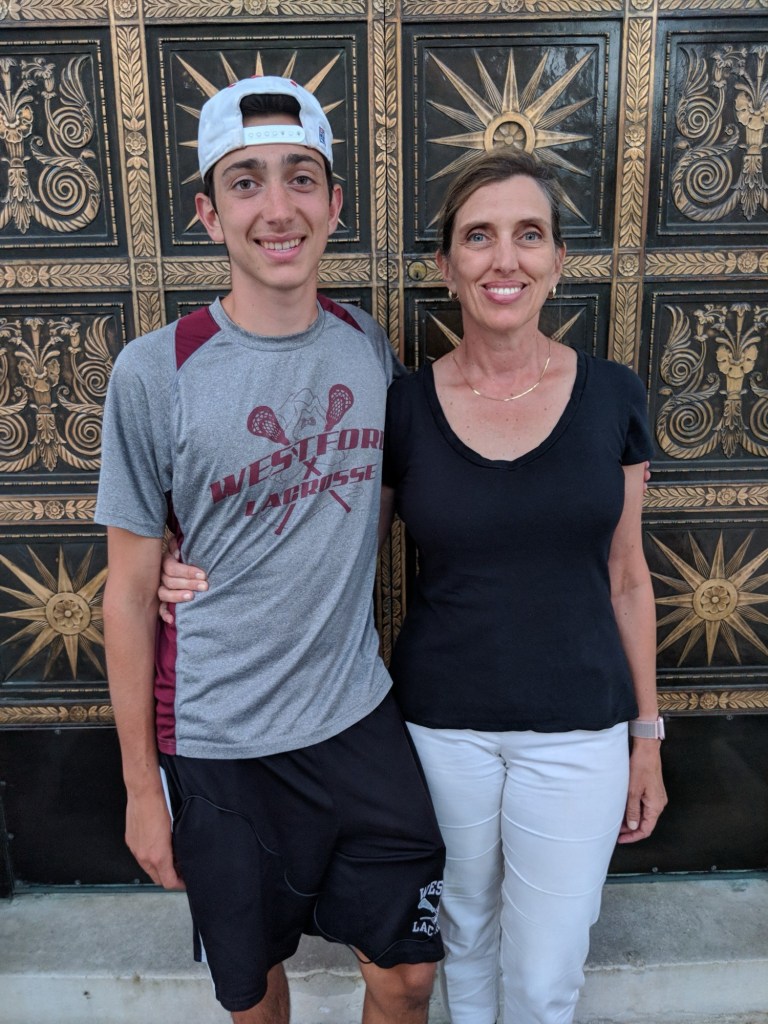
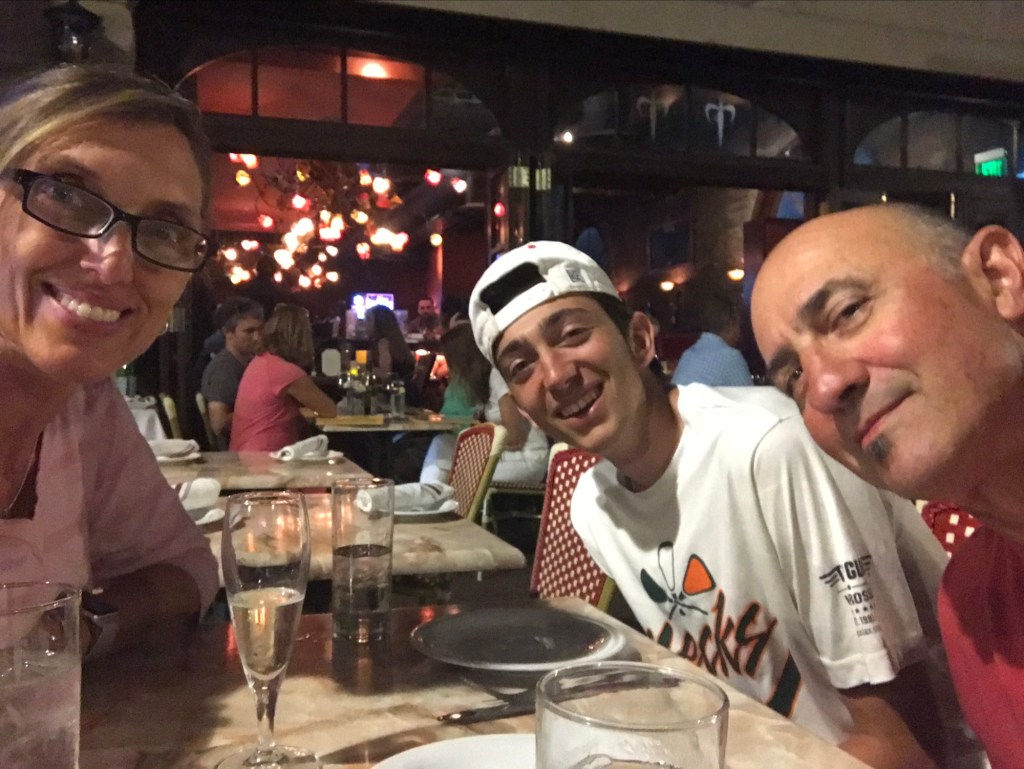
Clearly I was captivated by these doors as I took multiple pictures of them when we were visiting West Chester for a lacrosse tournament in July 2018.
Here’s my son in front of the doors for scale:
I think I really liked the decorative swirls and starbursts in the individual panels and the fact that they’re non-biblical. It’s not a church nor was it ever. In comparison to Europe (and its endless ornate doors), the United States was founded as a secular country. I tend to be drawn to beautiful evidence of that.
Also, I’m reminded that downtown West Chester, Pennsylvania is fun. Or at least it was in 2018. I hope it bounced back after the pandemic.
Outdoor dining in downtown West Chester, Pennsylvania (USA 🇺🇸)
If you’re GenX like me, about half your life was captured on film only (if at all). Digital cameras were not a thing when we were kids. If you were the third or fourth kid in the family, there may be very few photos of you as a child. This is not the case with me. I am the oldest and my parents were diligent. There are a lot of pics of me as a kid. Later on, I liked taking photos and even took a photography class or two.
Therefore, I’ve got a huge closet full of photo albums, boxes of loose photos, and a folder of black and white negatives in my basement, most of which have not been digitized. These include photos from throughout my life from 1965 through the birth of my second child in 2000. (After that, we went digital.) The photo albums are pretty easy to leaf through as they mostly have the correct year on the spine. And the boxes aren’t too bad because they’re pretty small. Until this weekend, I had ignored the big folder of negatives.
Welp, I finally decided to have a look and it turns out that the negatives are almost entirely from the year 1989–the year I took a photography class at the Museum of Fine Arts School in Boston. There are apps now for scanning negatives with your phone. I used one called FilmBox. It worked OK. There were a few surprises in those negatives. Things I had completely forgotten or only vaguely remembered were jolted back into my mind through the tiny black and white images.
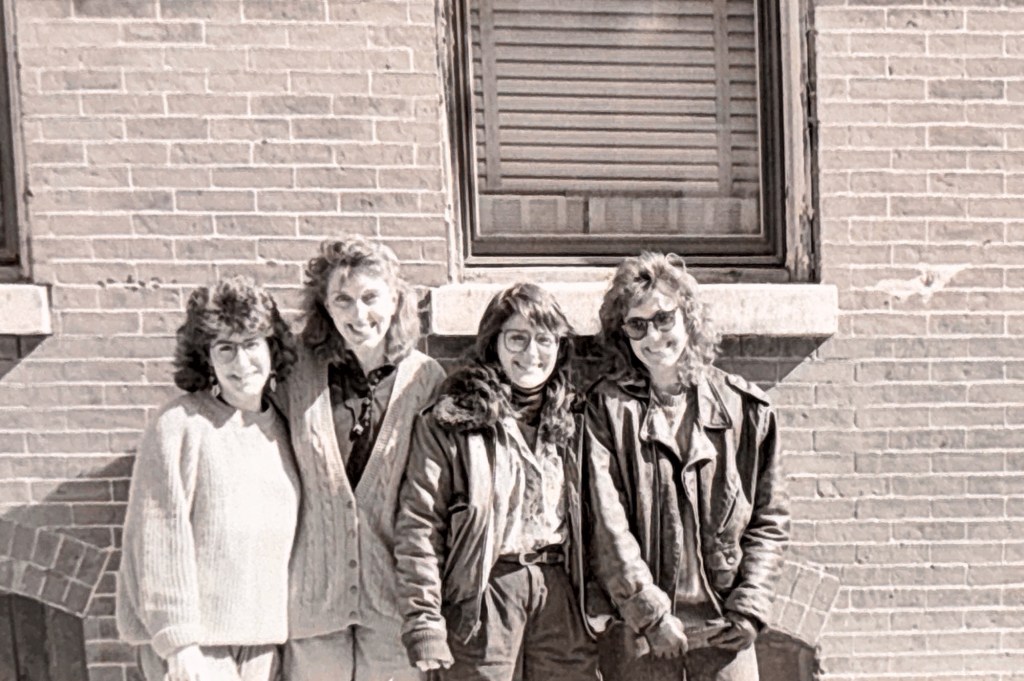
My three best friends from college and me in Boston’s North End. This was about 18 months after we graduated. I had forgotten that we briefly all lived in the same city.
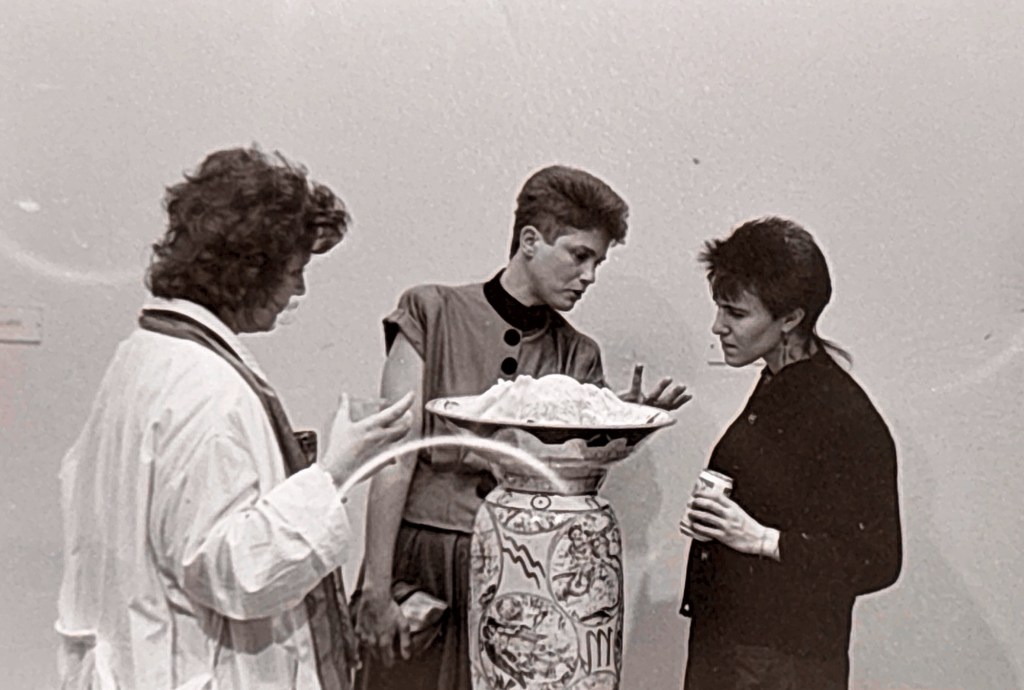
This was an art exhibition opening at the museum where I got my first job: The Institute of Contemporary Art. I had forgotten about those openings and the cheap white wine we always served at them. I typically invited my friends who lived in Boston.
The woman on the right, Teil, was my second boss at the museum. She taught me so much and was such a wonderful person. I think this is the only picture I have of Teil. It’s appropriate that she has a plastic cup of that cheap white wine in her hand.
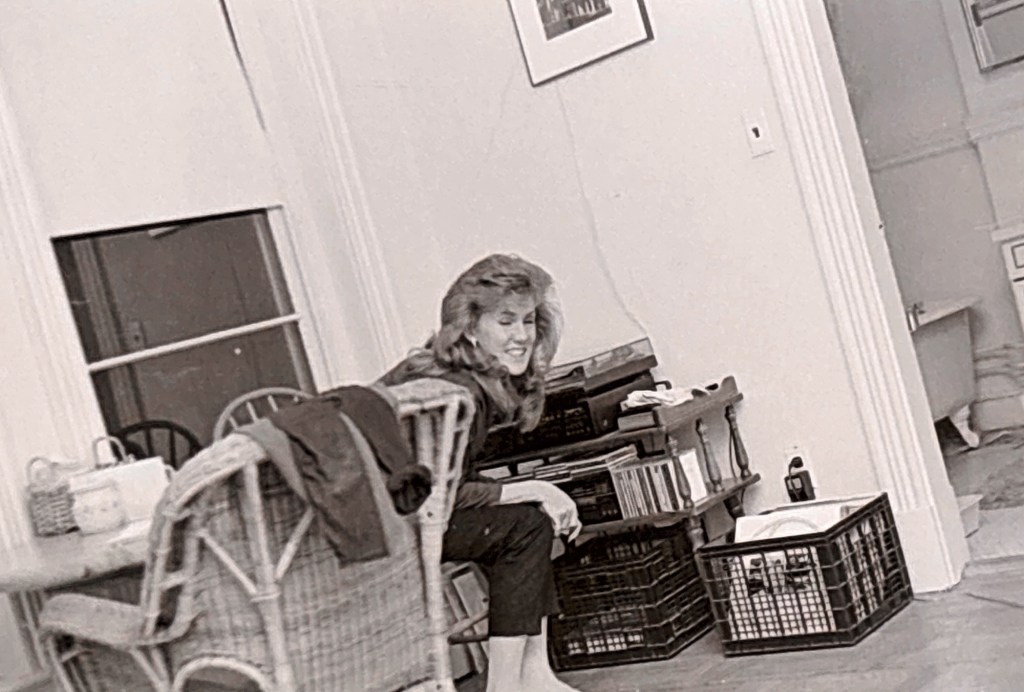
I had forgotten that my 80s friend Debbie came to visit me in my first studio apartment in the Fenway. Seeing her in front of my turntable, CDs and record albums (in milk crates) reminded me of how people used to look through each others music collections as a way of sort of figuring out what they were like. At that point, I think our musical tastes were diverging, but we both liked Prince.
In that same studio apartment, I had forgotten that my very bad cat Kimba was SO bad that I had to keep the bathroom trashcan above the mirror or he’d spread it all around the apartment. He was very cute, but a real pain in the neck.
I definitely remember going to the massive March on DC for abortion rights in April 1989, but had forgotten I went with two friends from work—Ann and Bridget. Later that year, Bridget and I became roommates in the North End.
Another commonly held belief seems to be that older generations are somehow tougher than younger ones. That life was harder for them and people have gotten progressively more comfortable.
I beg to differ.
Although the tremendous sacrifices and bravery of the so-called “Greatest Generation” can never be overestimated (they literally risked everything to defeat the Nazis), I would argue that non-marginalized groups in the following generation (my parents cohort) have had it pretty good. Many went from lower class (aka poor) to highly comfortable and secure in a single lifetime. And although we benefited from our parents’ prosperity, the following generation (mine) has had it harder in many ways. And our kids are going to have it even harder.
Not to be a Debbie Downer, but there are reasons the birthrate is historically low in 2025. We all know millennials who are choosing not to have children (or GenXers & Boomers who are sad that they will never be grandparents).
I asked ChatGPT to compare the lives of someone born in the mid 1930s, mid 1960s, and mid 1990s.
Facts:
1. Income & Jobs
Born mid-1930s (entered workforce ~1950s): Median household income in 1955: ~$5,000 (≈ $58,000 in today’s dollars). A single income (often the father’s) could support a family, home, and college savings. Job security was higher; pensions were common. Born mid-1960s (entered workforce ~1980s): Median household income in 1985: ~$23,600 (≈ $66,000 today). Both parents often worked, butwages grew more slowly compared to the cost of living. 401(k)s replaced pensions, shifting retirement risk to individuals. Born mid-1990s (entered workforce ~2015–2020): Median household income in 2019: ~$68,700. In real terms, wages for young workers have stagnated since the 1970s, while housing, education, and healthcare rose sharply. Gig economy and contract jobs more common, less stability/benefits.
2. Cost of College (Public University, In-State Tuition)
1930scohort (college in 1950s): $200/year tuition ($2,400 today). College was affordable even with part-time work; no significant debt. 1960scohort (college in 1980s): $1,500/year tuition ($4,000–$5,000 today). Still affordable with summer jobs; modest debt possible. 1990scohort (college in 2010s): ~$10,000/year tuition (public); $35,000–$50,000/year (private). Widespread reliance on loans; average borrower debt: $30,000+.
3. Healthcare Costs
1930s cohort: Out-of-pocket affordable; many employers covered full family insurance. Doctor visits and hospital stays far cheaper relative to income. 1960s cohort: Insurance became tied to employment. Costs rose, but still manageable. Deductibles/co-pays introduced. 1990s cohort: Healthcare costs skyrocketed (family premiums ~$24,000/year by 2025, often split with employer). Medical debt is a leading cause of bankruptcy.
4. Cost of Raising a Child (to age 18, middle-class family), not including college
1930s cohort (raising kids in 1960s): ~$25,000 total (≈ $240,000 today). 1960s cohort (raising kids in 1990s): ~$150,000 (≈ $280,000 today). 1990s cohort (raising kids in 2020s): ~$310,000. Housing, childcare, healthcare, and college costs exploded. Childcare alone can rival college tuition.
5. Retirement
1930s cohort: Retired with pensions, Social Security, mortgage-free home. Comfortable retirement was realistic for average workers. 1960s cohort: Retirement savings depended on 401(k)s and IRAs; investment risk shifted to individuals. Some still had pensions, but they were fading. 1990s cohort: Retirement is much more uncertain. Pensions rare; Social Security’s future questioned. Rising housing and healthcare costs make saving harder. Many expect to work past 65.
A final note: When my friend Carla was dying in 2022 at age 57 from brain cancer, she commented that at least she wasn’t going to have to worry about paying bills anymore. She felt that one upside of an early death would be a release from financial concerns. Carla had an advanced degree in nursing and worked (very hard) as a hospice medical director. She was married with two adult children that she’d been able to send to college.
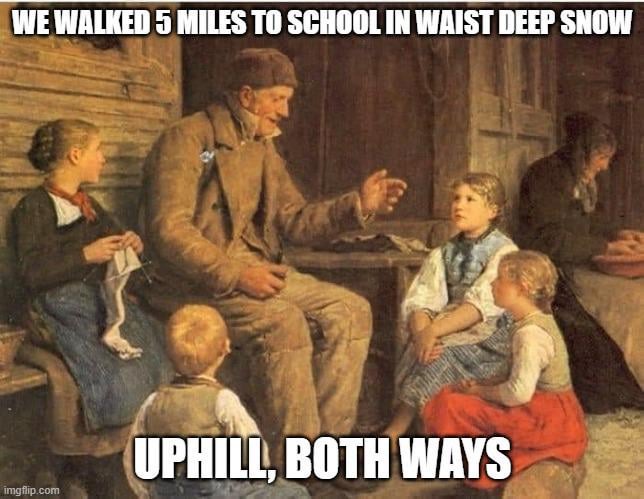
And I’m sure she walked to school in the snow plenty of times.
There seems to be a commonly held belief that people are basically good. That despite all the problems in the world, humans are decent. People seem to attribute this to the fact that we “all want the same things” (peace, safety, etc.) Two friends of mine (a well-off white couple in their 70s) travel the country more than half of each year in their deluxe RV. They go everywhere—red states, blue states, purple states, Canada. (Come to think of it, they never seem to cross over into Mexico.) Anyway, when they get back, they always gush about how wonderful people are.
I must say—lately, I’m really questioning this whole idea.
The obvious example is war. All war, but Gaza in particular. I mean—holy shit. How are we allowing that to go on? Not just allowing it—enabling it. Ten-year old boys getting shot, while trying to bring a bit of food back to their starving families. The terrorism that started that particular war on October 7, 2023 included children getting murdered. And not by bombs. Individual human adults consciously murdered individual human children that day, including at least one 10-month old baby.
But back to America.
The level of depravity in the man who currently occupies the White House is well-documented. His words are so objectionable to me that I typically don’t read them directly. But I hear about them and they always make me think about the amount of “overlooking” millions of Americans had to do to allow him to become our highest leader—twice. Would a country that’s filled with “basically good” people do that?
Just one of endless examples of his cruelty—very often directed at women and people of color
And because nothing else has worked, Governor Gavin Newsom of California is imitating Trump’s cruel, egomaniacal writing style in an effort to try to fight back against Trumpism. Even the most profoundly “decent” leader of my lifetime, Barack Obama, says that what Newsom is trying to do is justified, given where we are.
So yeah, I’m not so sure about the “basically good” thing anymore.
President Obama tearing up as he spoke of the slaying of 20 first-graders in Newtown, Connecticut.
The USS Constitution (“Old Ironsides”) with the Bunker Hill Monument in the background (August 21, 2025)
Do you know which great American city has been fighting authoritarians for 250 years? Sit down Philadelphia, because it’s Boston.
Fought on June 17, 1775, the Battle of Bunker Hill was one of the first major battles of the American Revolutionary War. Despite being technically a British victory, the battle showed that colonial forces could stand up to the British army, significantly boosting American morale.
In 1776, with the signing of the Declaration of Independence in Philadelphia (OK Philly we see you) the colonies formally declared themselves a new nation, requiring defense both on land and at sea. By 1794, with independence secured but U.S. ships vulnerable to attacks by pirates and foreign powers, Congress authorized the building of six frigates, including the USS Constitution.
In 1797, the USS Constitution was launched in Boston Harbor. During the War of 1812, she defeated multiple British ships in single day combat. In her most famous victory, British cannonballs bounced off her hull which was built with dense live oak (60% denser than white oak), thus the nickname Old Ironsides. The ship become a powerful symbol of the young republic’s survival and determination.
The ship in my photo is not a replica, it’s the actual USS Constitution. While she has undergone many restorations (her timbers have been replaced over time), her keel and much of her structure remain historic. She’s berthed at the Charlestown Navy Yard in Boston Harbor and is still an active U.S. Navy ship, with a crew of active-duty sailors who give tours.
Now check out Boston’s current mayor—Michelle Wu—telling overreaching, authoritarian President Donald Trump to go fuck himself in so many words.
![A logo for "50 Happens," [a site dedicated to Gen X women with children and grandchildren] [who embrace life's challenges with humor and resilience], [featuring a modern and uplifting design] [that embodies strength and positivity] [with an elegant and playful style] [and a harmonious blend of colors like pink, fuchsia, purple, and blue].](https://50happens.blog/wp-content/uploads/2024/12/img-5uorrxvwartomopcpuhjfjd0.png?w=300)












 50 Happens