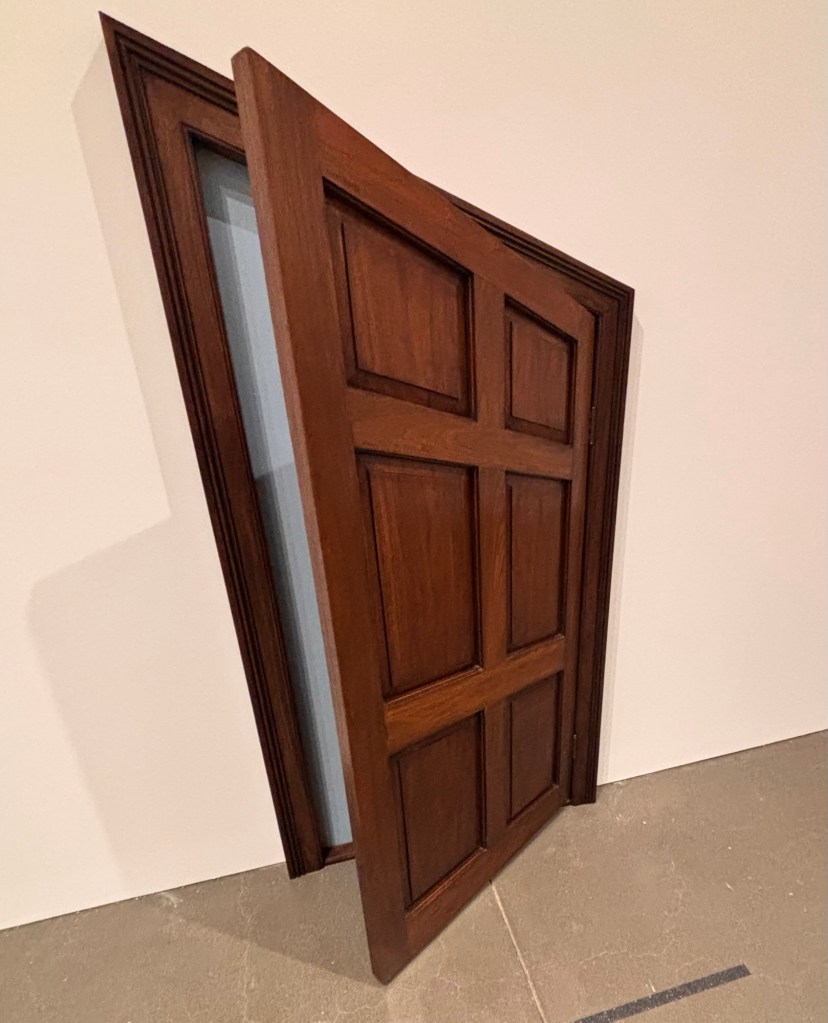
This door is a work of art by Kazumi Tanaka, a living artist born in 1962.
First conceived in 1996 during an unusual artist residency at Sabbathday Lake in Maine (the last active Shaker community in the world), Tanaka’s door was not shown until 2025. As part of The ICA/Boston’s Believers exhibition, the anamorphic door sat permanently ajar and is said to have alluded to Shaker founder Mother Ann Lee’s sentiment that the Shakers should open windows and doors to receive “whoever will arrive” in a spirit of openness and generosity.
I no longer own a 35mm camera, so all my pics are cell pics these days, but it’s fun to join in a creative group activity like John’s Cellpic Sunday.
Goosewing Beach Preserve, Little Compton, Rhode Island, USA, August 2025
I took this with the ultra wide lens (0.5x) on my iPhone 15. I like it because it captures lots of beach & sky and my legs look very long and tan and no cellulite is visible at that angle. They almost look like my old legs from my lifeguard days.
Happy Thursday! I’ve just learned of Dan’s Thursday Doors through Ritva’s post and I like it! Who doesn’t love an interesting door?
Here’s my understanding of the parameters:
Thursday Doors is a weekly feature allowing door lovers to come together to admire and share their favorite door photos from around the world. Anyone may join the fun by creating their own Thursday Doors post and then sharing the link in the comments on Dan’s site, anytime between Thursday morning and Saturday noon (North American Eastern Time).
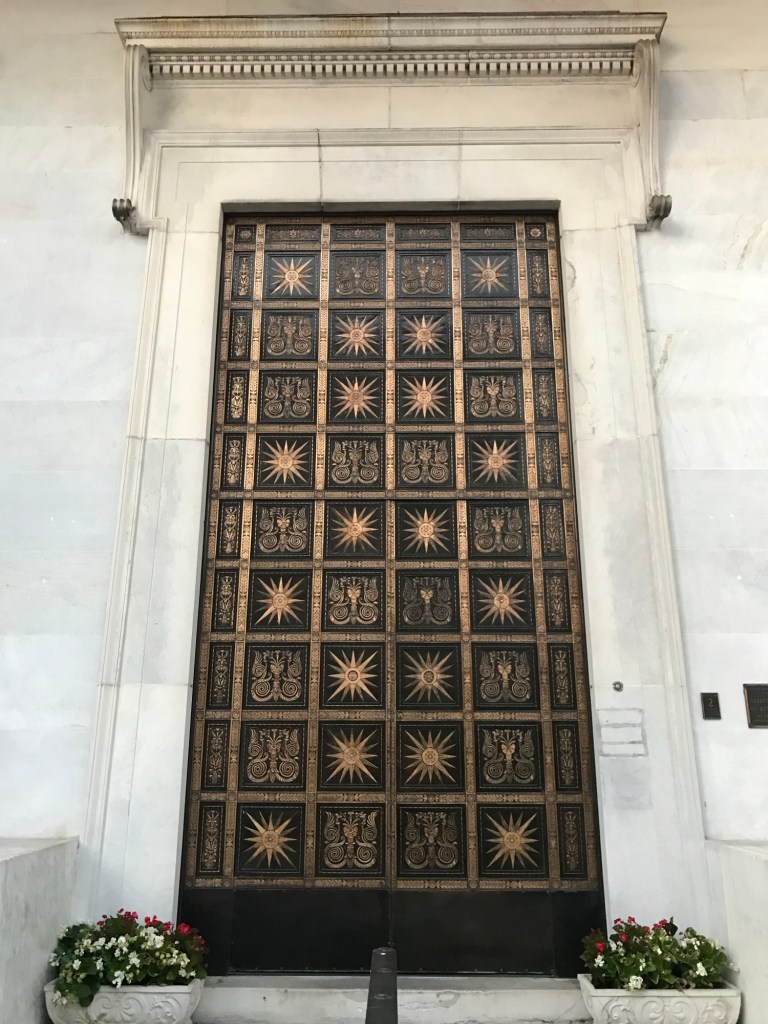
The mammoth bronze doors of the historic Bank of Chester County (now a Wells Fargo) in downtown West Chester, Pennsylvania. The Greek Revival building was completed in 1836 and is in the National Register of Historic Places.
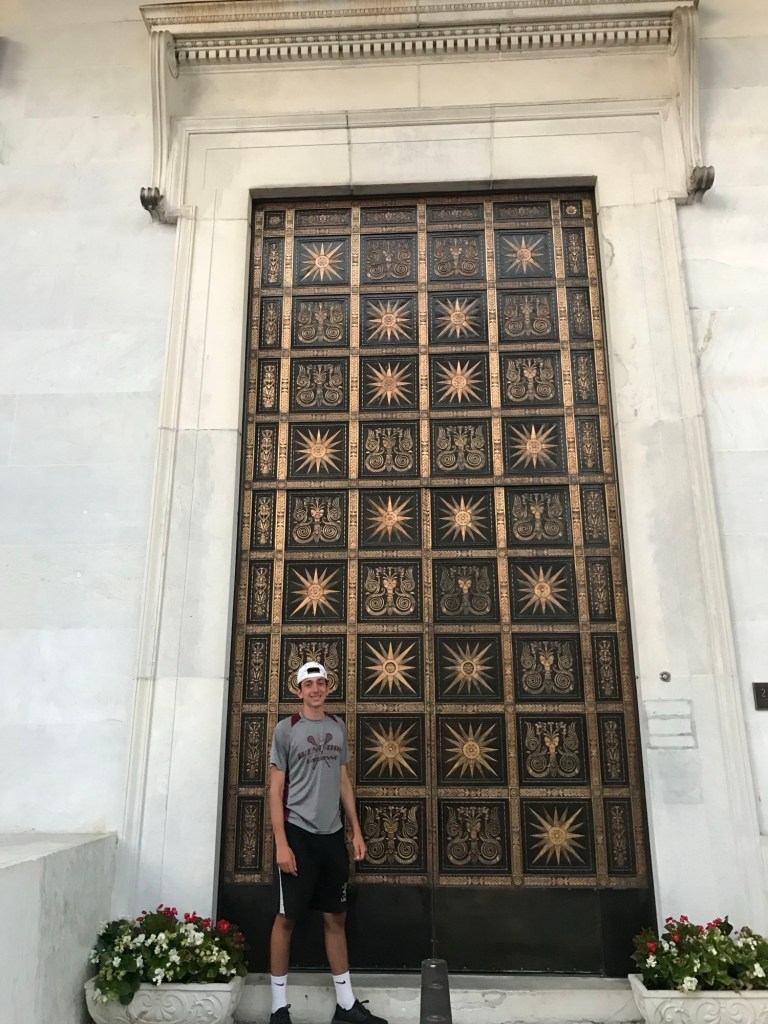
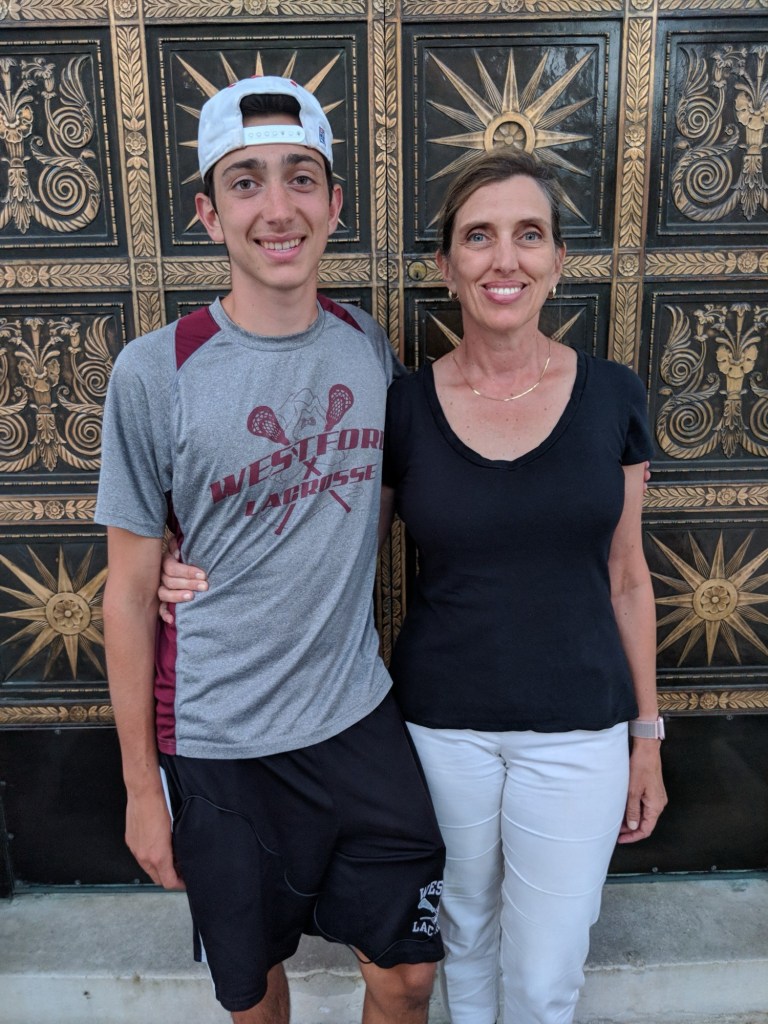
Clearly I was captivated by these doors as I took multiple pictures of them when we were visiting West Chester for a lacrosse tournament in July 2018.
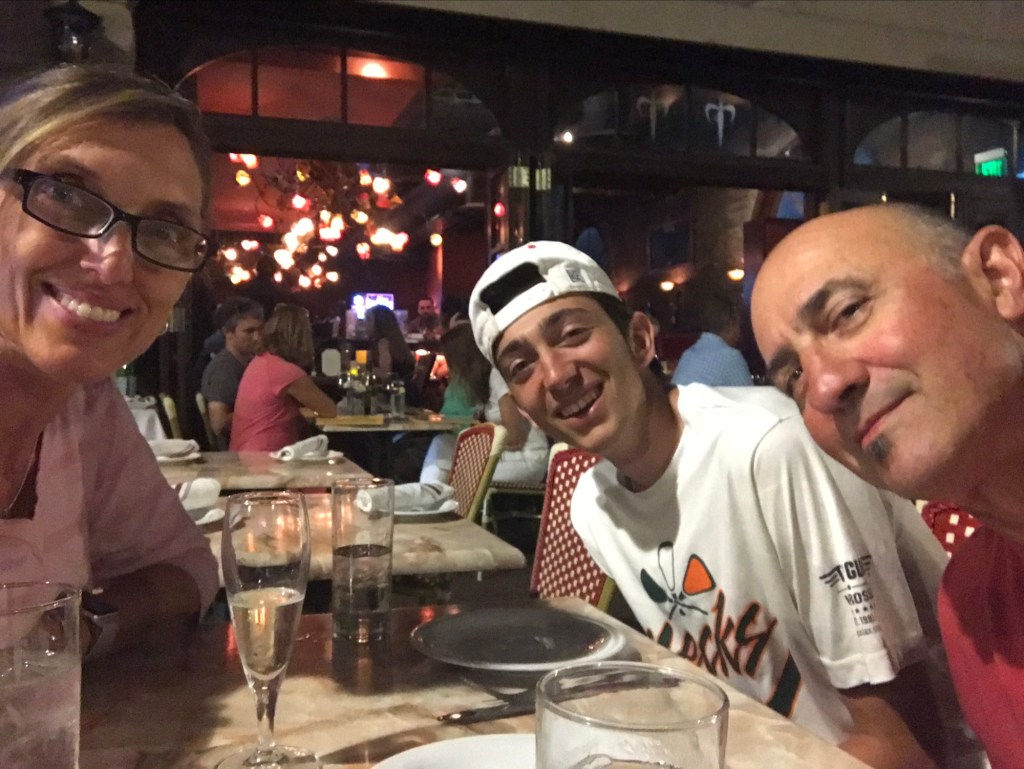
Here’s my son in front of the doors for scale:
I think I really liked the decorative swirls and starbursts in the individual panels and the fact that they’re non-biblical. It’s not a church nor was it ever. In comparison to Europe (and its endless ornate doors), the United States was founded as a secular country. I tend to be drawn to beautiful evidence of that.
Also, I’m reminded that downtown West Chester, Pennsylvania is fun. Or at least it was in 2018. I hope it bounced back after the pandemic.
Outdoor dining in downtown West Chester, Pennsylvania (USA 🇺🇸)
If you’re GenX like me, about half your life was captured on film only (if at all). Digital cameras were not a thing when we were kids. If you were the third or fourth kid in the family, there may be very few photos of you as a child. This is not the case with me. I am the oldest and my parents were diligent. There are a lot of pics of me as a kid. Later on, I liked taking photos and even took a photography class or two.
Therefore, I’ve got a huge closet full of photo albums, boxes of loose photos, and a folder of black and white negatives in my basement, most of which have not been digitized. These include photos from throughout my life from 1965 through the birth of my second child in 2000. (After that, we went digital.) The photo albums are pretty easy to leaf through as they mostly have the correct year on the spine. And the boxes aren’t too bad because they’re pretty small. Until this weekend, I had ignored the big folder of negatives.
Welp, I finally decided to have a look and it turns out that the negatives are almost entirely from the year 1989–the year I took a photography class at the Museum of Fine Arts School in Boston. There are apps now for scanning negatives with your phone. I used one called FilmBox. It worked OK. There were a few surprises in those negatives. Things I had completely forgotten or only vaguely remembered were jolted back into my mind through the tiny black and white images.
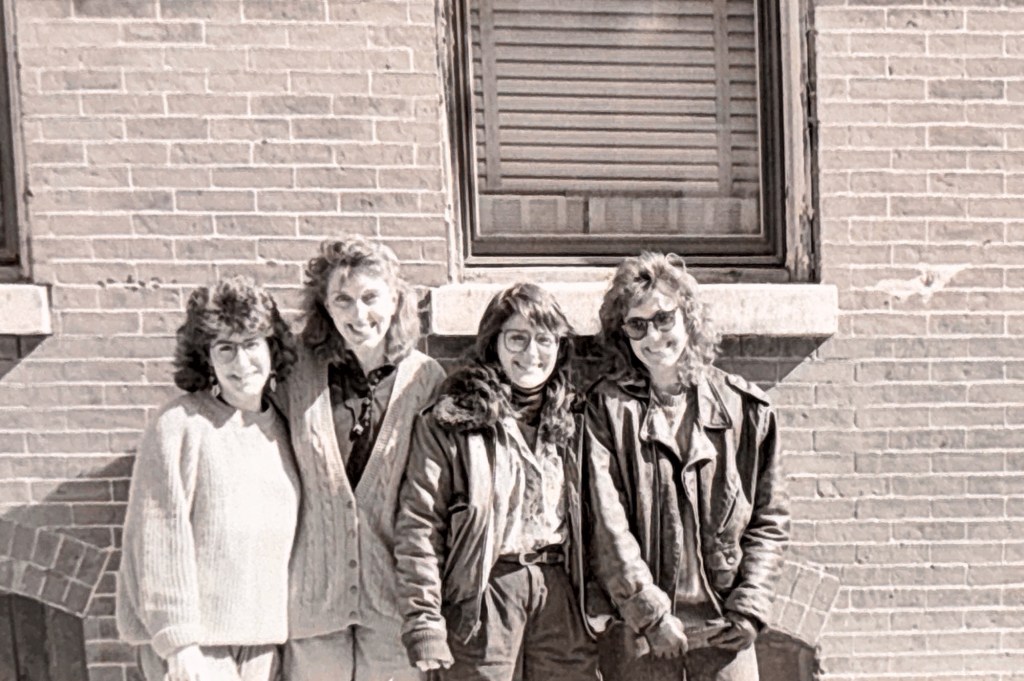
My three best friends from college and me in Boston’s North End. This was about 18 months after we graduated. I had forgotten that we briefly all lived in the same city.
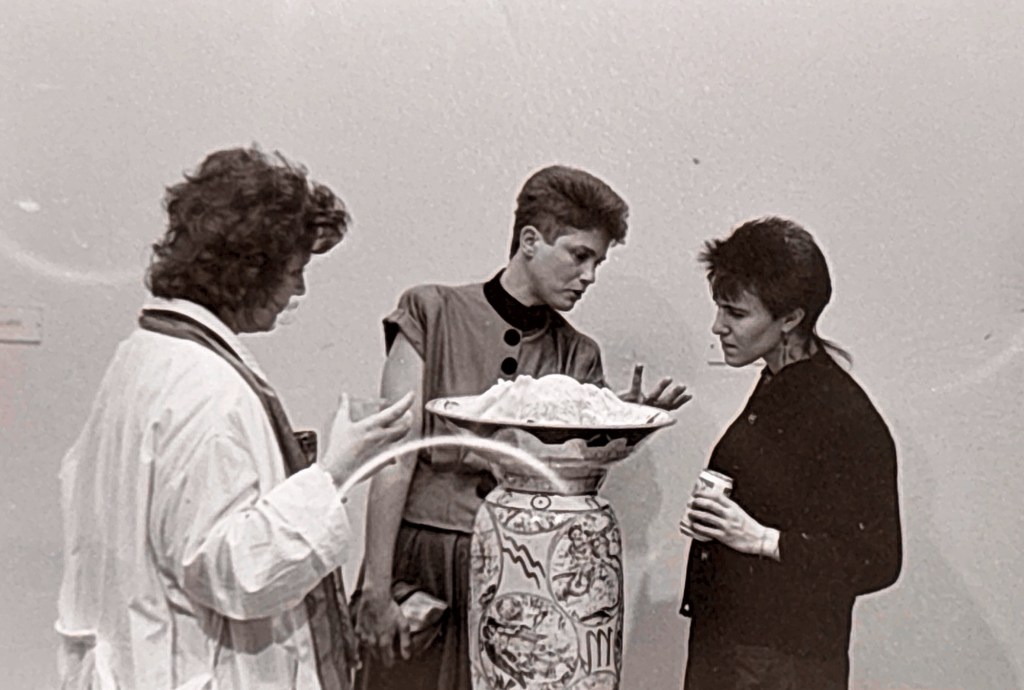
This was an art exhibition opening at the museum where I got my first job: The Institute of Contemporary Art. I had forgotten about those openings and the cheap white wine we always served at them. I typically invited my friends who lived in Boston.
The woman on the right, Teil, was my second boss at the museum. She taught me so much and was such a wonderful person. I think this is the only picture I have of Teil. It’s appropriate that she has a plastic cup of that cheap white wine in her hand.
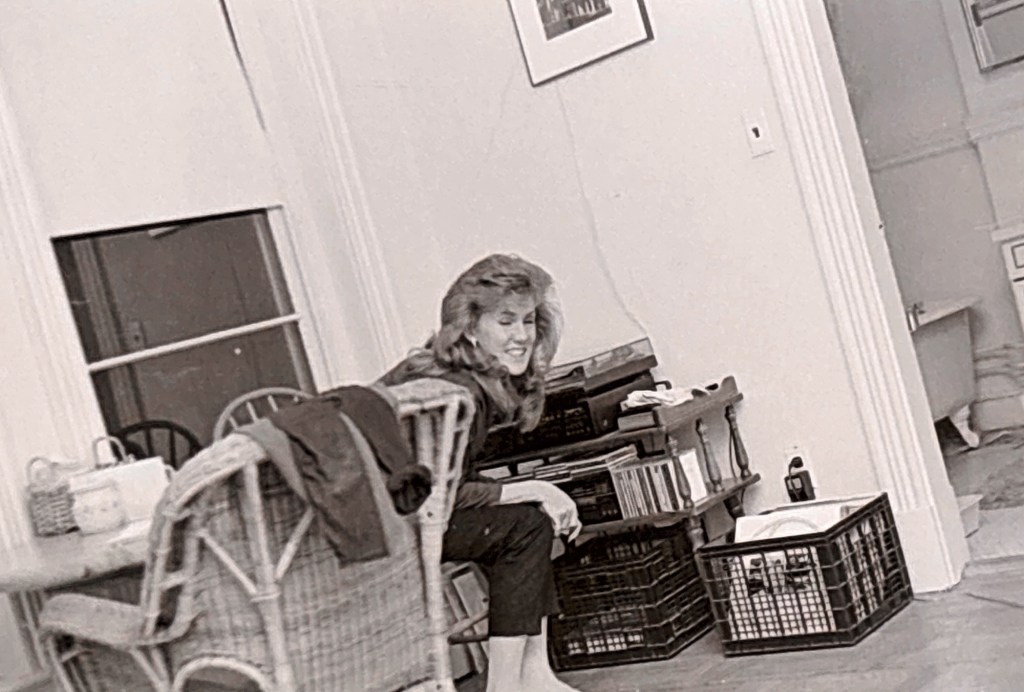
I had forgotten that my 80s friend Debbie came to visit me in my first studio apartment in the Fenway. Seeing her in front of my turntable, CDs and record albums (in milk crates) reminded me of how people used to look through each others music collections as a way of sort of figuring out what they were like. At that point, I think our musical tastes were diverging, but we both liked Prince.
In that same studio apartment, I had forgotten that my very bad cat Kimba was SO bad that I had to keep the bathroom trashcan above the mirror or he’d spread it all around the apartment. He was very cute, but a real pain in the neck.
I definitely remember going to the massive March on DC for abortion rights in April 1989, but had forgotten I went with two friends from work—Ann and Bridget. Later that year, Bridget and I became roommates in the North End.
I’ve long admired posts by photographers who respond to the creative Lens-Artist challenges, especially scillagrace, but have never responded myself.
While it’s daunting for a first-timer to find 5-10 images, I did find one image in my “archives” that seemed to fit 5 items on this week’s Scavenger Hunt list:
Jars of metallic leaf flakes in a Rhode Island artist’s studio, July 2017
It’s all of these:
Something glass
Something with a smooth texture
Something with a bumpy texture
Something circular
Art supplies
I’m not sure if that counts, but thanks to Lens-Artists for a bit of fun.
The USS Constitution (“Old Ironsides”) with the Bunker Hill Monument in the background (August 21, 2025)
Do you know which great American city has been fighting authoritarians for 250 years? Sit down Philadelphia, because it’s Boston.
Fought on June 17, 1775, the Battle of Bunker Hill was one of the first major battles of the American Revolutionary War. Despite being technically a British victory, the battle showed that colonial forces could stand up to the British army, significantly boosting American morale.
In 1776, with the signing of the Declaration of Independence in Philadelphia (OK Philly we see you) the colonies formally declared themselves a new nation, requiring defense both on land and at sea. By 1794, with independence secured but U.S. ships vulnerable to attacks by pirates and foreign powers, Congress authorized the building of six frigates, including the USS Constitution.
In 1797, the USS Constitution was launched in Boston Harbor. During the War of 1812, she defeated multiple British ships in single day combat. In her most famous victory, British cannonballs bounced off her hull which was built with dense live oak (60% denser than white oak), thus the nickname Old Ironsides. The ship become a powerful symbol of the young republic’s survival and determination.
The ship in my photo is not a replica, it’s the actual USS Constitution. While she has undergone many restorations (her timbers have been replaced over time), her keel and much of her structure remain historic. She’s berthed at the Charlestown Navy Yard in Boston Harbor and is still an active U.S. Navy ship, with a crew of active-duty sailors who give tours.
Now check out Boston’s current mayor—Michelle Wu—telling overreaching, authoritarian President Donald Trump to go fuck himself in so many words.
I think it is the nature of things for parents to care more about their children than vice versa.
Our children love us, but not how we love them. Oh how we love them. If they are struggling, sick or unhappy, it can be hard to function ourselves. If your parents live to be very old, you will be old too. You may be dealing with old people problems like osteoarthritis and macular degeneration at the same time as your parents. In some cases, very old parents outlive one or more of their children, which is obviously terrible for the parents. Nobody should have to bury a child. Ever.
But here’s what I think I want to say. You don’t owe your very old parents a myth of your own happy carefree existence. You’re old too. And things have gotten worse. The country has gotten worse.
I’m definitely not saying you should call up your very old parents and unload your problems on them. (If you’re still doing that at age 60+, you may have Peter Pan Syndrome.) I’m saying that if they call you a lot (and are of sound mind), it’s OK to be yourself. You don’t have to make up cheerful bullshit all the time just to keep them happy. Because that’s exhausting. And you’re old too.
On the flip side, if you’re having a good day and feel like chatting, call your mom. Nobody’s ever gonna love you like she does.
![A logo for "50 Happens," [a site dedicated to Gen X women with children and grandchildren] [who embrace life's challenges with humor and resilience], [featuring a modern and uplifting design] [that embodies strength and positivity] [with an elegant and playful style] [and a harmonious blend of colors like pink, fuchsia, purple, and blue].](https://50happens.blog/wp-content/uploads/2024/12/img-5uorrxvwartomopcpuhjfjd0.png?w=300)











 50 Happens