Watercolor Class Week 7: trial and error

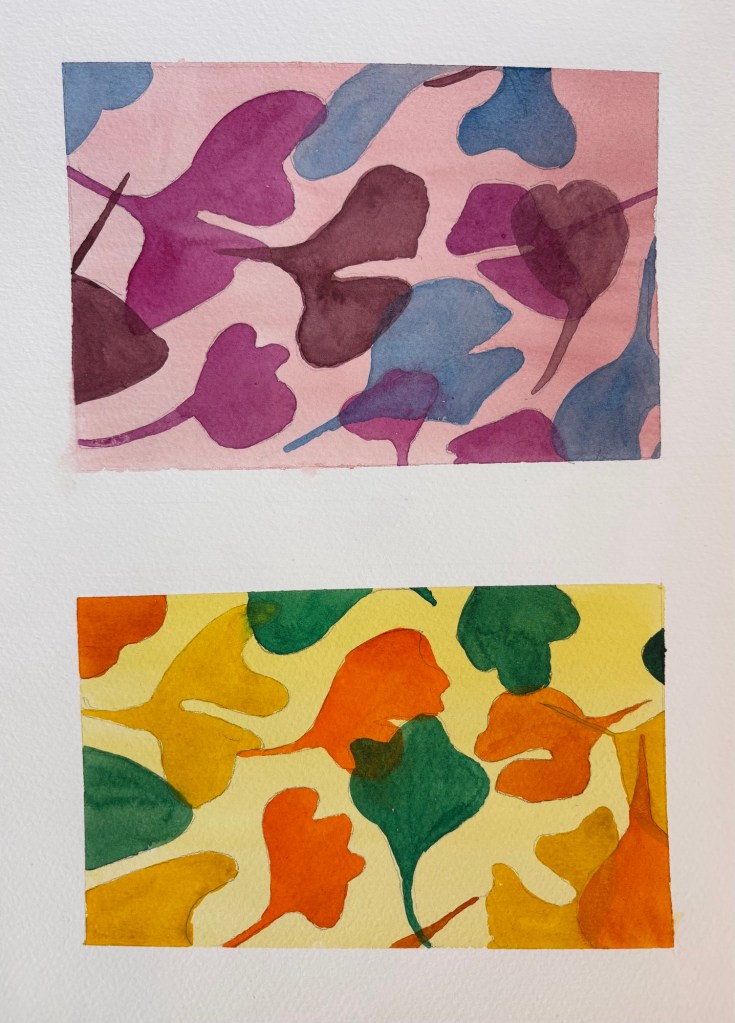
After my frustrating experience with complementary colors and sunsets, I made some gradients to try to better understand my color options.

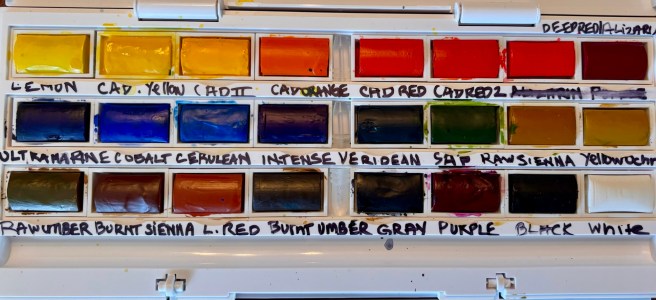
I have no pink. Alizarin Crimson can work as pink when diluted or mixed with Purple Lake.

I decided I do not like Cadmium Orange and will avoid it in the future.

Today the teacher gave a dog portrait painting demo (something she earns money doing) and then everyone worked on whatever they wanted. I decided to go back to my rail trail painting and see if I can make it better by adding more layers. A woman loaned me a sea sponge for applying paint to get a certain effect (like fall leaves), so that was fun. I hope to finish that painting by the last class next week. I also want to try one more portrait before the end of the session.

Although there are definitely some shared techniques in watercolor painting (like lifting paint to lighten areas), a lot of the learning seems to come from trial and error. Our teacher is self-taught and she swears she learned everything she knows (and she knows a lot) by just trying it. As she says, “it’s just a piece of paper.”

These are her top tips:

Painting Progressions

Light to Dark

Loose to detailed

Big to small brushes

Tealike to Creamy

90% to 10% of surface active painting to observing

**************************************

Update:

Here’s my “Rail Trail” with the additional layers. I do like it better now.

Yes!

Thank god!!

Two pro-choice women governors, Prop 50 in California, Pennsylvania Supreme Court justices, Virginia legislative seats, and a 34-year old NYC mayor who basically told Donald Trump to go fuck himself.

America hates Donald Trump and someday he will be gone. That’s what I take away from last night.

Thanks to Gov Newsom for leading the charge.

Watercolor Class Week 6: lessons learned

Each of the primary colors has a complementary color that you really want to avoid mixing with, at least for sunsets. If you put wet complementary colors near each other or layer them, you’re going to get brown. 💩

Red & Green = Brown

Blue & Orange = Brown

Yellow & Purple = Brown

That’s why my blue/violet to orange sunset sky ended up looking like a fried egg, especially from a distance,

The teacher said you can’t go directly from blue/purple to orange. You need some pink to transition.

She suggested using Alizarin crimson (not cadmium red) to make pink. It has blue undertones.

I tried again to get Key West sunset vibes, but without an ugly brown ring.

I’m not happy with the result. I really wanted a nice blended smooth gradient. The teacher said I painted “into it” too much. I need to try again, wetting the paper in both directions with my largest flat brush and then dragging the wet paint across in one direction only – end to end. In fact go off the paper with the brush.

Rather than masking, I could use a paper towel to lift out a circular moon or sun. (You can hold the paper towel in a round bunch and rotate the watercolor paper to create the circle.) And again, avoid complementary colors that will bleed into each other and make brown.

There are two classes left in this session and I need to decide what to do. I’ve been enjoying the class, but I’m not 100% sure that watercolors are my thing. But perhaps I should re-register and give it a bit longer.

One of the women who keeps re-registering is a very good watercolorist. She creates beautiful paintings of natural subjects like oyster shells and winter trees, and I can see that the teacher gives her good advice. Is that what I aspire to?

I am curious about both acrylic and oil painting, but those are more of an investment, and not as easy to whip out and work on at home.

Maybe I should take another drawing class and also re-up for one more 8-week session of watercolors. Maybe after that, I’ll feel confident enough in my drawing and color skills, to try working with real paint on an actual canvas.

Charcoal pencil sketch of a pug (like Horace from Poldark)

On the other hand, 8 more sessions of watercolors is a lot, if I decide I’m not that into it.

***********************************

Update: Third and final try on this silly Key West sunset! Water colors are hard.

Of Light and Air

I dragged brought my husband to the special Winslow Homer exhibition at Boston’s Museum of Fine Arts. Given my recent interest in watercolor painting, I couldn’t miss Of Light and Air.

Here’s what I learned:

Watercolors fade. These paintings are delicate. That’s why they only display them once every forty years or so—and in very dark galleries. (If you really want to make art that lasts forever, watercolors might not be a great choice.)

One of the most famous (and vibrant) pieces in the show

Pencil lines are OK, as long as they don’t bleed into the paint. In fact, most of his works were described as “watercolor over graphite.” And being able to draw well really helps. Plenty of modern painters can’t draw, but most artists I admire draw well…really well. So, keep practicing or studying drawing.

Having started as a commercial lithographer and magazine illustrator, Homer could create a realistic image with just a few well-planned lines. In fact, one of his magazine employers sent him to the front lines of the Civil War to draw battlefield images. Talk about trial by fire!

A sponge diver in the Bahamas. I have no idea how he would’ve painted something like this without a photo to refer to.

Watercolor paintings are about choices. There is no real white in watercolors. Your white is your paper, so what you choose not to paint is a critical decision.

Things can be represented with just a few brush strokes. Layers matter. Choices. What will you choose to fully depict? What will you simply allude to with a brush stroke or two?

Driving Cows to Pasture, 1879
“This watercolor, painted in central Massachusetts, is noticeably looser and more abstract than earlier work. The boy, turned away from the viewer, is seemingly rooted to the ground; dappled hills and unruly vegetation surround him. A moody sky, composed of thin washes of blues and purples, casts a somber tone. The cows, rendered as brown dabs on the hillside, would be easily missed were it not for the title. Here, Homer embraced abstraction as well as some advanced watercolor techniques, removing pigment through scraping and lifting to create rough rocks and ghostly ferns.”

Everyone’s eyesight gets worse as they age. Apparently Homer told people to save rocks for your old age, because “painting rocks is easy.”

Thursday Doors—St. Ann’s Church, Kennebunkport, Maine

Good GOD I’ve taken a lot of photos of church doors over the years—especially for a Unitarian.

Here’s another one in the Protestant realm:

This is the entrance door of St. Ann’s Chapel in Kennebunkport, Maine, which has to be one of the most beautiful—perhaps THE most beautiful— seaside chapel in all of New England.

Built in the late 19th century (The Gilded Age), this church operates in summer only, when the well-heeled WASPy residents of Kennebunkport are in town (including the Bush Family).

What really got me was the OUTDOOR chapel with the sweeping views.

The rocky coast of Maine near the chapel
Nice view
Seriously, this chapel has the best New England location I’ve ever seen
As descendants of “peasants” from Italy, our ancestors were more likely to have hauled the rocks to build this church than to have ever visited it.

Multiple Bush family weddings have taken place here. They are longtime, generous supporters of the church and their compound—Walker’s Point—is close by. Not to get political, but I can’t believe I’ve lived to an age where I think of the Bush family with some fondness. Thirty-year old me would not have believed it! I’ll take Walker’s Point over Mar-a-Lago (and all it represents) any day of the week.

Dan’s Thursday Doors

Masking with tape

I wanted to try another one of the “resistance” methods from Monday’s class, so I blocked out the sun and the other large sphere with blue painters tape. I’m not sure why I got that dark ring around the sun. Maybe the paint collected and mixed under the tape? I painted the sky very wet. I’m going to bring this in next week for feedback/help from the class.

Here was the inspiration:

Key West sunset with the Naval Air Station on the horizon (supposedly that is truly the Southernmost Point in the US, rather than the tourist buoy).

Fond memories of Key West. Hopefully we can go back sometime 🌅

Watercolor Class Week 5: masking fluid & MagicErase

Yesterday was a discussion of the various “resisting” techniques (tape, wax crayon, etc) and a demo of how masking fluid works.

I gave it a try in this painting, inspired by my photo shoot on the rail trail the other day.

Here’s the inspo pic:

You can see I tried to use the masking fluid (aka rubber cement) to try to create those tiny rays around the sun. The teacher said to rub them out a bit with a MagicErase sponge, which is a tool that watercolorists use to soften areas and rub out paint that has already dried.

I also used the MagicErase sponge on the bike path because I felt I had “overpainted” it. One of the hard things with watercolors is knowing when to stop. It’s very easy to ruin a nice effect by doing too much.

I sat away from the major gabbers in the class and was happier (although it did not go unnoticed that I changed my seat).

Bingeworthy

What are you watching and/or reading to escape paying attention to the fall of democracy?

My husband and I just started season 5 of “Poldark”—the period drama from Masterpiece. We were watching it in Passport (the PBS app), but Netflix just acquired it, so you can watch it there. Highly recommend (if you like period dramas). I’m a longtime Masterpiece lover, but somehow I missed Poldark when it originally aired. It takes place in the late 1700s, with the main character (Ross Poldark) having returned to Cornwall from Virginia, where he was fighting for the British in “the American War.”

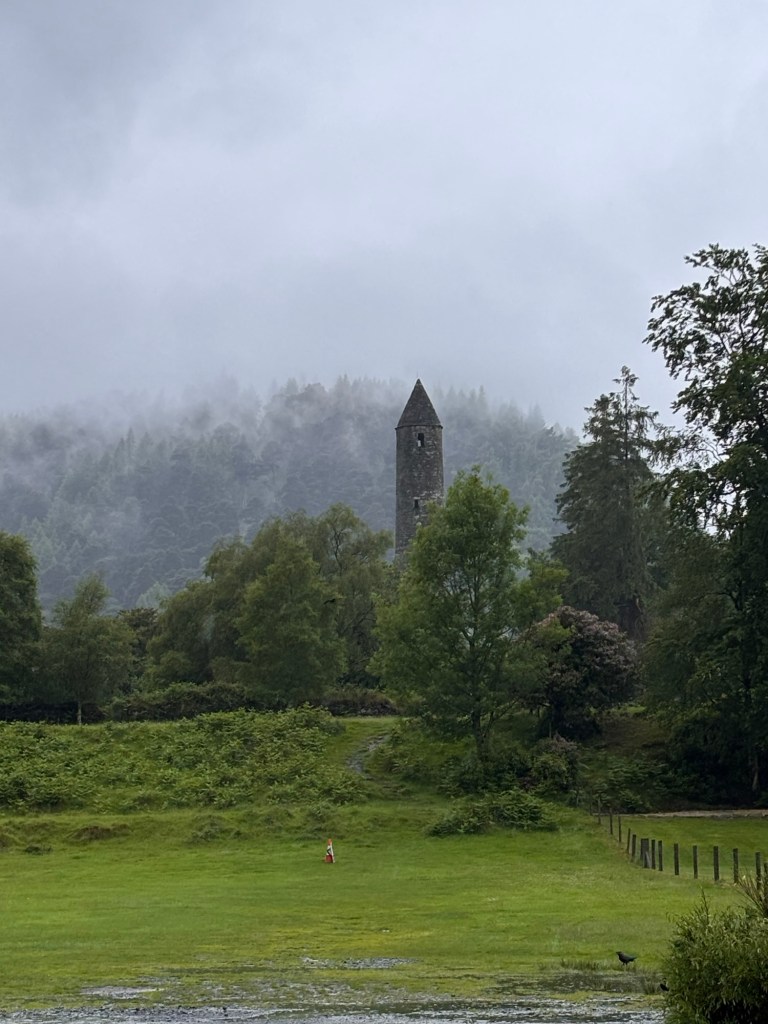
Ross and Demelza Poldark will win you over as they gallop across the cliffs of Cornwall, which look very much like Ireland to me.

Also, we recently read “A Visit from the Goon Squad” (copyright 2010) by Jennifer Egan in my book group. It won the Pulitzer Prize for Fiction in 2011, but I had never read it. This genre-blurring book traces the lives of a GenX record-executive and his young assistant across decades of cultural change, interlocking thirteen short stories into a vivid mosaic of time, music, ambition and memory. I liked it so much, I read “the sequel” The Candy House, which came out in 2022. I can’t really explain it, but the term “sequel” is not particularly apt in this case. It’s more of a prequel & futuristic running out of the stories from Goon Squad. Highly recommend if you’re between 50 and 70 years old and find the zeitgeist interesting. Even if you simply enjoy saying the word zeitgeist, I think you will like these books.

Knowing me as you do (😉), please let me know if you have any other recommendations.

Related:

Bingeworthy, part 2