My husband thinks it’s “sad” that I’ve been using ChatGPT for a lot of types of advice lately—from travel to interpersonal problems. He is not a fan. He’s especially mad about how much energy AI uses and how it’s going to drive up energy costs for all of us.
I’m sure that’s true, but at this point, I’m feeling so depressed and powerless about what’s happening in the world that I figure I might as well do little things that make me happier. As my friend Alissa said recently, “things are OK right now, but it feels as if the other shoe is about to drop.”
So while we’re waiting for that other shoe (the next pandemic; skyrocketing energy and healthcare costs; a nuclear mishap via incompetent government officials), I figured I might as well get some new curtains.
I don’t even have a picture of the old curtain panels that I’d had for 20+ years but they were completely light-blocking and needed to go. I replaced them with these light-filtering panels:
But I wasn’t sure I liked the color.
ChatGPT confirmed that she wasn’t crazy about the color either. In fact, she straight up said the curtains are a different shade of blue than the rug and that they didn’t stand up to the vibrant wall color. “The room doesn’t feel as tightly pulled together as it could.” She suggested teal curtains with teal and burnt orange accent pillows.
Another commonly held belief seems to be that older generations are somehow tougher than younger ones. That life was harder for them and people have gotten progressively more comfortable.
I beg to differ.
Although the tremendous sacrifices and bravery of the so-called “Greatest Generation” can never be overestimated (they literally risked everything to defeat the Nazis), I would argue that non-marginalized groups in the following generation (my parents cohort) have had it pretty good. Many went from lower class (aka poor) to highly comfortable and secure in a single lifetime. And although we benefited from our parents’ prosperity, the following generation (mine) has had it harder in many ways. And our kids are going to have it even harder.
Not to be a Debbie Downer, but there are reasons the birthrate is historically low in 2025. We all know millennials who are choosing not to have children (or GenXers & Boomers who are sad that they will never be grandparents).
I asked ChatGPT to compare the lives of someone born in the mid 1930s, mid 1960s, and mid 1990s.
Facts:
1. Income & Jobs
Born mid-1930s (entered workforce ~1950s): Median household income in 1955: ~$5,000 (≈ $58,000 in today’s dollars). A single income (often the father’s) could support a family, home, and college savings. Job security was higher; pensions were common. Born mid-1960s (entered workforce ~1980s): Median household income in 1985: ~$23,600 (≈ $66,000 today). Both parents often worked, butwages grew more slowly compared to the cost of living. 401(k)s replaced pensions, shifting retirement risk to individuals. Born mid-1990s (entered workforce ~2015–2020): Median household income in 2019: ~$68,700. In real terms, wages for young workers have stagnated since the 1970s, while housing, education, and healthcare rose sharply. Gig economy and contract jobs more common, less stability/benefits.
2. Cost of College (Public University, In-State Tuition)
1930scohort (college in 1950s): $200/year tuition ($2,400 today). College was affordable even with part-time work; no significant debt. 1960scohort (college in 1980s): $1,500/year tuition ($4,000–$5,000 today). Still affordable with summer jobs; modest debt possible. 1990scohort (college in 2010s): ~$10,000/year tuition (public); $35,000–$50,000/year (private). Widespread reliance on loans; average borrower debt: $30,000+.
3. Healthcare Costs
1930s cohort: Out-of-pocket affordable; many employers covered full family insurance. Doctor visits and hospital stays far cheaper relative to income. 1960s cohort: Insurance became tied to employment. Costs rose, but still manageable. Deductibles/co-pays introduced. 1990s cohort: Healthcare costs skyrocketed (family premiums ~$24,000/year by 2025, often split with employer). Medical debt is a leading cause of bankruptcy.
4. Cost of Raising a Child (to age 18, middle-class family), not including college
1930s cohort (raising kids in 1960s): ~$25,000 total (≈ $240,000 today). 1960s cohort (raising kids in 1990s): ~$150,000 (≈ $280,000 today). 1990s cohort (raising kids in 2020s): ~$310,000. Housing, childcare, healthcare, and college costs exploded. Childcare alone can rival college tuition.
5. Retirement
1930s cohort: Retired with pensions, Social Security, mortgage-free home. Comfortable retirement was realistic for average workers. 1960s cohort: Retirement savings depended on 401(k)s and IRAs; investment risk shifted to individuals. Some still had pensions, but they were fading. 1990s cohort: Retirement is much more uncertain. Pensions rare; Social Security’s future questioned. Rising housing and healthcare costs make saving harder. Many expect to work past 65.
A final note: When my friend Carla was dying in 2022 at age 57 from brain cancer, she commented that at least she wasn’t going to have to worry about paying bills anymore. She felt that one upside of an early death would be a release from financial concerns. Carla had an advanced degree in nursing and worked (very hard) as a hospice medical director. She was married with two adult children that she’d been able to send to college.
And I’m sure she walked to school in the snow plenty of times.
There seems to be a commonly held belief that people are basically good. That despite all the problems in the world, humans are decent. People seem to attribute this to the fact that we “all want the same things” (peace, safety, etc.) Two friends of mine (a well-off white couple in their 70s) travel the country more than half of each year in their deluxe RV. They go everywhere—red states, blue states, purple states, Canada. (Come to think of it, they never seem to cross over into Mexico.) Anyway, when they get back, they always gush about how wonderful people are.
I must say—lately, I’m really questioning this whole idea.
The obvious example is war. All war, but Gaza in particular. I mean—holy shit. How are we allowing that to go on? Not just allowing it—enabling it. Ten-year old boys getting shot, while trying to bring a bit of food back to their starving families. The terrorism that started that particular war on October 7, 2023 included children getting murdered. And not by bombs. Individual human adults consciously murdered individual human children that day, including at least one 10-month old baby.
But back to America.
The level of depravity in the man who currently occupies the White House is well-documented. His words are so objectionable to me that I typically don’t read them directly. But I hear about them and they always make me think about the amount of “overlooking” millions of Americans had to do to allow him to become our highest leader—twice. Would a country that’s filled with “basically good” people do that?
Just one of endless examples of his cruelty—very often directed at women and people of color
And because nothing else has worked, Governor Gavin Newsom of California is imitating Trump’s cruel, egomaniacal writing style in an effort to try to fight back against Trumpism. Even the most profoundly “decent” leader of my lifetime, Barack Obama, says that what Newsom is trying to do is justified, given where we are.
So yeah, I’m not so sure about the “basically good” thing anymore.
President Obama tearing up as he spoke of the slaying of 20 first-graders in Newtown, Connecticut.
The USS Constitution (“Old Ironsides”) with the Bunker Hill Monument in the background (August 21, 2025)
Do you know which great American city has been fighting authoritarians for 250 years? Sit down Philadelphia, because it’s Boston.
Fought on June 17, 1775, the Battle of Bunker Hill was one of the first major battles of the American Revolutionary War. Despite being technically a British victory, the battle showed that colonial forces could stand up to the British army, significantly boosting American morale.
In 1776, with the signing of the Declaration of Independence in Philadelphia (OK Philly we see you) the colonies formally declared themselves a new nation, requiring defense both on land and at sea. By 1794, with independence secured but U.S. ships vulnerable to attacks by pirates and foreign powers, Congress authorized the building of six frigates, including the USS Constitution.
In 1797, the USS Constitution was launched in Boston Harbor. During the War of 1812, she defeated multiple British ships in single day combat. In her most famous victory, British cannonballs bounced off her hull which was built with dense live oak (60% denser than white oak), thus the nickname Old Ironsides. The ship become a powerful symbol of the young republic’s survival and determination.
The ship in my photo is not a replica, it’s the actual USS Constitution. While she has undergone many restorations (her timbers have been replaced over time), her keel and much of her structure remain historic. She’s berthed at the Charlestown Navy Yard in Boston Harbor and is still an active U.S. Navy ship, with a crew of active-duty sailors who give tours.
Now check out Boston’s current mayor—Michelle Wu—telling overreaching, authoritarian President Donald Trump to go fuck himself in so many words.
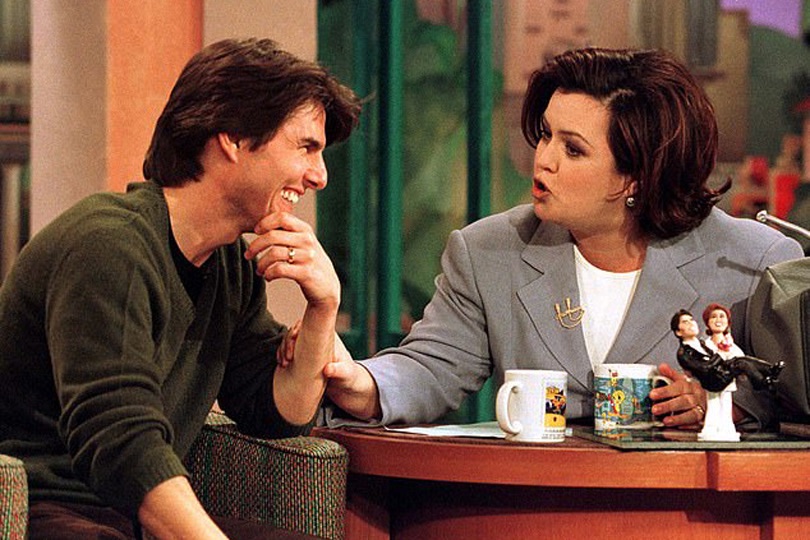
Like Sex and the City, Rosie O’Donnell is very aligned to me culturally.
In case you don’t remember the 1990s, Rosie O’Donnell was HUGE—one of America’s biggest cultural figures. Her daytime talkshow The Rosie O’Donnell Show won multiple Emmys and the media nicknamed her “The Queen of Nice.” She was truly a household name. I watched her a lot. She adopted her first child Parker in 1995, the same year I became a mom. She kept me company during the day when I was home with my kids. She was funny, kind, warm and loved Broadway musicals like I did.
In the 2000s, her image shifted as she came out publicly and became a strong advocate for LGBTQ+ rights, which made me like her even more. Later, when she was on The View, I didn’t watch her as often because I was back working, but I know that’s when her public fights with Donald Trump really ramped up. My recollection is that it was primarily a beef between two New Yorkers that had history and absolutely hated each other in a way that only two New Yorkers can.
Well, lo and behold, thirty years later, Trump is the most authoritarian President the United States has ever seen and Rosie has escaped to Ireland.
In fact, since I discovered her TikTok and Substack shortly before my trip to Ireland, I’ve been following her time abroad closely. She seems to really love living in Dublin, although she misses her family. I even went to the Dublin comedy club where she had been practicing her act for the Edinburgh Fringe Festival. By all accounts, she was a smashing success there. She plays Australia next.
I’m happy for Rosie that things are going well for her abroad, but I’m very aware of the absolutely dystopian reasons she left the country.
We are in uncharted waters now.
We live in a time when an American President publicly threatens to revoke a natural-born American’s citizenship for no reason other than that he just really fucking hates her.
Tom Cruise on The Rosie O’Donnell Show (and BTW, good on Tom for declining to accept a lifetime achievement award from Orange Mussolini at The Kennedy Center)
I think it is the nature of things for parents to care more about their children than vice versa.
Our children love us, but not how we love them. Oh how we love them. If they are struggling, sick or unhappy, it can be hard to function ourselves. If your parents live to be very old, you will be old too. You may be dealing with old people problems like osteoarthritis and macular degeneration at the same time as your parents. In some cases, very old parents outlive one or more of their children, which is obviously terrible for the parents. Nobody should have to bury a child. Ever.
But here’s what I think I want to say. You don’t owe your very old parents a myth of your own happy carefree existence. You’re old too. And things have gotten worse. The country has gotten worse.
I’m definitely not saying you should call up your very old parents and unload your problems on them. (If you’re still doing that at age 60+, you may have Peter Pan Syndrome.) I’m saying that if they call you a lot (and are of sound mind), it’s OK to be yourself. You don’t have to make up cheerful bullshit all the time just to keep them happy. Because that’s exhausting. And you’re old too.
On the flip side, if you’re having a good day and feel like chatting, call your mom. Nobody’s ever gonna love you like she does.
It’s painful to go back and read this post from about a year ago—the day after Kamala Harris accepted the Democratic nomination for President of the United States. I had cried during her acceptance speech.
After so many months of dread and fear, I finally let myself feel hope and optimism for the future. My little granddaughter would be coming into a world where a woman of color was President, women’s rights to their own bodies would be restored, protecting our planet would be an international mission, and hate and racism would recede.
My father turned 91 yesterday. My granddaughter will turn 1 next month. And this beloved poem from The Prophet by Kahlil Gibran, which I first read in college, still resonates so deeply with me.
“Your children are not your children.
They are the sons and daughters of Life’s longing for itself.”
Predictably, I was a fan of Sex and the City and have eagerly watched all three seasons of the reboot—And Just Like That. (I saw both of the Sex and the City movies too.) We now know that this will be the final season of And Just Like That, so fans are getting ready to bid goodbye to Carrie Bradshaw forever.
My obvious connection to the show has been that I am the same generation as the main characters. Sarah Jessica Parker and Kristin Davis are my age exactly—sixty. They are among the group of actresses born in 1965 that I tend to keep tabs on.
I know there are plenty of haters out there, based on very legitimate criticisms of the show, but for me Sex and the City was like an alternate reality. By the time the show first aired in 1998, I was married with a three-year old, living in a somewhat dilapidated antique house in suburbia. What if I hadn’t gone that route? What if I had had the gumption to leave Boston for the real city in my twenties, like several of my friends? Would I be dashing around Manhattan in a tulle skirt, going to art openings and brunch?
The 60-year old versions of the characters in the reboot, still living in Manhattan in fabulous clothes, have been dealing with some relatable GenX problems from bouts of vertigo to ageism at work. Still, they’ve kept it mostly light and escapist. Even when Carrie’s husband (Mr. Big) drops dead in the shower, I wasn’t exactly heartbroken. The female friendships are still central. New York City is still central.
We’ll see what the final two episodes bring. How will my life in an alternate universe turn out?
SJP as Carrie Bradshaw in Season One of Sex and the City (1998)
Me hosting a rather cramped birthday party in our living room in 1998
![A logo for "50 Happens," [a site dedicated to Gen X women with children and grandchildren] [who embrace life's challenges with humor and resilience], [featuring a modern and uplifting design] [that embodies strength and positivity] [with an elegant and playful style] [and a harmonious blend of colors like pink, fuchsia, purple, and blue].](https://50happens.blog/wp-content/uploads/2024/12/img-5uorrxvwartomopcpuhjfjd0.png?w=300)













 50 Happens