![A logo for "50 Happens," [a site dedicated to Gen X women with children and grandchildren] [who embrace life's challenges with humor and resilience], [featuring a modern and uplifting design] [that embodies strength and positivity] [with an elegant and playful style] [and a harmonious blend of colors like pink, fuchsia, purple, and blue].](https://50happens.blog/wp-content/uploads/2024/12/img-5uorrxvwartomopcpuhjfjd0.png?w=300)
I’m locked out of WordPress Daily Prompts (because I’ve already responded to all of them) and I don’t usually look back at my old responses, but in this case, I’m happy to report that I did something I said I would do!
My husband and I visited the newly renovated Concord Museum in December and it was impressive.
This year, 2025, is the 250th anniversary of the start of the American Revolution, specifically the Battles of Lexington and Concord (April 19, 1775).
Along with the Old North Bridge Visitor Center, the Concord Museum is the place to learn about the American Revolution. If you don’t know the story of the lantern warning (“one if by land, two if by sea”) and Paul Revere’s famous ride from Boston to warn the colonists (“the British are coming!”), you’ll learn it here.

There’s also a ton of cultural information about Concord’s many famous intellectuals and writers like Louisa May Alcott, Ralph Waldo Emerson, and Henry David Thoreau. Many unsung leaders of both the abolitionist and suffrage movements also lived in Concord.

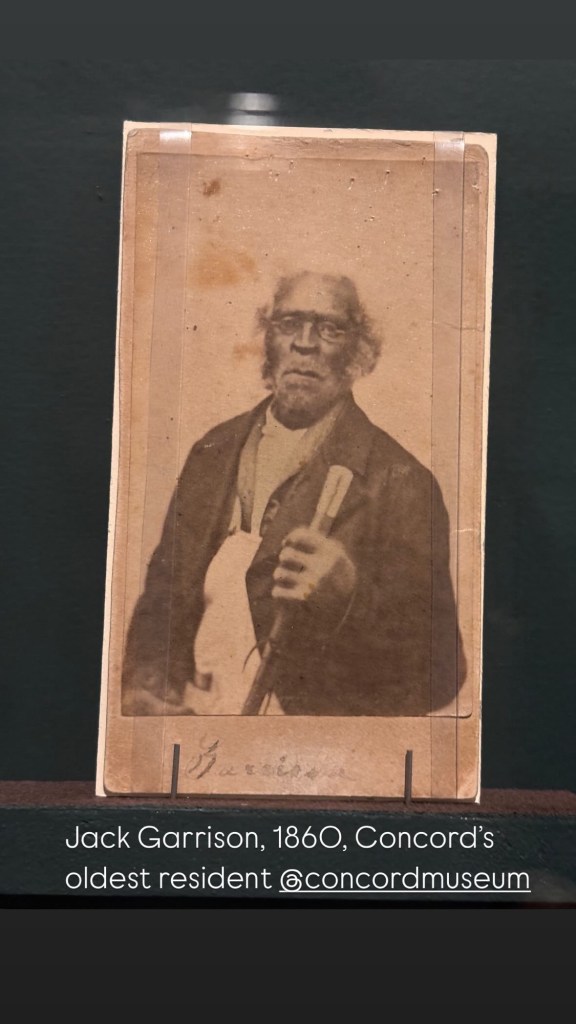
John “Jack” Garrison was an African American man who escaped slavery in New Jersey around 1810 and settled in Concord, Massachusetts. In Concord, he worked as a woodcutter and day laborer. In 1812, he married Susan Robbins, the daughter of Caesar Robbins, a Revolutionary War veteran. Together, Jack and Susan raised nine children, four of whom survived into adulthood. Despite the challenges of his early life, Jack became an integral part of the Concord community. He was known for walking around town with his saw-horse over his shoulder and his saw on his arm, even into his 60s. In recognition of his status as the oldest person in town, he was presented with a walking stick, which is now part of the Concord Museum’s collection. Jack’s life in Concord was marked by both acceptance and the persistent threat of capture due to the Fugitive Slave Acts.
Something new I learned is that a lot of “privileged” white Concord ladies used their influence for good, mainly by talking some sense into the white men. For example, did you know that Ralph Waldo Emerson had to be convinced that slavery was bad? Seriously, Ralph?? And guess who convinced him. Women. Especially Elizabeth Palmer Peabody, a close friend and vocal abolitionist, and his aunt, Mary Moody Emerson.
 50 Happens
Good for Emerson in following his friend’s and sister’s advice. Isn’t there an old wives tales stating: “if you listen to your sister, you’ll always be on the right track.” I grew up with brothers — God help me — but there definitely seems to be some wisdom in that old saying. Ha, ha.
LikeLiked by 1 person
I never heard that one, but it sounds like good advice!
LikeLiked by 1 person
Actually I made a mistake. Mary was his aunt not his sister.
LikeLiked by 1 person
Interesting. Thanks for sharing:) Tragically, any of my knowledge of American history comes from John Wayne movies or Disneyland. How about asking your readers for some fresh Daily Prompts?
LikeLiked by 1 person
We love that we told the British to F off, much more forcefully than any of the other colonies! The story of the ragtag farmers (aka Minutemen) chasing the Red Coats back to Boston is reenacted every year here on April 19.
LikeLiked by 1 person
When people are raised where something is normal, it isn’t surprising that they have shown that thing is bad. Everyone grows up in a culture where morally dubious things are taken for granted, just not the same things in every culture.
LikeLiked by 1 person
Good point. When he did come around, he was a fervent advocate for the abolition movement in New England.
LikeLiked by 1 person